


Meal-exercise challenge and physical activity reduction impact on immunity and inflammation (MERIIT trial)
- PMID: 30009276
- PMCID: PMC6042468
- DOI: 10.1016/j.conctc.2018.05.010
Meal-exercise challenge and physical activity reduction impact on immunity and inflammation (MERIIT trial)
Erratum in
-
Erratum regarding missing Declaration of Competing Interest statements in previously published articles.Contemp Clin Trials Commun. 2020 Dec 10;20:100688. doi: 10.1016/j.conctc.2020.100688. eCollection 2020 Dec. Contemp Clin Trials Commun. 2020. PMID: 33392412 Free PMC article.
Abstract
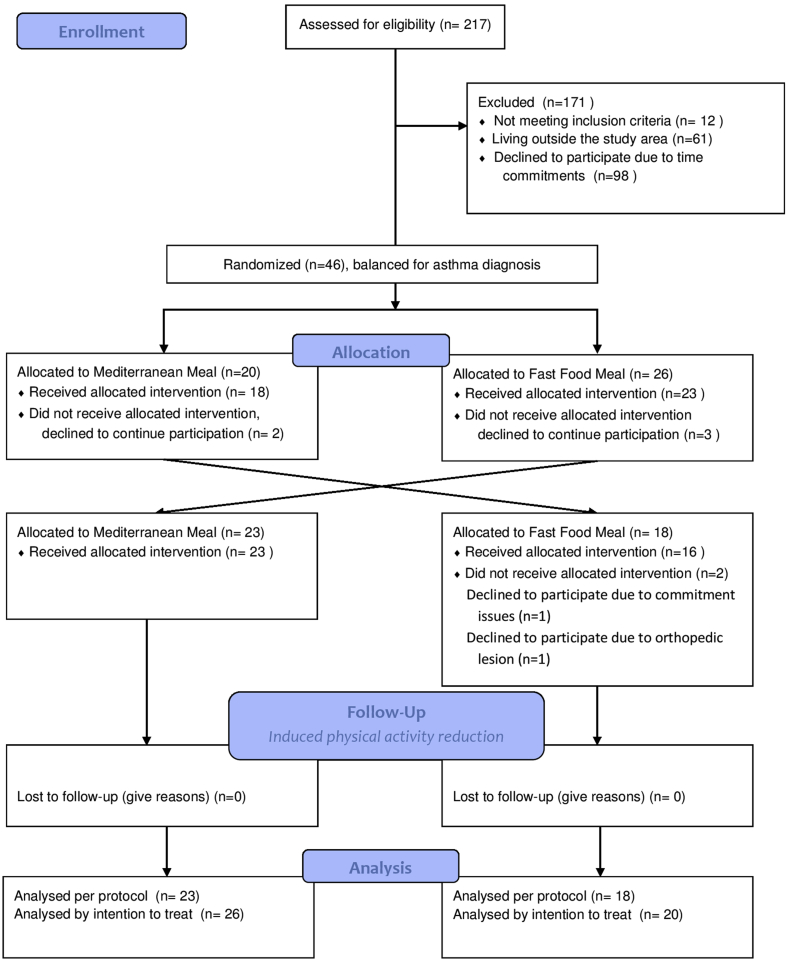
Background: The effect of a pre-exercise meal as countermeasure to exercise induced immunodepression is poorly known. Also, sedentary behavior is associated with increased cardiometabolic risk but studies on immune changes are lacking. Therefore, we aimed to assess: 1) the impact of a pre-exercise Mediterranean meal (MdM) compared with a fast-food type meal (FFM) on exercise-induced immunological changes and 2) the impact of an induced acute period of sedentary behavior on neuro-immune-endocrine status.
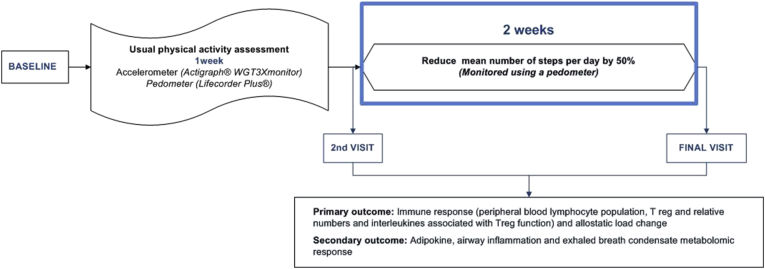
Methods: /Design: This is a two steps clinical trial including: (a) randomized crossover clinical trial, comparing the effect a high-fat/low-nutrient dense meal, FFM, with an isoenergetic similar high-nutrient dense meal, MdM, in the immune response to an exercise challenge (EC) and (b) a pilot trial assessing the neuro-immune-endocrine change induced by acute decreasing by half the usual physical activity level.
Results: A total of 46 participants (26 females), median aged 25 years were included. Of those 39-completed protocol, including overweight, physical active and inactive and participants with asthma. There were no differences in the EC between interventions. Dietary factors and physical activity were closely monitored during interventions and kept similar. During physical inactivity induction, 31% reached the target of 50% reduction in mean step number and 77% reached a 30% reduction.
Conclusion: The use of a pre-exercise meal to modulate immune response and the understanding of the immunological impact of physical inactivity might help to establish future recommendations on how to practice exercise in a safer way and to recognize the potential impact of inactivity.
Keywords: Allostatic load; Exercise challenge; Meal; Physical inactivity.
Figures
References
-
- Schwellnus M., Soligard T., Alonso J.M., Bahr R., Clarsen B., Dijkstra H.P., Gabbett T.J., Gleeson M., Hagglund M., Hutchinson M.R., Janse Van Rensburg C., Meeusen R., Orchard J.W., Pluim B.M., Raftery M., Budgett R., Engebretsen L. How much is too much? (Part 2) International Olympic Committee consensus statement on load in sport and risk of illness. Br. J. Sports Med. 2016;50(17):1043–1052. - PMC - PubMed
-
- Siedlik J.A., Benedict S.H., Landes E.J., Weir J.P., Vardiman J.P., Gallagher P.M. Acute bouts of exercise induce a suppressive effect on lymphocyte proliferation in human subjects: a meta-analysis. Brain Behav. Immun. 2016;56:343–351. - PubMed
-
- Shaw D.M., Merien F., Braakhuis A., Dulson D. T-cells and their cytokine production: the anti-inflammatory and immunosuppressive effects of strenuous exercise. Cytokine. 2018;104:136–142. - PubMed
-
- Hoff P., Belavy D.L., Huscher D., Lang A., Hahne M., Kuhlmey A.K., Maschmeyer P., Armbrecht G., Fitzner R., Perschel F.H., Gaber T., Burmester G.R., Straub R.H., Felsenberg D., Buttgereit F. Effects of 60-day bed rest with and without exercise on cellular and humoral immunological parameters. Cell. Mol. Immunol. 2015;12(4):483–492. - PMC - PubMed
LinkOut - more resources
Full Text Sources
Other Literature Sources
