Improving telestroke treatment times through a quality improvement initiative in a Singapore emergency department
- PMID: 30009318
- PMCID: PMC6395833
- DOI: 10.11622/smedj.2018083
Improving telestroke treatment times through a quality improvement initiative in a Singapore emergency department
Abstract
Introduction: Telestroke allows for remote determination of suitability for treatment with thrombolysis in patients with acute ischaemic stroke. However, this approach is time-dependent and most centres have yet to achieve the recommended treatment times. We describe a quality improvement initiative aimed at improving the telestroke workflow and treatment times at our centre.
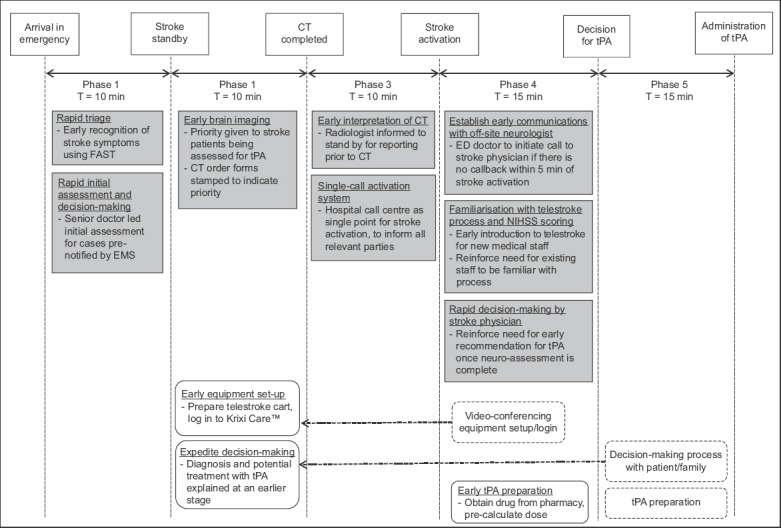
Methods: A multidisciplinary workgroup comprising clinicians, stroke case managers and radiology staff was formed to oversee the initiative. A phase-by-phase review of the existing workflow was done to identify the reasons for delay. Phase-specific measures were then introduced to address these delays, and a data-monitoring system was established to track the impact of these measures. The initiatives were implemented through four Plan-Do-Study-Act cycles. The door-to-needle (DTN) times for thrombolysis and clinical outcomes before and after the interventions were compared.
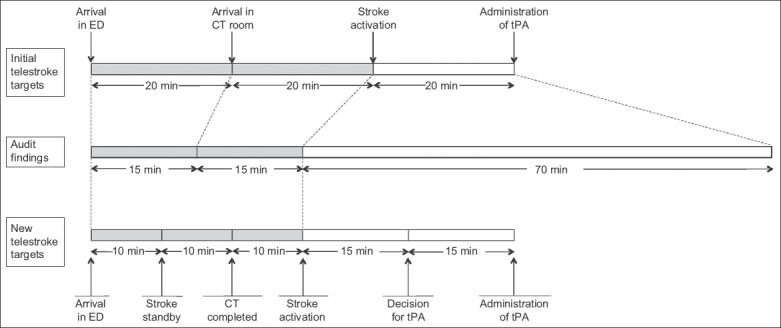
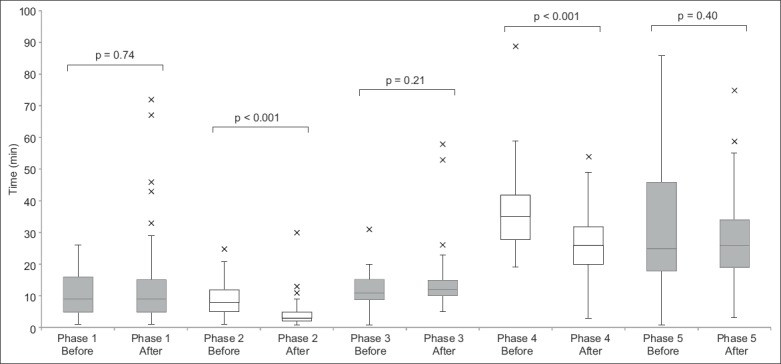
Results: A total of 104 patients were evaluated. The median DTN time improved from 96 minutes to 78 minutes post implementation of initiatives (p = 0.003). Fewer patients had symptomatic intracranial haemorrhages (8.5% vs. 24.2%; p = 0.03), and more patients had improvements in their National Institutes of Health Stroke Scale score (47.9% vs. 25.0%; p = 0.031) after the initiatives were introduced.
Conclusion: The quality improvement initiative resulted in a reduction in median DTN time. Our approach allowed for a systematic method to resolve delays within the telestroke workflow. This initiative is part of an ongoing effort aimed at providing thrombolysis safely to eligible patients in the shortest possible time.
Keywords: door-to-needle time; quality improvement; stroke; telemedicine.
Copyright: © Singapore Medical Association.
Figures
Similar articles
-
Novel Telestroke Program Improves Thrombolysis for Acute Stroke Across 21 Hospitals of an Integrated Healthcare System.Stroke. 2018 Jan;49(1):133-139. doi: 10.1161/STROKEAHA.117.018413. Epub 2017 Dec 15. Stroke. 2018. PMID: 29247142 Free PMC article. Clinical Trial.
-
Door-to-needle times for tissue plasminogen activator administration and clinical outcomes in acute ischemic stroke before and after a quality improvement initiative.JAMA. 2014 Apr 23-30;311(16):1632-40. doi: 10.1001/jama.2014.3203. JAMA. 2014. PMID: 24756513
-
Improving Telestroke Treatment Times in an Expanding Network of Hospitals.J Stroke Cerebrovasc Dis. 2016 Feb;25(2):288-91. doi: 10.1016/j.jstrokecerebrovasdis.2015.09.030. Epub 2015 Nov 30. J Stroke Cerebrovasc Dis. 2016. PMID: 26654667
-
The establishment of a telestroke service using multimodal CT imaging decision assistance: "Turning on the fog lights".J Clin Neurosci. 2017 Mar;37:1-5. doi: 10.1016/j.jocn.2016.10.018. Epub 2016 Nov 23. J Clin Neurosci. 2017. PMID: 27887976 Review.
-
[The application of telemedicine for stroke in the Balearic Islands: the Balearic Telestroke project].Rev Neurol. 2012 Jan 1;54(1):31-40. Rev Neurol. 2012. PMID: 22187210 Review. Spanish.
Cited by
-
Global stroke statistics 2023: Availability of reperfusion services around the world.Int J Stroke. 2024 Mar;19(3):253-270. doi: 10.1177/17474930231210448. Epub 2024 Jan 1. Int J Stroke. 2024. PMID: 37853529 Free PMC article. Review.
-
The Need for Structured Strategies to Improve Stroke Care in a Rural Telestroke Network in Northern New South Wales, Australia: An Observational Study.Front Neurol. 2021 Apr 9;12:645088. doi: 10.3389/fneur.2021.645088. eCollection 2021. Front Neurol. 2021. PMID: 33897601 Free PMC article.
-
Does the Implementation of a Telestroke Program Play a Role in Improving the Clinical Outcomes of Acute Stroke Patients in South East Asian Region?: A Literature Review.Risk Manag Healthc Policy. 2025 Jul 19;18:2461-2468. doi: 10.2147/RMHP.S517766. eCollection 2025. Risk Manag Healthc Policy. 2025. PMID: 40703311 Free PMC article. Review.
-
Telemedicine in the emergency department: an overview of systematic reviews.Z Gesundh Wiss. 2022 Jan 27:1-15. doi: 10.1007/s10389-021-01684-x. Online ahead of print. Z Gesundh Wiss. 2022. PMID: 35103232 Free PMC article. Review.
-
Using a lean management approach in acute ischemic stroke management: a systematic review.Postep Psychiatr Neurol. 2024 Jun;33(2):67-79. doi: 10.5114/ppn.2024.141056. Epub 2024 Jul 24. Postep Psychiatr Neurol. 2024. PMID: 39119549 Free PMC article. Review.
References
-
- National Institute of Neurological Disorders and Stroke rt-PA Stroke Study Group. Tissue plasminogen activator for acute ischemic stroke. N Engl J Med. 1995;333:1581–7. - PubMed
-
- Saver JL, Fonarow GC, Smith EE, et al. Time to treatment with intravenous tissue plasminogen activator and outcome from acute ischemic stroke. JAMA. 309:2480–8. - PubMed
-
- Lees KR, Bluhmki E, von Kummer R, et al. Time to treatment with intravenous alteplase and outcome in stroke:an updated pooled analysis of ECASS, ATLANTIS, NINDS, and EPITHET trials. Lancet. 2010;375:1695–703. - PubMed
-
- Fonarow GC, Smith EE, Saver JL, et al. Improving door-to-needle times in acute ischemic stroke:the design and rationale for the American Heart Association/American Stroke Association's Target:Stroke initiative. Stroke. 2011;42:2983–9. - PubMed
-
- Jauch EC, Saver JL, Adams HP, Jr, et al. American Heart Association Stroke Council;Council on Cardiovascular Nursing; Council on Peripheral Vascular Disease;Council on Clinical Cardiology. Guidelines for the early management of patients with acute ischemic stroke:a guideline for healthcare professionals from the American Heart Association/American Stroke Association. Stroke. 2013;44:870–947. - PubMed
Publication types
MeSH terms
Substances
LinkOut - more resources
Full Text Sources
Other Literature Sources
Medical