


Correlation between restriction endonuclease analysis and PCR ribotyping for the identification of Clostridioides (Clostridium) difficile clinical strains
- PMID: 30009944
- PMCID: PMC6924008
- DOI: 10.1016/j.anaerobe.2018.07.004
Correlation between restriction endonuclease analysis and PCR ribotyping for the identification of Clostridioides (Clostridium) difficile clinical strains
Abstract
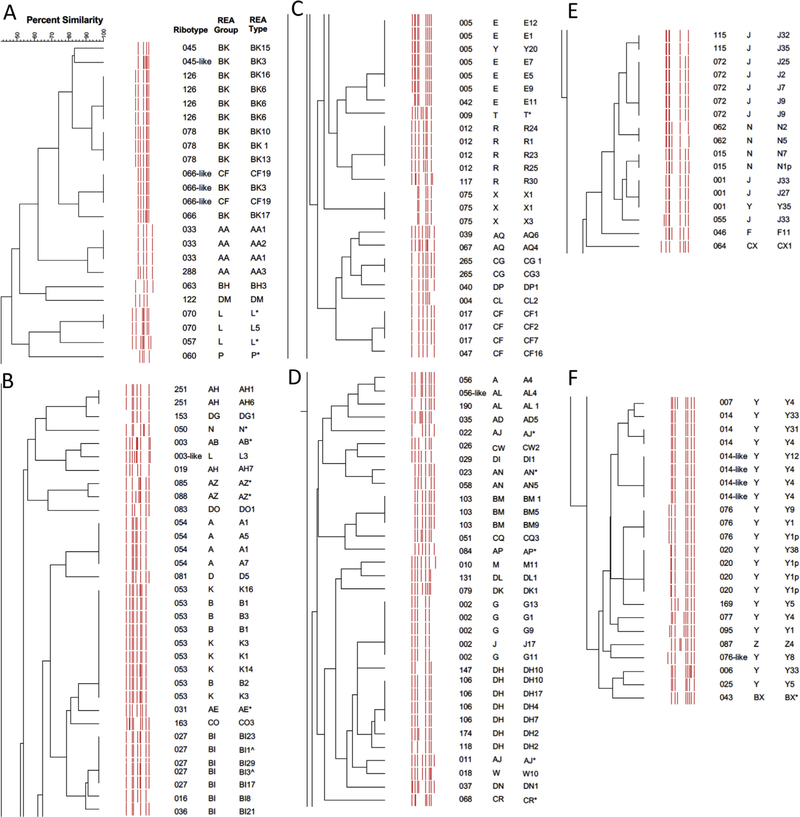
Restriction endonuclease analysis (REA) and PCR ribotyping are two typing systems that have been frequently utilized for molecular epidemiologic characterization of Clostridioides (Clostridium) difficile. To correlate typing data obtained from each method, we performed both REA and PCR ribotyping on a large and diverse set of historical and contemporary C. difficile infection clinical isolates. Eighty isolates were selected from each reference laboratory in the United States (Microbiology Reference Laboratory, Hines VA Medical Center) and United Kingdom (Clostridium difficile Network for England and Northern Ireland laboratory, University of Leeds). The 160 isolates were assigned to 82 unique ribotypes and 51 unique REA groups (116 unique REA types). In general, concordance between typing methods was good. Dendrogram analysis of PCR ribotype band patterns demonstrated close genetic relationships among strain types with discordant REA and ribotype assignments. While REA typing was more discriminatory, several REA types in this study were further discriminated by PCR ribotyping, indicating that discriminatory value of these typing methods may be strain dependent. These data will assist with molecular epidemiologic surveillance of strains identified by these two commonly used C. difficile typing systems.
Keywords: Clostridium difficile; Molecular epidemiology; PCR ribotyping; Restriction endonuclease analysis; Typing.
Copyright © 2018 Elsevier Ltd. All rights reserved.
Conflict of interest statement
Conflicts of interest
None relevant to this manuscript.
Figures
References
-
- Kelly CP, Lamont JT, Clostridium difficile- More difficult than ever, N. Engl. J. Med. 359 (2008) 1932–1940. - PubMed
-
- Loo VG, Poirier L, Miller MA, Oughton M, Libman MD, Michaud S, et al., A predominantly clonal multi-institutional outbreak of Clostridium difficile-associated diarrhea with high morbidity and mortality, N. Engl. J. Med. 353 (2005) 2442–2449. - PubMed
-
- McDonald LC, Killgore GE, Thompson A, Owens RC, Kazakova SV, Sambol SP, et al., An epidemic, toxin-gene variant strain of Clostridium difficile, N. Engl. J. Med. 353 (2005) 2433–2441. - PubMed
-
- Karlsson M, Paulick A, Albreght V, Granade M, Guh A, Rasheed JK, et al., ElP CDl Pathogen Group. 2016. Abstr 13th Biennial Congress of the Anaerobe Society of the Americas, Abstr Plll-4. Molecular Epidemiology of Clostridium difficile Isolated in the United States, 2014. http://www.anaerobe.org/2016/2016abBook.pdf.
Publication types
MeSH terms
Substances
Grants and funding
LinkOut - more resources
Full Text Sources
Other Literature Sources
