


Web-Based Intervention Using Behavioral Activation and Physical Activity for Adults With Depression (The eMotion Study): Pilot Randomized Controlled Trial
- PMID: 30012547
- PMCID: PMC6066639
- DOI: 10.2196/10112
Web-Based Intervention Using Behavioral Activation and Physical Activity for Adults With Depression (The eMotion Study): Pilot Randomized Controlled Trial
Abstract
Background: Physical activity is a potentially effective treatment for depression and depressive relapse. However, promoting physical activity in people with depression is challenging. Interventions informed by theory and evidence are therefore needed to support people with depression to become more physically active. eMotion is a Web-based intervention combining behavioral activation and physical activity promotion for people in the community with symptoms of depression.
Objective: The objectives were to assess the feasibility and acceptability of delivering eMotion to people in the community with symptoms of depression and to explore outcomes.
Methods: Participants with elevated depressive symptoms were recruited from the community through various methods (eg, social media) and randomized to eMotion or a waiting list control group for 8 weeks. eMotion is an administratively supported weekly modular program that helps people use key behavior change techniques (eg, graded tasks, action planning, and self-monitoring) to re-engage in routine, pleasurable, and necessary activities, with a focus on physical activities. Feasibility data were collected that included the following: recruitment and trial retention rates; fidelity of intervention delivery, receipt, and enactment; and acceptability of the intervention and data collection procedures. Data were collected for the primary (depression) and secondary outcomes (eg, anxiety, physical activity, fidelity, and client satisfaction) at baseline and 2 months postrandomization using self-reported Web-based questionnaires and accelerometers. Delivery fidelity (logins, modules accessed, time spent) was tracked using Web usage statistics. Exploratory analyses were conducted on the primary and secondary outcomes.
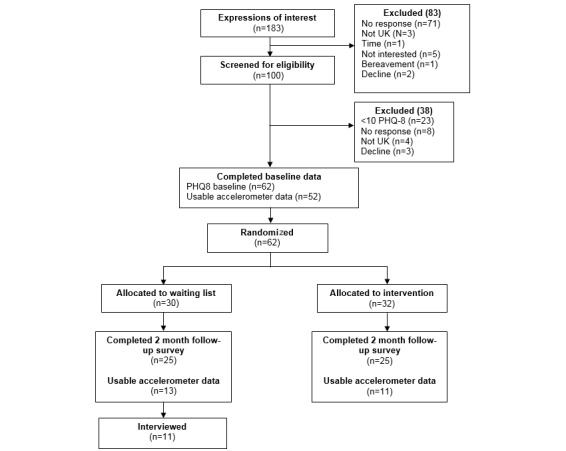
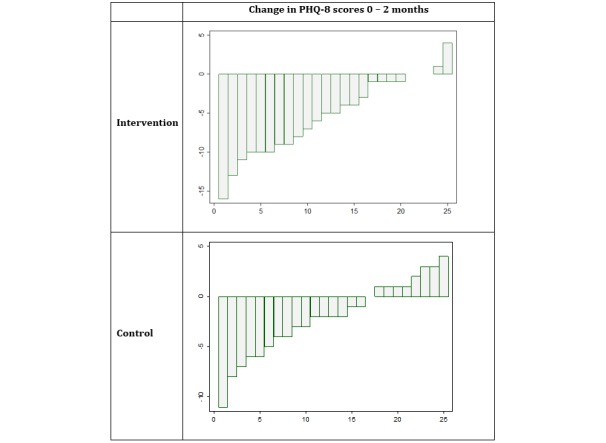
Results: Of the 183 people who contacted the research team, 62 were recruited and randomized. The mean baseline score was 14.6 (SD 3.2) on the 8-item Patient Health Questionnaire depression scale (PHQ-8). Of those randomized, 52 participants provided accelerometer-recorded physical activity data at baseline that showed a median of 35.8 (interquartile range [IQR] 0.0-98.6) minutes of moderate-to-vigorous physical activity (MVPA) recorded in at least 10-minute bouts per week, with only 13% (7/52) people achieving guideline levels (150 minutes of MVPA per week). In total, 81% (50/62) of participants provided follow-up data for the primary outcome (PHQ-8), but only 39% (24/62) provided follow-up accelerometer data. Within the intervention group, the median number of logins, modules accessed, and total minutes spent on eMotion was 3 (IQR 2.0-8.0), 3 (IQR 2.0-5.0), and 41.3 (IQR 18.9-90.4), respectively. Acceptability was mixed. Exploratory data analysis showed that PHQ-8 levels were lower for the intervention group than for the control group at 2 months postrandomization (adjusted mean difference -3.6, 95% CI -6.1 to -1.1).
Conclusions: It was feasible to deliver eMotion in UK communities to inactive populations. eMotion has the potential to be effective and is ready for testing in a full-scale trial. Further work is needed to improve engagement with both the intervention and data collection procedures.
Trial registration: ClinicalTrials.gov NCT03084055; https://clinicaltrials.gov/ct2/show/NCT03084055 (Archived by WebCite at http://www.webcitation.org/6zoyM8UXa).
Keywords: acceptability; anxiety; eHealth; exercise; feasibility; mood; psychological therapy.
©Jeffrey D Lambert, Colin J Greaves, Paul Farrand, Lisa Price, Anne M Haase, Adrian H Taylor. Originally published in the Journal of Medical Internet Research (http://www.jmir.org), 16.07.2018.
Conflict of interest statement
Conflicts of Interest: None declared.
Figures
References
-
- Stevenson D, Farmer P. GOV.UK. Thriving at work: The Stevenson / Farmer review of mental health and employers https://assets.publishing.service.gov.uk/government/uploads/system/uploa... .
-
- Anderson RJ, Freedland KE, Clouse RE, Lustman PJ. The prevalence of comorbid depression in adults with diabetes: a meta-analysis. Diabetes Care. 2001 Jun;24(6):1069–78. - PubMed
-
- Whooley MA, de JP, Vittinghoff E, Otte C, Moos R, Carney RM, Ali S, Dowray S, Na B, Feldman MD, Schiller NB, Browner WS. Depressive symptoms, health behaviors, and risk of cardiovascular events in patients with coronary heart disease. JAMA. 2008 Nov 26;300(20):2379–88. doi: 10.1001/jama.2008.711. http://europepmc.org/abstract/MED/19033588 300/20/2379 - DOI - PMC - PubMed
-
- Onyike CU, Crum RM, Lee HB, Lyketsos CG, Eaton WW. Is obesity associated with major depression? Results from the Third National Health and Nutrition Examination Survey. Am J Epidemiol. 2003 Dec 15;158(12):1139–47. - PubMed
Publication types
MeSH terms
Associated data
LinkOut - more resources
Full Text Sources
Other Literature Sources
Medical
