


Lamins in Lung Cancer: Biomarkers and Key Factors for Disease Progression through miR-9 Regulation?
- PMID: 30012957
- PMCID: PMC6071028
- DOI: 10.3390/cells7070078
Lamins in Lung Cancer: Biomarkers and Key Factors for Disease Progression through miR-9 Regulation?
Abstract
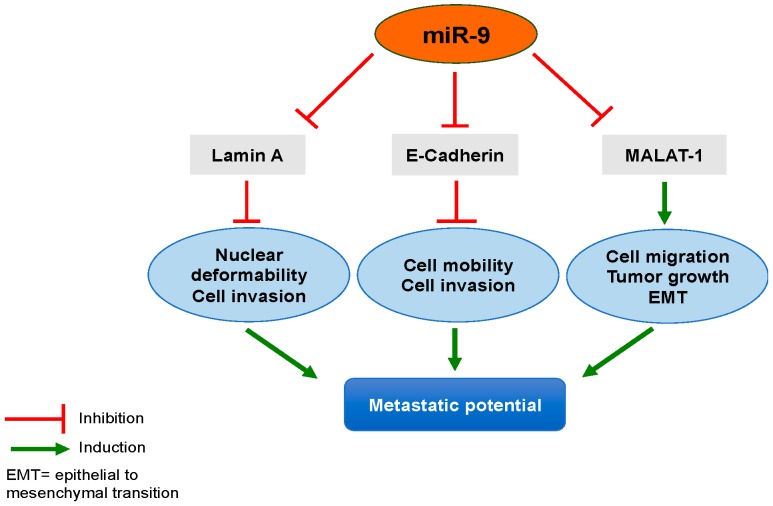
Lung cancer represents the primary cause of cancer death in the world. Malignant cells identification and characterization are crucial for the diagnosis and management of patients with primary or metastatic cancers. In this context, the identification of new biomarkers is essential to improve the differential diagnosis between cancer subtypes, to select the most appropriate therapy, and to establish prognostic correlations. Nuclear abnormalities are hallmarks of carcinoma cells and are used as cytological diagnostic criteria of malignancy. Lamins (divided into A- and B-types) are localized in the nuclear matrix comprising nuclear lamina, where they act as scaffolding protein, involved in many nuclear functions, with regulatory effects on the cell cycle and differentiation, senescence and apoptosis. Previous studies have suggested that lamins are involved in tumor development and progression with opposite results concerning their prognostic role. This review provides an overview of lamins expression in lung cancer and the relevance of these findings for disease diagnosis and prognosis. Furthermore, we discuss the link between A-type lamins expression in lung carcinoma cells and nuclear deformability, epithelial to mesenchymal transition, and metastatic potential, and which mechanisms could regulate A-type lamins expression in lung cancer, such as the microRNA miR-9.
Keywords: lamins; lung adenocarcinoma; lung cancer; miR-9; microRNAs.
Conflict of interest statement
E. Kaspi reports grants from ARARD (Association Régionale d’Aide Respiratoire à Domicile) grant, Parc d’activités de Napollon, 100 avenue des Templiers, 13676 Aubagne Cedex, France. Tel.: +33-442-848-701, Fax: +33-442-846-999.
Figures
References
-
- Lozano R., Naghavi M., Foreman K., Lim S., Shibuya K., Aboyans V., Abraham J., Adair T., Aggarwal R., Ahn S.Y., et al. Global and regional mortality from 235 causes of death for 20 age groups in 1990 and 2010: A systematic analysis for the Global Burden of Disease Study 2010. Lancet. 2012;380:2095–2128. doi: 10.1016/S0140-6736(12)61728-0. - DOI - PMC - PubMed
-
- Barlesi F., Mazieres J., Merlio J.-P., Debieuvre D., Mosser J., Lena H., Ouafik L., Besse B., Rouquette I., Westeel V., et al. Routine molecular profiling of patients with advanced non-small-cell lung cancer: Results of a 1-year nationwide programme of the French Cooperative Thoracic Intergroup (IFCT) Lancet. 2016;387:1415–1426. doi: 10.1016/S0140-6736(16)00004-0. - DOI - PubMed
Publication types
LinkOut - more resources
Full Text Sources
Other Literature Sources
