Data Integration for Future Medicine (DIFUTURE)
- PMID: 30016812
- PMCID: PMC6178202
- DOI: 10.3414/ME17-02-0022
Data Integration for Future Medicine (DIFUTURE)
Abstract
Introduction: This article is part of the Focus Theme of Methods of Information in Medicine on the German Medical Informatics Initiative. Future medicine will be predictive, preventive, personalized, participatory and digital. Data and knowledge at comprehensive depth and breadth need to be available for research and at the point of care as a basis for targeted diagnosis and therapy. Data integration and data sharing will be essential to achieve these goals. For this purpose, the consortium Data Integration for Future Medicine (DIFUTURE) will establish Data Integration Centers (DICs) at university medical centers.
Objectives: The infrastructure envisioned by DIFUTURE will provide researchers with cross-site access to data and support physicians by innovative views on integrated data as well as by decision support components for personalized treatments. The aim of our use cases is to show that this accelerates innovation, improves health care processes and results in tangible benefits for our patients. To realize our vision, numerous challenges have to be addressed. The objective of this article is to describe our concepts and solutions on the technical and the organizational level with a specific focus on data integration and sharing.
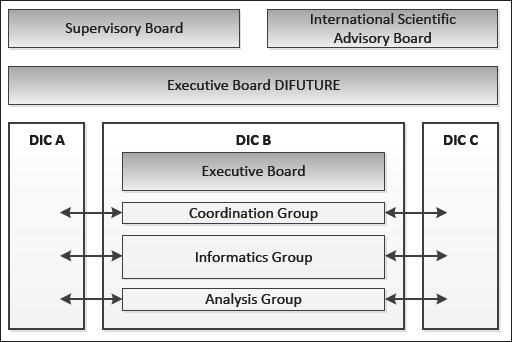
Governance and policies: Data sharing implies significant security and privacy challenges. Therefore, state-of-the-art data protection, modern IT security concepts and patient trust play a central role in our approach. We have established governance structures and policies safeguarding data use and sharing by technical and organizational measures providing highest levels of data protection. One of our central policies is that adequate methods of data sharing for each use case and project will be selected based on rigorous risk and threat analyses. Interdisciplinary groups have been installed in order to manage change.
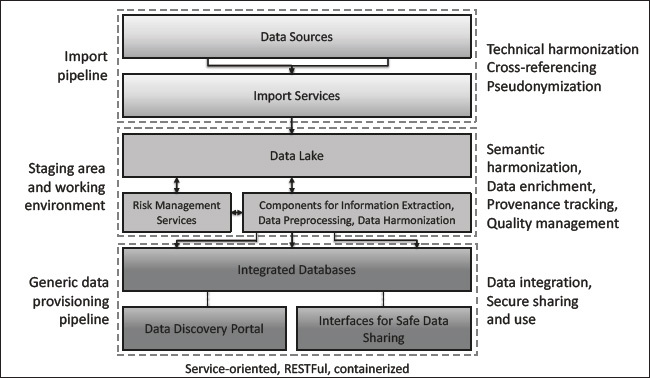
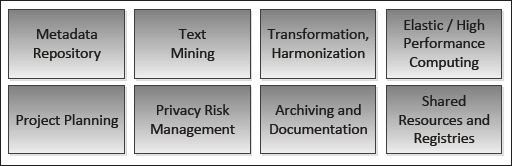
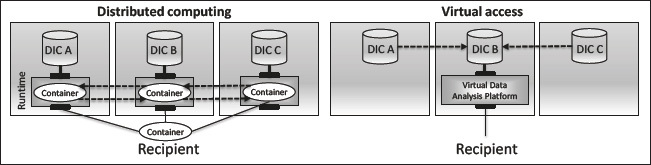
Architectural framework and methodology: The DIFUTURE Data Integration Centers will implement a three-step approach to integrating, harmonizing and sharing structured, unstructured and omics data as well as images from clinical and research environments. First, data is imported and technically harmonized using common data and interface standards (including various IHE profiles, DICOM and HL7 FHIR). Second, data is preprocessed, transformed, harmonized and enriched within a staging and working environment. Third, data is imported into common analytics platforms and data models (including i2b2 and tranSMART) and made accessible in a form compliant with the interoperability requirements defined on the national level. Secure data access and sharing will be implemented with innovative combinations of privacy-enhancing technologies (safe data, safe settings, safe outputs) and methods of distributed computing.
Use cases: From the perspective of health care and medical research, our approach is disease-oriented and use-case driven, i.e. following the needs of physicians and researchers and aiming at measurable benefits for our patients. We will work on early diagnosis, tailored therapies and therapy decision tools with focuses on neurology, oncology and further disease entities. Our early uses cases will serve as blueprints for the following ones, verifying that the infrastructure developed by DIFUTURE is able to support a variety of application scenarios.
Discussion: Own previous work, the use of internationally successful open source systems and a state-of-the-art software architecture are cornerstones of our approach. In the conceptual phase of the initiative, we have already prototypically implemented and tested the most important components of our architecture.
Schattauer GmbH.
Conflict of interest statement
Disclosure The authors report no conflicts of interest in this work.
Figures

References
-
- Prasser F, Kohlmayer F, Spengler H, Kuhn KA. A scalable and pragmatic method for the safe sharing of high-quality health data. IEEE J Biomed Health Inform. 2018;22(02):611–622. - PubMed
-
- DIFUTURE – Scientific Advisory Board[cited 2017 Nov 27]. Available from:https://difuture.de/advisory-board/
Publication types
MeSH terms
Grants and funding
LinkOut - more resources
Full Text Sources
Other Literature Sources