


Efficacy, effectiveness and safety of vaccination against human papillomavirus in males: a systematic review
- PMID: 30016957
- PMCID: PMC6050686
- DOI: 10.1186/s12916-018-1098-3
Efficacy, effectiveness and safety of vaccination against human papillomavirus in males: a systematic review
Abstract
Background: Human papillomavirus (HPV) vaccination is safe and effective in preventing cervical cancer in females. As HPV infections can also induce cancers of the anus, penis and oral cavity, male vaccination is also advocated, but systematic reviews on efficacy and safety in males are lacking.
Methods: We performed a systematic review on the efficacy, effectiveness and safety of HPV vaccination in males of any age. MEDLINE, Embase, the Cochrane Central Register of Controlled Trials and ClinicalTrials.gov were searched from inception to April 2017.
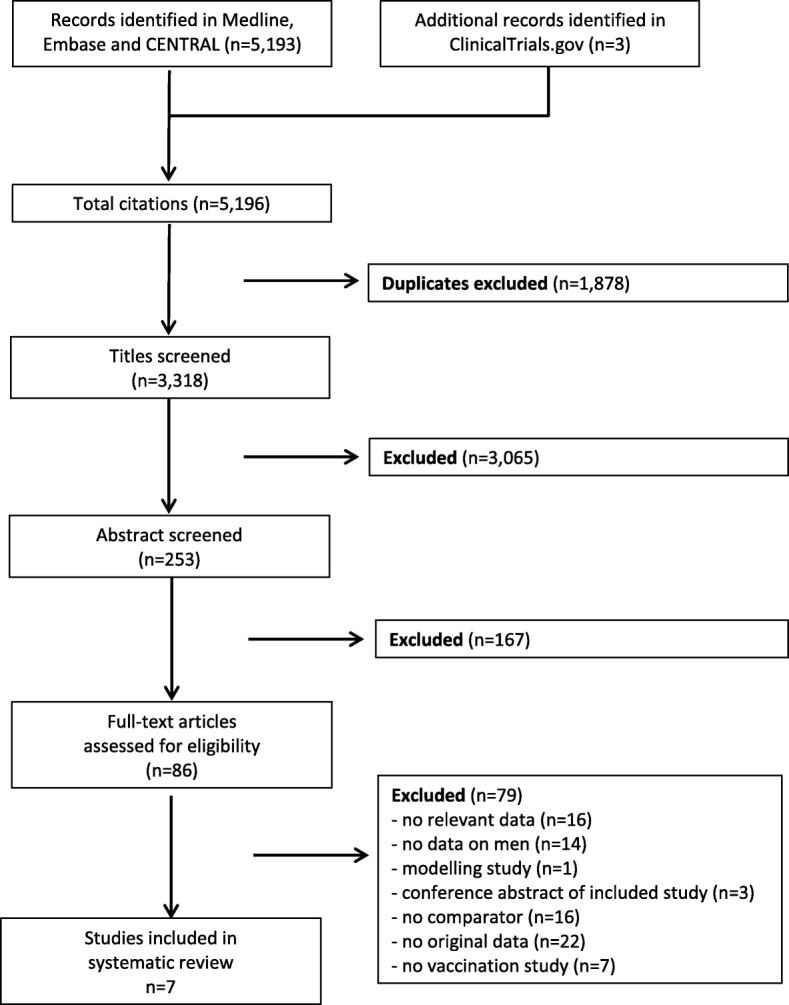
Results: We identified 5196 articles and seven studies (four randomized controlled trials (RCTs), three non-randomized studies) were included, comprising a total of 5294 participants. Vaccine efficacy against at least 6-month persisting anogenital HPV 16 infections was 46.9% (95% confidence interval (CI) 28.6-60.8%), whereas efficacy against persisting oral infections was 88% (2-98%). A vaccine efficacy of 61.9% (21.4-82.8%) and 46.8% (- 20 to -77.9%) was observed against anal intraepithelial neoplasia grade 2 and grade 3 lesions, respectively. No meaningful estimates were available on vaccine efficacy or effectiveness against penile intraepithelial neoplasia grade 2 or 3, and no data were identified for anal, penile or head and neck squamous cell cancer. In participants who were HPV-seronegative and PCR-negative at enrolment, efficacy against all outcomes was higher as compared to seropositive and/or PCR-positive individuals. Risk of bias was low in three RCTs and high in one, while the three non-randomized studies were at serious to critical risk of bias. Grading of Recommendations Assessment, Development and Evaluation evidence quality was moderate to low for most outcomes.
Conclusions: HPV vaccination in males is moderately effective against persistent anogenital HPV infection and high-grade anal intraepithelial lesions in studies where the population consists mainly of HPV-infected males. Vaccine effectiveness was high in study groups comprising HPV-naïve males. This supports a recommendation for vaccination of boys before the onset of sexual activity with the goal of establishing optimal vaccine-induced protection. Mathematical modelling studies will still be needed to assess the effects of adding males to existing HPV vaccination programs in females.
Trial registration: Prospective Register for Systematic Reviews (PROSPERO) registration CRD42016038965 .
Keywords: Effectiveness; Efficacy; Human papillomavirus; Safety; Systematic review.
Conflict of interest statement
Ethics approval and consent to participate
Not required.
Consent for publication
Not applicable.
Competing interests
The authors declare that they have no competing interests.
Publisher’s Note
Springer Nature remains neutral with regard to jurisdictional claims in published maps and institutional affiliations.
References
-
- Jaisamrarn U, Castellsague X, Garland SM, Naud P, Palmroth J, Del Rosario-Raymundo MR, Wheeler CM, Salmeron J, Chow SN, Apter D, et al. Natural history of progression of HPV infection to cervical lesion or clearance: analysis of the control arm of the large, randomised PATRICIA study. PLoS One. 2013;8(11):e79260. doi: 10.1371/journal.pone.0079260. - DOI - PMC - PubMed
Publication types
MeSH terms
Substances
LinkOut - more resources
Full Text Sources
Other Literature Sources
Molecular Biology Databases
Research Materials
Miscellaneous
