


The role of 3D genome organization in disease: From compartments to single nucleotides
- PMID: 30017907
- PMCID: PMC6335187
- DOI: 10.1016/j.semcdb.2018.07.005
The role of 3D genome organization in disease: From compartments to single nucleotides
Abstract
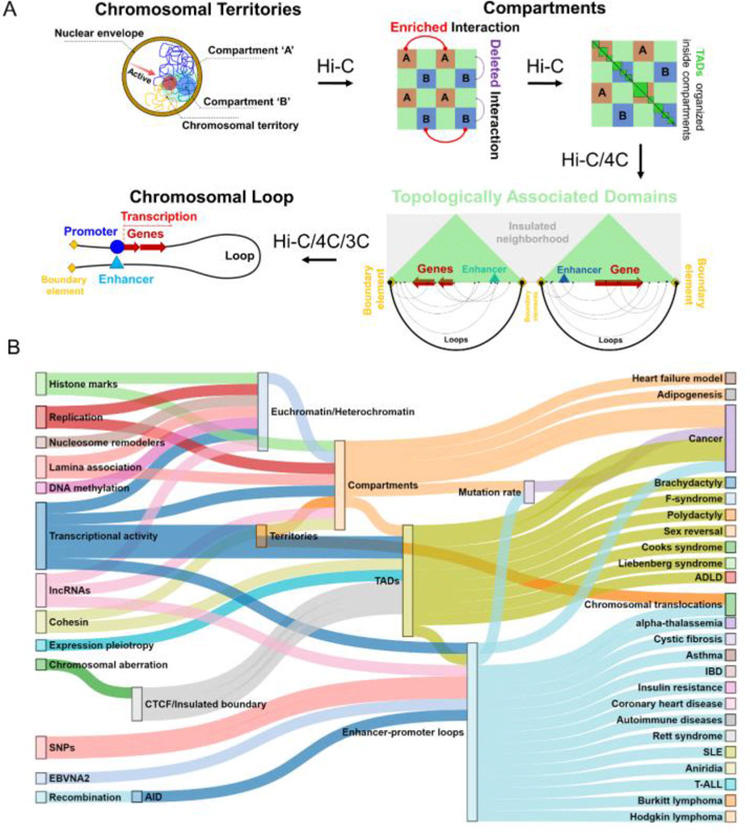
Since the advent of the chromosome conformation capture technology, our understanding of the human genome 3D organization has grown rapidly and we now know that human interphase chromosomes are folded into multiple layers of hierarchical structures and each layer can play a critical role in transcriptional regulation. Alterations in any one of these finely-tuned layers can lead to unwanted cascade of molecular events and ultimately drive the manifestation of diseases and phenotypes. Here we discuss, starting from chromosome level organization going down to single nucleotide changes, recent studies linking diseases or phenotypes to changes in the 3D genome architecture.
Copyright © 2018 Elsevier Ltd. All rights reserved.
Figures
References
-
- Jiang YH, Bressler J, Beaudet AL, Epigenetics and human disease, Annu Rev Genomics Hum Genet 5 (2004) 479–510. - PubMed
-
- Brookes E, Shi Y, Diverse epigenetic mechanisms of human disease, Annu Rev Genet 48 (2014) 237–68. - PubMed
-
- Li G, Zhu P, Structure and organization of chromatin fiber in the nucleus, FEBS Lett 589(20 Pt A) (2015) 2893–904. - PubMed
Publication types
MeSH terms
Substances
Grants and funding
LinkOut - more resources
Full Text Sources
Other Literature Sources
