. 2018 Jul 17;8(1):10770.
doi: 10.1038/s41598-018-28791-2.

A Universal Live Cell Barcoding-Platform for Multiplexed Human Single Cell Analysis

Affiliations

A Universal Live Cell Barcoding-Platform for Multiplexed Human Single Cell Analysis

Felix J Hartmann et al. Sci Rep. .

Abstract

Single-cell barcoding enables the combined processing and acquisition of multiple individual samples as one. This maximizes assay efficiency and eliminates technical variability in both sample preparation and analysis. Remaining challenges are the barcoding of live, unprocessed cells to increase downstream assay performance combined with the flexibility of the approach towards a broad range of cell types. To that end, we developed a novel antibody-based platform that allows the robust barcoding of live human cells for mass cytometry (CyTOF). By targeting both the MHC class I complex (beta-2-microglobulin) and a broadly expressed sodium-potassium ATPase-subunit (CD298) with platinum-conjugated antibodies, human immune cells, stem cells as well as tumor cells could be multiplexed in the same single-cell assay. In addition, we present a novel palladium-based covalent viability reagent compatible with this barcoding strategy. Altogether, this platform enables mass cytometry-based, live-cell barcoding across a multitude of human sample types and provides a scheme for multiplexed barcoding of human single-cell assays in general.


Conflict of interest statement

The authors declare no competing interests.

Figures
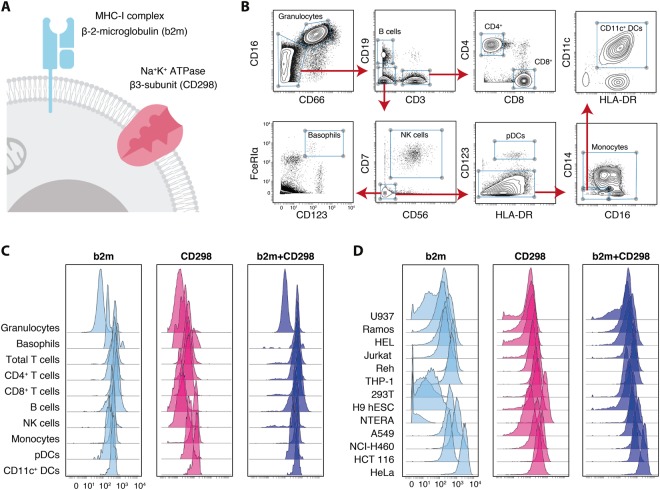
Figure 1
Figure 1
MHC-I and sodium-potassium ATPase-subunits are broadly expressed across different cell types. (A) The two surface proteins b2m as part of the MHC-I complex and CD298, a subunit of the sodium potassium pump, were selected as potential targets for live cell barcoding. (B) Human whole blood was subjected to red blood cell (RBC) lysis and subsequently stained with heavy-metal isotope-conjugated antibodies for mass cytometry (Table S1). Cells were pre-gated on live, single, CD45+ and CD235ab-. The main immune lineages were then identified via the indicated gating scheme. (C) Expression of b2m (light blue, left), CD298 (magenta, middle) and combined expression values from b2m and CD298 using the same reporter isotope (dark blue, right) on immune populations as in B. (D) Expression of b2m (light blue, left), CD298 (magenta, middle) and combined expression values from b2m and CD298 using the same reporter isotope (dark blue, right) on various cancer cell lines. Shown is one representative experiment out of two.
Figure 2
Figure 2
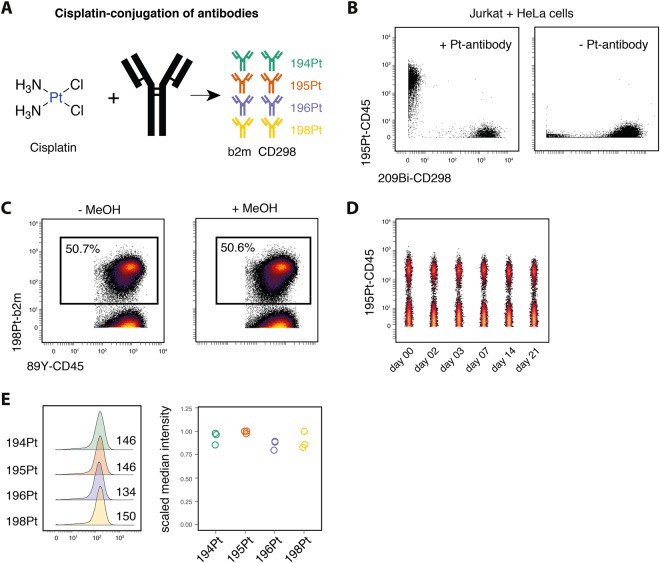
Cisplatin-conjugation of antibodies provides a specific and stable extension to lanthanide antibodies. (A) CD298 and b2m antibodies were conjugated to four different platinum isotopes (194Pt, 195Pt, 196Pt and 198Pt) via covalent binding of cisplatin. (B) Unstained Jurkat and 209Bi-stained HeLa cells were combined and stained with cisplatin-conjugated anti-CD45 (left) or no anti-CD45 antibody (right). (C) Cisplatin-antibody (anti-b2m) stained PBMCs and unstained PBMCs were mixed and acquired without (left) or after MeOH fixation (right). (D) Cells as in (C) were kept in intercalation solution at 4 °C for the indicated number of days before acquisition. (E) PBMC samples were stained with anti-b2m and anti-CD298 antibodies conjugated to different platinum isotopes. Numbers indicate median intensity in the respective channel (left). Median intensities were scaled to the maximum of the respective experiment (right).
Figure 3
Figure 3
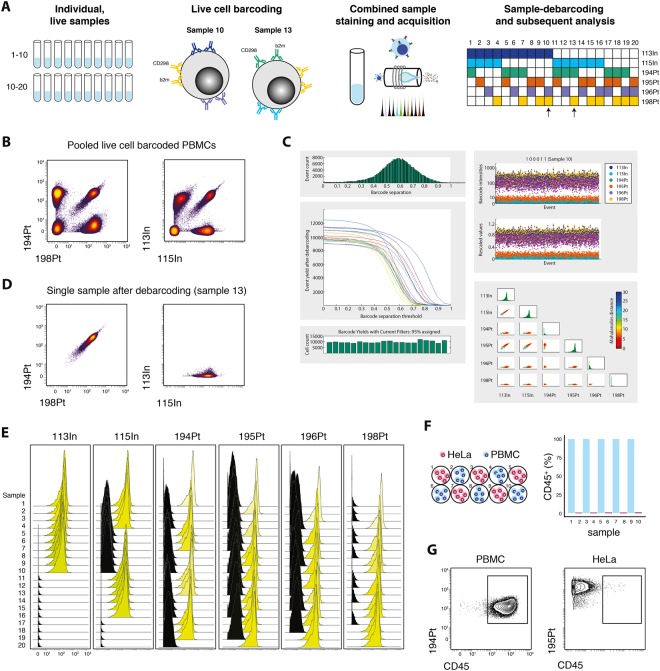
CD298 and b2m enable robust live cell barcoding of heterogeneous samples. (A) Schematic representation of the barcoding procedure. Individual samples are barcoded with a combination of three different b2m and CD298 antibodies, pooled, stained and acquired. Samples can then be debarcoded using the supplied barcoding matrix. Arrows point out sample 10 and 13 which are used as examples in A and C. (B) 20 PBMC samples were barcoded using the above described method. Shown are live, single cells from combined samples before debarcoding. (C) Combined samples can be debarcoded using existing algorithms and software. (D) Example of a debarcoded sample positive for three of the available six barcodes. (E) Signal intensities of all barcode isotopes from combined anti-b2m and anti-CD298 antibodies on debarcoded samples as in E. (F) PBMC and HeLa samples were barcoded, combined and stained with anti-CD45 (left). Frequency of CD45+ in debarcoded cells (right). (G) Exemplary biaxial plots demonstrating CD45 staining in debarcoded cells as in F, assigned to a PBMC (left) or HeLa sample (right).
Figure 4
Figure 4
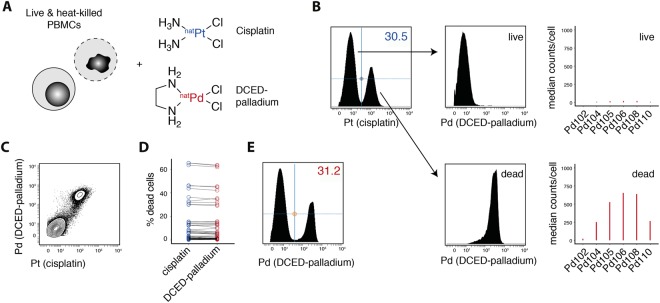
Palladium-based viability staining reproduces cisplatin-based dead cell identification. (A) Live and heat-killed (55 °C for 1 h) PBMCs were mixed and incubated for 5 min at RT with 500 nM cis-dichloro-diamine-platinum(II) (cisplatin) and 500 nM dichloro-(ethylenediamine)-palladium(II) (DCED-palladium). (B) Platinum (198Pt) signal (left) in cells as in (A) was used to discriminate live (cisplatinlow) and dead cells (cisplatinhigh), which were then analyzed for their palladium signal in one palladium channel (110 Pd, middle) or across all measured palladium isotopes (right). 110 Pd is shown as an example but other Pd-channels (with the exception of 102 Pd) could be used analogously. Representative example from a total of n = 8. (C) DCED-palladium (110 Pd) and cisplatin (198Pt) in cells as in (A). (D) The frequency of dead cells within multiple different types of samples was assessed using cisplatin and DCED-palladium simultaneously (n = 48, pooled from 10 independent experiments). (E) DCED-palladium on its own can be used to discriminate live from dead cells (here heat-killed as in A). Representative example from a total of n = 48.
Figure 5
Figure 5
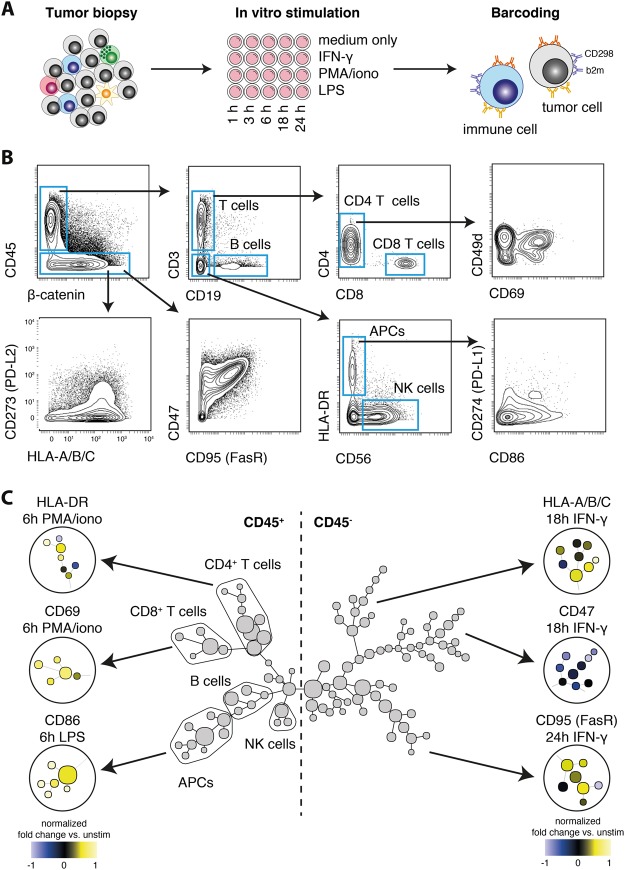
Live cell barcoding enables the combined investigation of tumor- and immune cell phenotypes and interplays. (A) Single-cell suspensions were prepared from a lung tumor tissue biopsy and stimulated in vitro for different periods of time with the indicated reagents. Tumor as well as immune cells from individual conditions were then live cell barcoded, combined and stained for immune-relevant markers (Table S1). (B) Different immune as well as tumor cell populations were identified via the indicated gating scheme and analyzed for their expression of multiple surface markers. APCs = antigen presenting cells. (C) Combined data was subjected to SPADE clustering (100 clusters) and represented as a minimal spanning tree (MST). Selected clusters are overlaid with a color-scheme representing the normalized fold-change in unstimulated vs. the indicated stimulus.

References

    1. Bendall SC, et al. Single-cell mass cytometry of differential immune and drug responses across a human hematopoietic continuum. Science. 2011;332:687–96. doi: 10.1126/science.1198704. - DOI - PMC - PubMed
    1. Bendall SC, et al. Single-cell trajectory detection uncovers progression and regulatory coordination in human B cell development. Cell. 2014;157:714–25. doi: 10.1016/j.cell.2014.04.005. - DOI - PMC - PubMed
    1. Zunder ER, Lujan E, Goltsev Y, Wernig M, Nolan GP. A continuous molecular roadmap to iPSC reprogramming through progression analysis of single-cell mass cytometry. Cell Stem Cell. 2015;16:323–37. doi: 10.1016/j.stem.2015.01.015. - DOI - PMC - PubMed
    1. Levine JH, et al. Data-Driven Phenotypic Dissection of AML Reveals Progenitor-like Cells that Correlate with Prognosis. Cell. 2015;162:184–197. doi: 10.1016/j.cell.2015.05.047. - DOI - PMC - PubMed
    1. Spitzer MH, et al. IMMUNOLOGY. An interactive reference framework for modeling a dynamic immune system. Science. 2015;349:1259425. doi: 10.1126/science.1259425. - DOI - PMC - PubMed

Publication types

Substances