Review
. 2018 Jul 3:9:1357.
doi: 10.3389/fmicb.2018.01357. eCollection 2018.

On the Natural History of Flavin-Based Electron Bifurcation

Affiliations
Review

On the Natural History of Flavin-Based Electron Bifurcation

Frauke Baymann et al. Front Microbiol. .

Abstract

Electron bifurcation is here described as a special case of the continuum of electron transfer reactions accessible to two-electron redox compounds with redox cooperativity. We argue that electron bifurcation is foremost an electrochemical phenomenon based on (a) strongly inverted redox potentials of the individual redox transitions, (b) a high endergonicity of the first redox transition, and (c) an escapement-type mechanism rendering completion of the first electron transfer contingent on occurrence of the second one. This mechanism is proposed to govern both the traditional quinone-based and the newly discovered flavin-based versions of electron bifurcation. Conserved and variable aspects of the spatial arrangement of electron transfer partners in flavoenzymes are assayed by comparing the presently available 3D structures. A wide sample of flavoenzymes is analyzed with respect to conserved structural modules and three major structural groups are identified which serve as basic frames for the evolutionary construction of a plethora of flavin-containing redox enzymes. We argue that flavin-based and other types of electron bifurcation are of primordial importance to free energy conversion, the quintessential foundation of life, and discuss a plausible evolutionary ancestry of the mechanism.

Keywords: bioenergetics; electron bifurcation; emergence of life; flavoenzymes; redox cooperativity; redox enzyme construction kit.


Figures
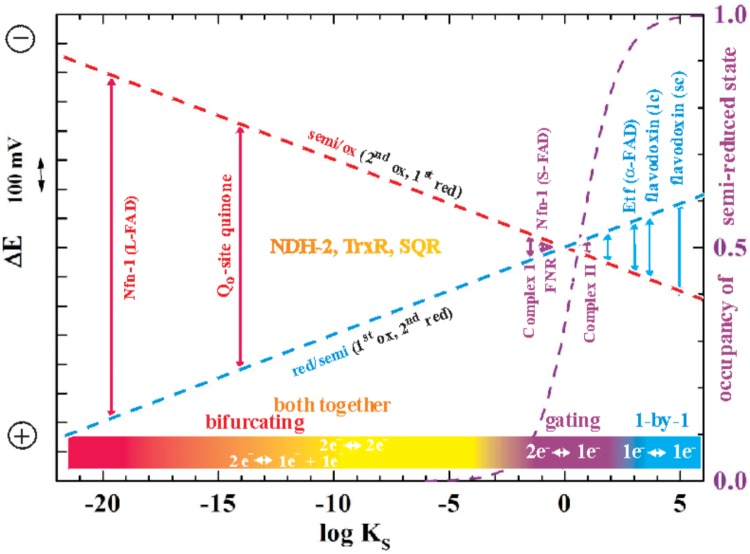
FIGURE 1
FIGURE 1
Redox seesaw-type representation of the correlation between the electron transfer function of selected flavoenzymes and the redox cooperativity of their flavin cofactors. The redox midpoint potentials of the first (oxidized to one-electron reduced, red dashes) and the second redox transition (half-reduced to two-electron reduced, blue dashes) is shown as a function of the semiquinone stability constant KS = [semi-reduced]2/[ox]x[red]. The maximal occupancy of the flavosemiquinone as would be observed in equilibrium redox titrations on the respective flavins is indicated as a violet dashed curve. Note that in this and all following figures more negative potentials are toward the upper part of the graphs.
FIGURE 2
FIGURE 2
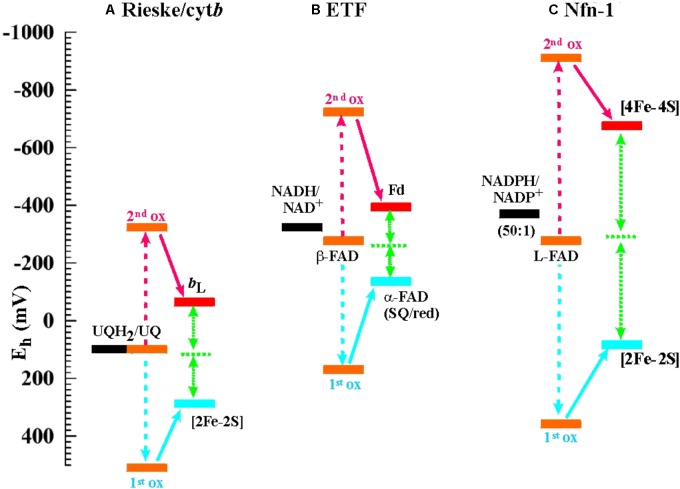
Electrochemical landscapes for the electron bifurcation reactions in (A) the Rieske/cytb complexes (the shown potentials are for the ubiquinone-oxidizing enzymes in mitochondria and alpha-proteobacteria; for enzymes operating with other types of quinones, see Bergdoll et al., 2016), (B) ETF, and (C) Nfn-1.
FIGURE 3
FIGURE 3
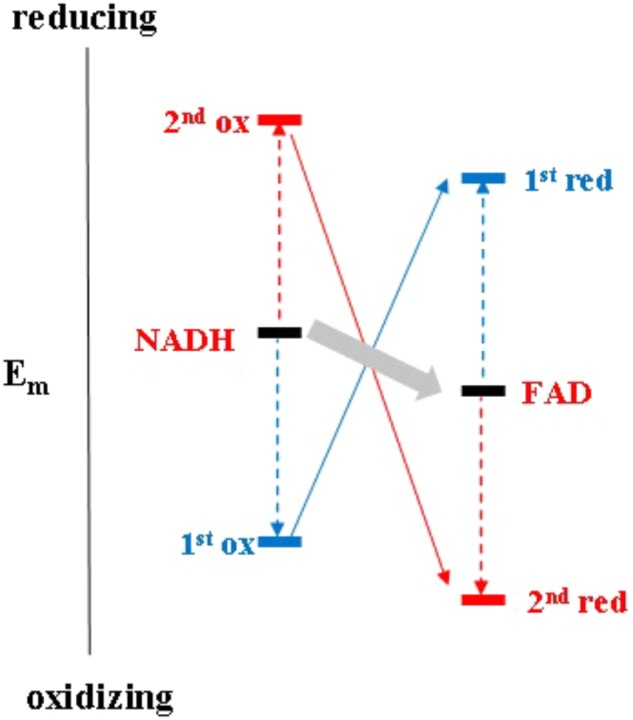
Electrochemical landscape for the two-electron transfer reaction between NADH and FAD in the framework of the escapement-type mechanism discussed in the text.
FIGURE 4
FIGURE 4
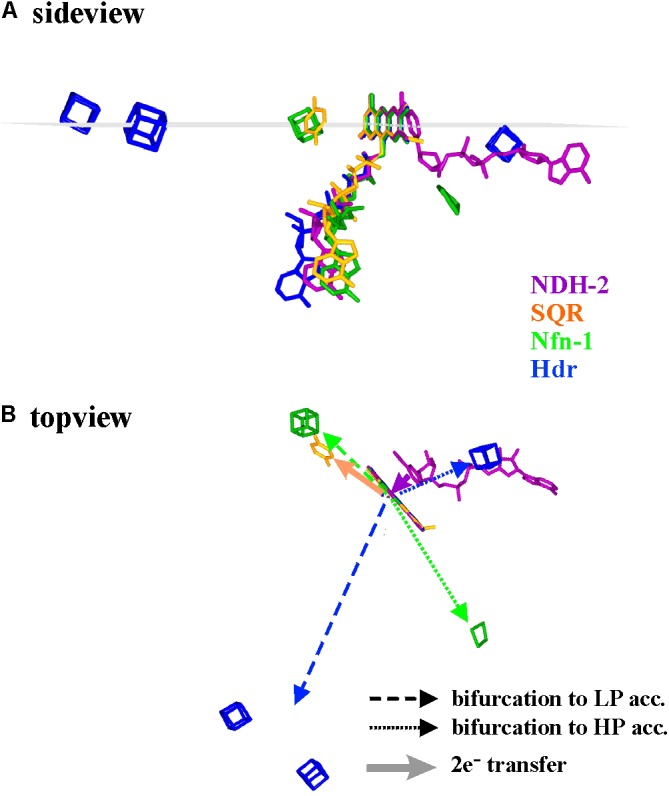
Spatial arrangement with respect to the flavin of electron donating and accepting cofactors in four different flavoenzymes, two of which perform electron bifurcation (Nfn-1 and Hdr), while the other two transfer both electrons together from/to their redox partners. The sideview in (A) renders the cofactors as seen from within a plane perpendicular to the flavin macrocycle (indicated in gray) while in (B) the same cofactors are seen from above this plane. LP and HP stand for low and high potential electron acceptors, respectively.
FIGURE 5
FIGURE 5
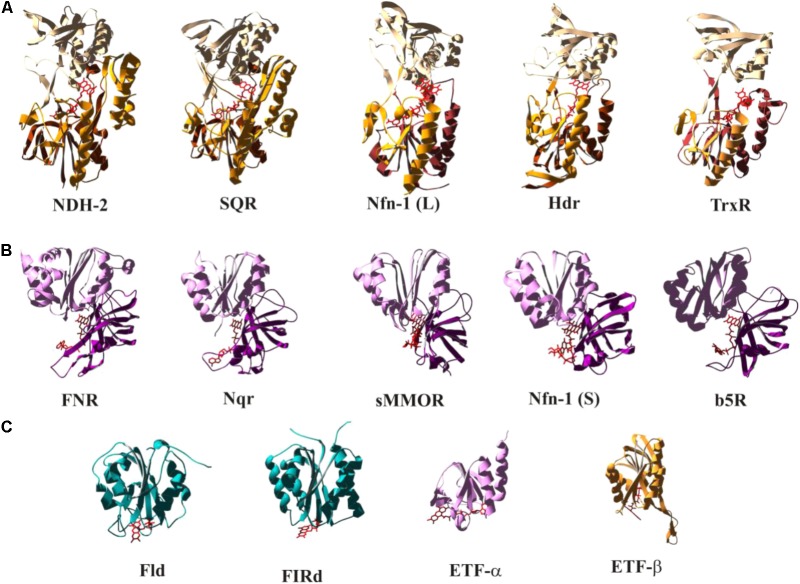
Structural comparison of selected flavoenzymes or their flavin-containing domains highlighting conserved folds as discussed in the text. The color-coding indicates the mode of electron transfer reactions as defined in Figure 1. A more extended version of this figure, containing substantially more cases, can be found as Supplementary Figure S2. Detailed electrochemical parameters and relevant references are listed in Supplementary Table S1.
FIGURE 6
FIGURE 6
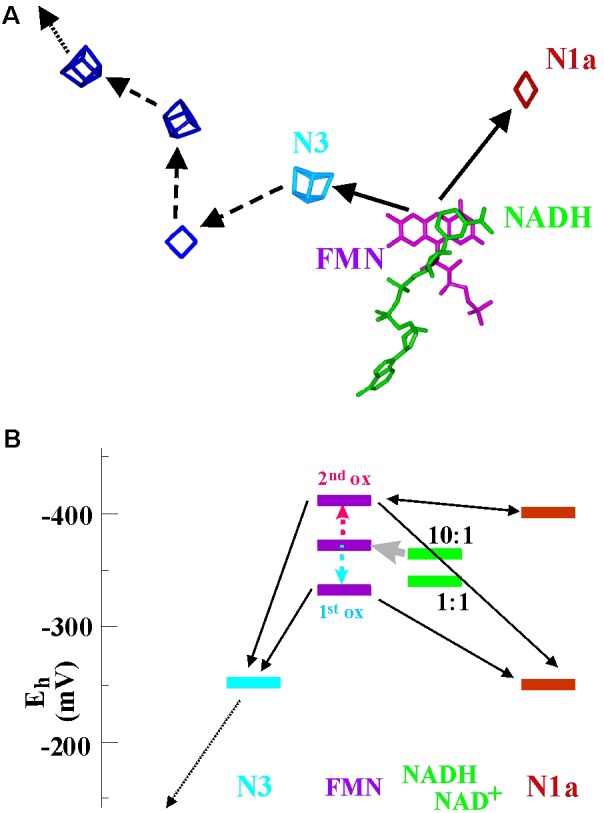
Spatial arrangement (A) and electrochemical landscape (B) of the NuoE/F-module in Complex I. The spatial bifurcation reaction is indicated in (A) by the two continuous arrows while the subsequent electron transfer events down the chain of iron–sulfur centers and toward the quinone (not shown) are marked by dashed and dotted arrows. In (B) two different redox potentials are depicted for cluster N1a, corresponding to the values reported for the mitochondrial and Aquifex aeolicus enzyme (–250 mV) and for the Thermus thermophilus enzyme (–400 mV).
FIGURE 7
FIGURE 7
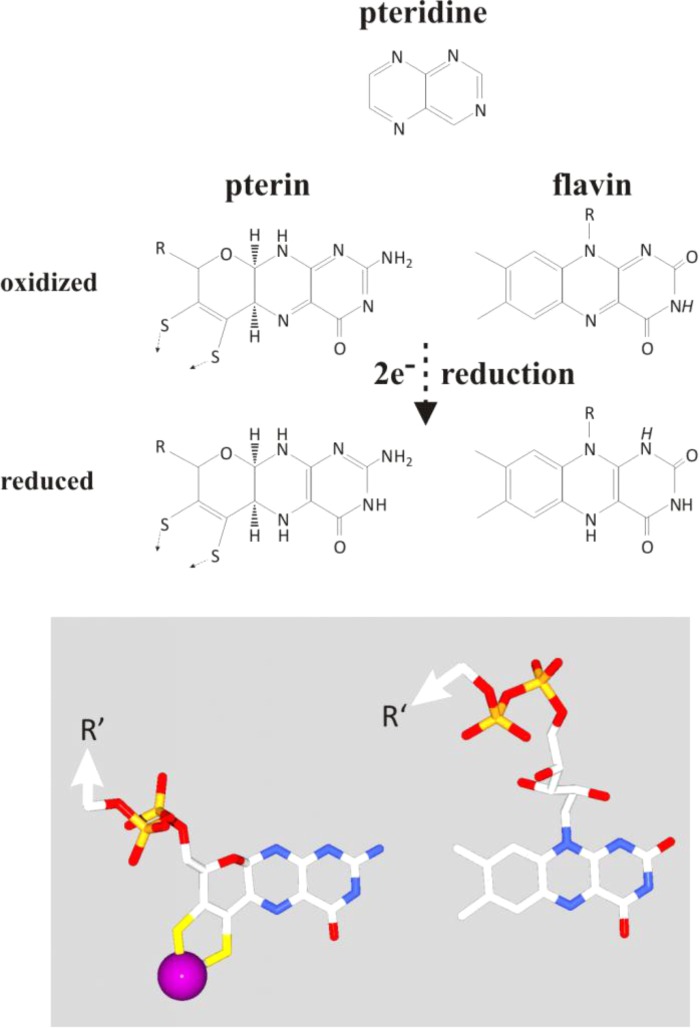
Comparison of the chemical layout (top part) and 3D-conformation (bottom part) of pterins and flavins together with a representation of their precursor-moiety, the pteridine (top). Protons indicated in italics on the flavin molecule feature pK-values in the physiological range of pH.

References

    1. Anbar A. D. (2008). Elements and evolution. Science 322 1481–1483. 10.1126/science.1163100 - DOI - PubMed
    1. Anderson R. F. (1980). Energetics of the one-electron steps in the NAD+/NADH redox couple. Biochim. Biophys. Acta 590 277–281. 10.1016/0005-2728(80)90032-8 - DOI - PubMed
    1. Antony H., Legrand L., Chaussé A. (2008). Carbonate and sulphate green rusts—mechanisms of oxidation and reduction. Electrochim. Acta 53 7146–7156. 10.1016/j.electacta.2008.05.008 - DOI
    1. Appel P. W. U. (1980). On the early Archaean Isua iron-formation, west Greenland. Precambrian Res. 11 73–87. 10.1016/0301-9268(80)90081-9 - DOI
    1. Arrhenius G. O. (2003). Crystals and life. Helv. Chim. Acta 86 1569–1586. 10.1002/hlca.200390135 - DOI

LinkOut - more resources