


Cohort Profile: The Swiss Eosinophilic Esophagitis Cohort Study (SEECS)
- PMID: 30018966
- PMCID: PMC5988195
- DOI: 10.1159/000486131
Cohort Profile: The Swiss Eosinophilic Esophagitis Cohort Study (SEECS)
Abstract
Background and aims: The prospective, observational Swiss Eosinophilic Esophagitis Cohort Study (SEECS) was set up in 2015 with the following goals in mind: (1) to provide up-to-date epidemiologic data; (2) to assess the appropriateness of care; (3) to evaluate the psychosocial impact; and (4) to foster translational research projects. Data capture relies on validated instruments to assess disease activity and focuses on epidemiologic variables and biosamples (esophageal biopsies and blood specimens). An annual inclusion of 70 new patients with eosinophilic esophagitis (EoE) or proton pump inhibitor-responsive esophageal eosinophilia (PPI-REE) is intended. We herein describe the SEECS cohort profile.
Methods: The SEECS includes adult patients (age ≥18 years) with EoE or PPI-REE diagnosed according to published criteria. After inclusion, the patients are typically seen once a year for a clinical and endoscopic/histologic follow-up examination. Data are captured using validated questionnaires. Biosamples from patients with gastroesophageal reflux disease (GERD) and controls with a healthy esophagus are collected as well.
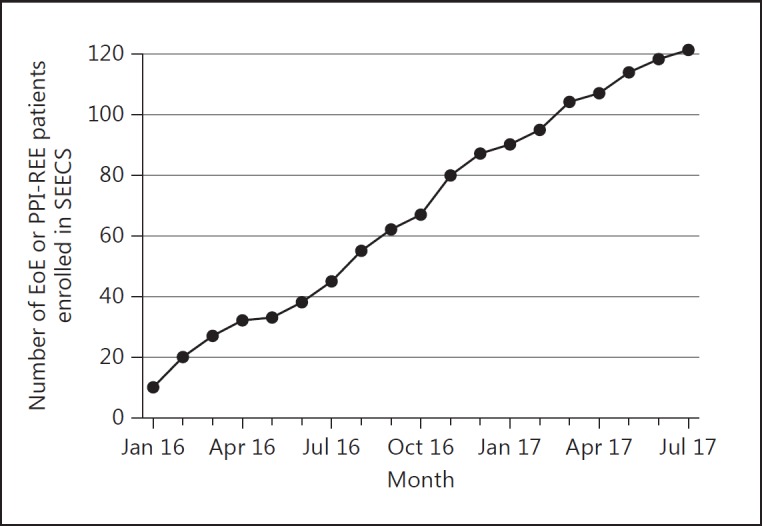
Results: From January 2016 to July 2017, a total of 111 patients with EoE and 10 patients with PPI-REE were recruited. In addition, esophageal biopsies and blood samples from 11 patients with GERD and 20 controls with a healthy esophagus were collected. The mean age of the patients with EoE and those with PPI-REE was 39.6 ± 12.9 and 44.6 ± 15.6 years, respectively. A male predominance was found among both the patients with EoE (77.5%) and those with PPI-REE (70%). Concomitant allergic disorders were found in 79.3% of the patients with EoE and 90% of the patients with PPI-REE. At inclusion, the EoE patients were treated with the following therapeutic regimens: no therapy (0.9%), PPI (36%), swallowed topical corticosteroids (82.9%), elimination diets (15.3%), and esophageal dilation (19.8%).
Conclusions: The SEECS is the first national cohort study of patients with EoE or PPI-REE. The SEECS will provide up-to-date epidemiologic data and foster translational research projects.
Keywords: Cohort profile; Cohort study; Eosinophilic esophagitis; Gastroesophageal reflux disease; Proton pump inhibitor-responsive esophageal eosinophilia.
Figures
References
-
- Attwood SE, Smyrk TC, Demeester TR, Jones JB. Esophageal eosinophilia with dysphagia, a distinct clinicopathologic syndrome. Dig Dis Sci. 1993;38:109–116. - PubMed
-
- Straumann A, Spichtin HP, Bernoulli R, et al. Idiopathic eosinophilic esophagitis: a frequently overlooked disease with typical clinical aspects and discrete endoscopic findings (in German with English abstract) Schweiz Med Wochenschr. 1994;124:1419–1429. - PubMed
-
- Liacouras CA, Furuta GT, Hirano I, et al. Eosinophilic esophagitis: updated consensus recommendations for children and adults. J Allergy Clin Immunol. 2011;128:3–20. - PubMed
-
- Dellon ES, Gonsalves N, Hirano I, et al. ACG clinical guideline: evidenced based approach to the diagnosis and management of esophageal eosinophilia and eosinophilic esophagitis (EoE) Am J Gastroenterol. 2013;108:679–692. - PubMed
LinkOut - more resources
Full Text Sources
Other Literature Sources
