


Presence of the Carcinogen N'-Nitrosonornicotine in Saliva of E-cigarette Users
- PMID: 30019582
- PMCID: PMC8556657
- DOI: 10.1021/acs.chemrestox.8b00089
Presence of the Carcinogen N'-Nitrosonornicotine in Saliva of E-cigarette Users
Abstract
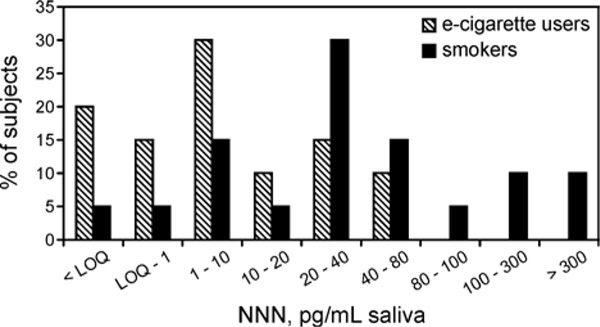
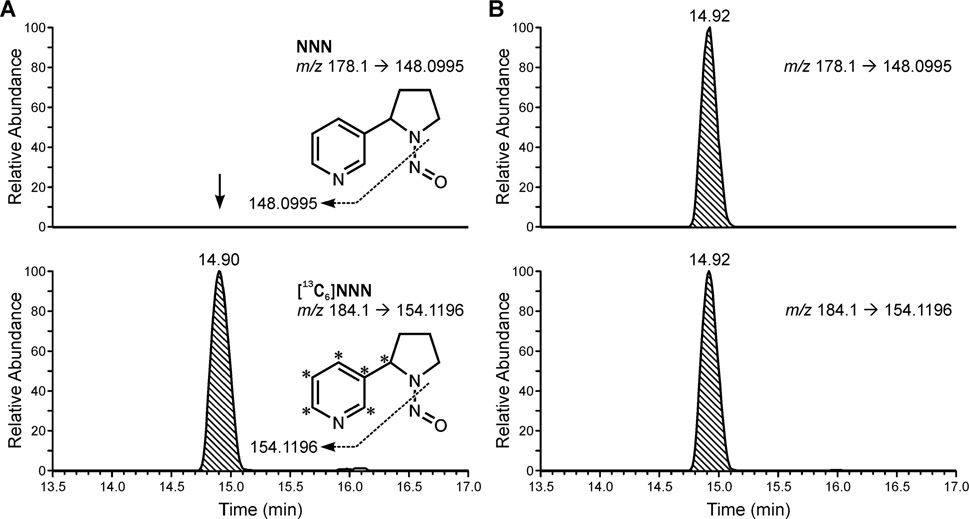
Many harmful constituents are present in e-cigarettes at much lower levels than in cigarette smoke, and the results of analysis of urinary biomarkers in e-cigarette users are consistent with these findings. However, understanding the health effects of chronic exposures to e-cigarette aerosols may require thinking beyond these comparisons. In this study, we investigated the endogenous formation of the tobacco-specific oral and esophageal carcinogen N'-nitrosonornicotine (NNN) in e-cigarette users. Salivary NNN, nornicotine, and nicotine as well as urinary tobacco biomarkers, including total NNN, were analyzed in 20 e-cigarette users, 20 smokers, and 19 nonsmokers. Nornicotine and NNN levels in e-cigarettes used by the study participants were also analyzed. The mean of NNN in saliva of e-cigarette users was 14.6 (±23.1) pg/mL, ranging from nonquantifiable (below the limit of quantitation, LOQ) to 76.0 pg/mL. In smokers, salivary NNN ranged from below LOQ to 739 pg/mL, with 80% of smokers having salivary NNN in the range of levels found in e-cigarette users. Consistent with a previous report, very low levels of urinary total NNN were present in only 5 out of 20 e-cigarette users (ranging from 0.001 to 0.01 pmol/mL urine). Only trace levels of NNN were found in e-cigarette liquids. Together, our findings demonstrate that NNN is formed endogenously in e-cigarette users. While the overall exposure to NNN in e-cigarette users is dramatically lower than in smokers, the known carcinogenic potency of NNN warrants further investigations into the potential consequences of its endogenous formation. Salivary NNN, rather than urinary total NNN, which accounts for only 1-3% of the NNN dose, should be used to monitor e-cigarette users' exposure to this carcinogen.
Conflict of interest statement
Figures
References
-
- Hecht SS, Chen CB, Hirota N, Ornaf RM, Tso TC, and Hoffmann D (1978) Tobacco specific nitrosamines: formation from nicotine in vitro and during tobacco curing and carcinogenicity in strain A mice. J. Natl. Cancer Inst 60, 819–824. - PubMed
-
- Hecht SS (1998) Biochemistry, biology, and carcinogenicity of tobacco-specific N-nitrosamines. Chem. Res. Toxicol 11, 559–603. - PubMed
-
- Hoffmann D, Raineri R, Hecht SS, Maronpot R, and Wynder EL (1975) Effects of N’-nitrosonornicotine and N’-nitrosoanabasine in rats. J. Natl. Cancer Inst 55, 977–981. - PubMed
-
- Hecht SS, Young R, and Maeura Y (1983) Comparative carcinogenicity in F344 rats and Syrian golden hamsters of N’-nitrosonornicotine and N’-nitrosonornicotine-1-N-oxide. Cancer Lett 20, 333–340. - PubMed
-
- Hecht SS, Chen CB, Ohmori T, and Hoffmann D (1980) Comparative carcinogenicity in F344 rats of the tobacco specific nitrosamines, N’-nitrosonornicotine and 4-(N-methyl-N-nitrosamino)-1-(3-pyridyl)-1-butanone. Cancer Res 40, 298–302. - PubMed
Publication types
MeSH terms
Substances
Grants and funding
LinkOut - more resources
Full Text Sources
Other Literature Sources
Medical
