As Safe as Possible (ASAP): A Brief App-Supported Inpatient Intervention to Prevent Postdischarge Suicidal Behavior in Hospitalized, Suicidal Adolescents
- PMID: 30021457
- PMCID: PMC6169524
- DOI: 10.1176/appi.ajp.2018.17101151
As Safe as Possible (ASAP): A Brief App-Supported Inpatient Intervention to Prevent Postdischarge Suicidal Behavior in Hospitalized, Suicidal Adolescents
Erratum in
-
Corrections to Kennard et al., Pham et al., Brent et al.Am J Psychiatry. 2019 Sep 1;176(9):764. doi: 10.1176/appi.ajp.2019.1769correction. Am J Psychiatry. 2019. PMID: 31474123 No abstract available.
Abstract
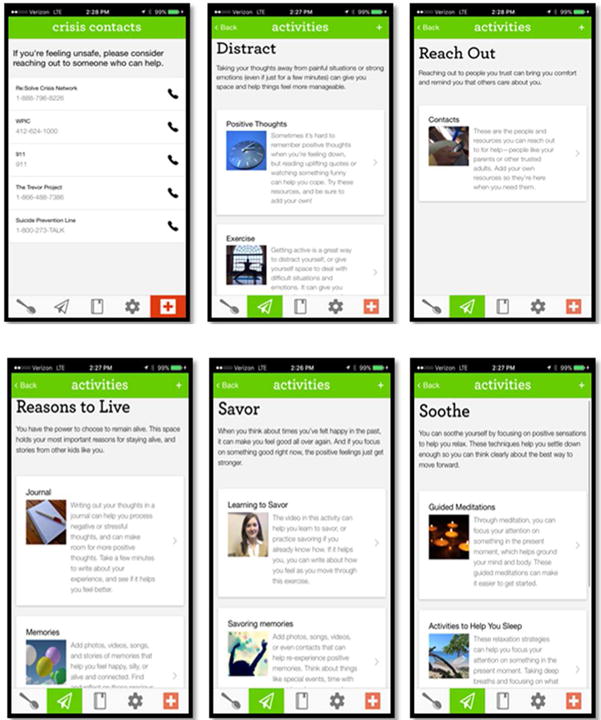
Objective: The authors report on a pilot study of an inpatient intervention for suicidal adolescents, As Safe as Possible (ASAP), supported by a smartphone app (BRITE) to reduce suicide attempts following hospital discharge.
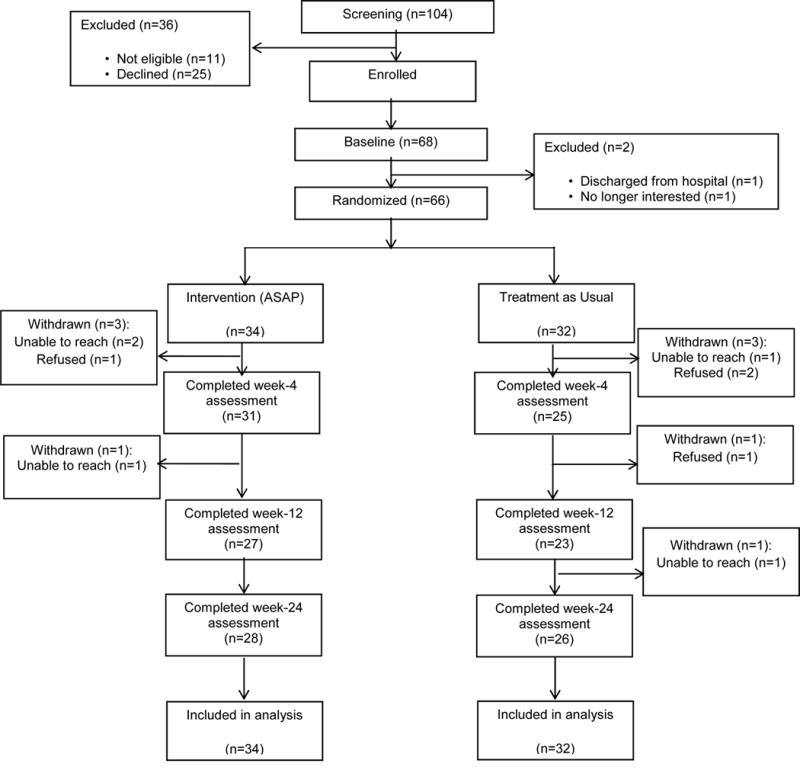
Method: Across two sites, 66 adolescents hospitalized for suicidal ideation (N=26) or a recent suicide attempt (N=40) were randomly assigned to the ASAP intervention program plus treatment as usual or to treatment as usual alone. ASAP, which focuses on emotion regulation and safety planning, is a 3-hour intervention delivered on the inpatient unit. The BRITE app prompted participants to rate their level of emotional distress on a daily basis and provided personalized strategies for emotion regulation and safety planning. A blind, independent evaluator assessed suicide attempts following hospital discharge and suicidal ideation at 4, 12, and 24 weeks after discharge.
Results: The ASAP intervention did not have a statistically significant effect on suicide attempt, although findings were in the hypothesized direction for occurrence of an attempt (16% compared with 31%; χ2=1.86, df=1, g=-0.36) and time to an attempt (hazard ratio=0.49, 95% CI=0.16, 1.47). Past history of a suicide attempt was a significant moderator of treatment outcome, with a stronger, albeit nonsignificant, effect of the ASAP intervention among participants with a history of suicide attempt (hazard ratio=0.23, 95% CI=0.05, 1.09). There were no treatment effects on suicidal ideation. The majority of participants (70%) used the BRITE app (median usage, 19 times). Participants reported high satisfaction with both the intervention and the app.
Conclusions: The ASAP intervention program shows promise in reducing the incidence of postdischarge suicide attempts among adolescents hospitalized for suicidality and merits further study.
Trial registration: ClinicalTrials.gov NCT02272179.
Keywords: Adolescents; Inpatient Intervention; Phone Application; Suicide Prevention.
Conflict of interest statement
The other authors report no conflict of interests or financial disclosures.
Figures
Comment in
-
Suicide Attempt Prevention: A Technology-Enhanced Intervention for Treating Suicidal Adolescents After Hospitalization.Am J Psychiatry. 2018 Sep 1;175(9):817-819. doi: 10.1176/appi.ajp.2018.18050554. Am J Psychiatry. 2018. PMID: 30173549 No abstract available.
References
-
- WISQARS Leading Causes of Death. Centers for Disease Control and Prevention. From http://webappa.cdc.gov/sasweb/ncipc/leadcaus10_us.html Published June 24, 2015.
-
- Curtin SC, Warner M, Hedegaard H. Increase in suicide in the United States, 1999–2014. Hyattsville, MD: National Center for Health Statistics; 2016. (NCHS data brief, no 241).
-
- Han B, Compton WM, Blanco C, Colpe L, Huang L, McKeon R. National trends in the prevalence of suicidal ideation and behavior among young adults and receipt of mental health care among suicidal young adults. J Am Acad Child Adolesc Psychiatry. 2018;57:20–27. - PubMed
-
- Shain BN. American Academy of Pediatrics Committee on Adolescence: Suicide and suicide attempts in adolescents. Pediatrics. 2016;138(1):e20161420.
Publication types
MeSH terms
Associated data
Grants and funding
LinkOut - more resources
Full Text Sources
Other Literature Sources
Medical
Research Materials
Miscellaneous