


Differences of Four Work-Related Behavior and Experience Patterns in Work Ability and Other Work-Related Perceptions in a Finance Company
- PMID: 30022016
- PMCID: PMC6068895
- DOI: 10.3390/ijerph15071521
Differences of Four Work-Related Behavior and Experience Patterns in Work Ability and Other Work-Related Perceptions in a Finance Company
Abstract
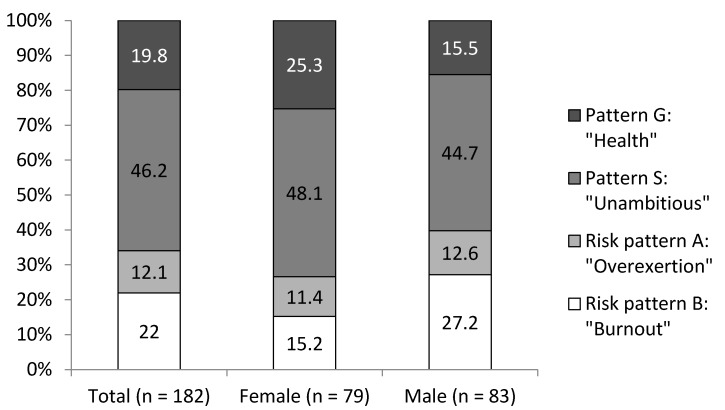
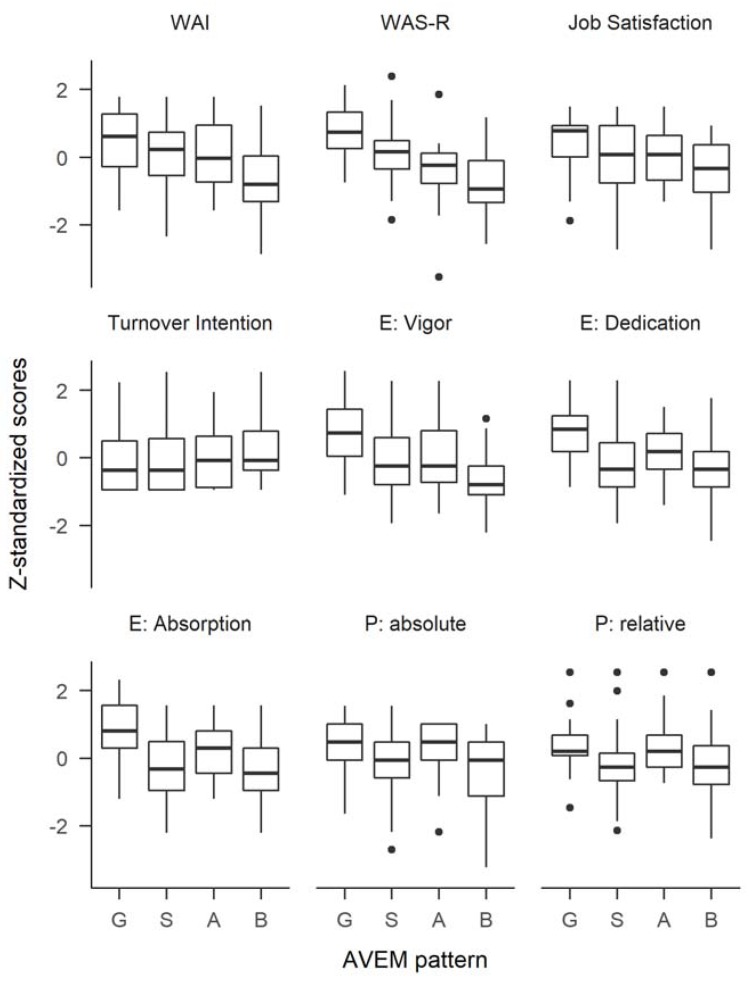
The present study applies a salutogenetic approach to psycho-social stress and wellbeing at work and for the first time analyzes the relation of an extended model of four work-related behavior and experience patterns to work related perceptions, like work ability, job satisfaction and turnover intention, or engagement. Employees of an international financial services company (N = 182) completed the questionnaire Work-related behavior and experience pattern (Arbeitsbezogenes Verhaltens- und Erlebensmuster; AVEM). The AVEM has oftentimes been used for research in helping professions, but research in non-helping professions is scarce. In addition to the AVEM, measures of job satisfaction, work ability, work engagement, presenteeism, and turnover intention were included in this study. Almost half (46.2%) of the sample showed a rather unambitious attitude towards work, followed by a burnout-related risk pattern (22.0%), a healthy pattern (19.8%), and a pattern at risk for overexertion (12.1%). Significantly more favorable scores were found for all work-related perceptions in participants with the healthy pattern compared to those with the burnout-related risk pattern, except for turnover intention where no significant differences were found. For work ability and vigor, those with a healthy pattern also had significantly higher scores than those with an unambitious pattern and a pattern at risk for overexertion. Being at risk for burnout not only affects job-related wellbeing and coping resources, but also work ability and work engagement. A need for personnel and organizational development and health promotion is indicated by a high number of individuals with reduced working motivation and risk patterns for overexertion or burnout.
Keywords: behavior and experience patterns; job satisfaction; non-helping profession; presenteeism; work ability; work engagement.
Conflict of interest statement
The authors declare no conflict of interest.
Figures
References
-
- Knieps F., Pfaff H., editors. Digitale Arbeit—Digitale Gesundheit. BKK Gesundheitsreport 2017 [Digital Work—DIGITAL health: BKK Health Report 2017] Medizinisch Wissenschaftliche Verlagsgesellschaft; Berlin, Germany: 2017.
-
- Nöllenheidt C. Arbeitswelt im Wandel. Zahlen-Daten-Fakten (Changing World of Work: Facts and Figures) Federal Institute for Occupational Safety and Health; Dortmund, Germany: 2013.
-
- Bußmann S., Seyda S. Fachkräfteengpässe in Unternehmen [Shortage of skilled workers]. Die Altersstruktur in Engpassberufen (The Age Distribution in Bottleneck Jobs) Institut der deutschen Wirtschaft Köln e.V.; Köln, Germany: 2014.
Publication types
MeSH terms
LinkOut - more resources
Full Text Sources
Other Literature Sources
Medical
