


Protocol and pilot study of a short message service-guided training after acute stroke/transient ischemic attack to increase walking capacity and physical activity
- PMID: 30023162
- PMCID: PMC6046608
- DOI: 10.1016/j.pmedr.2018.05.016
Protocol and pilot study of a short message service-guided training after acute stroke/transient ischemic attack to increase walking capacity and physical activity
Abstract
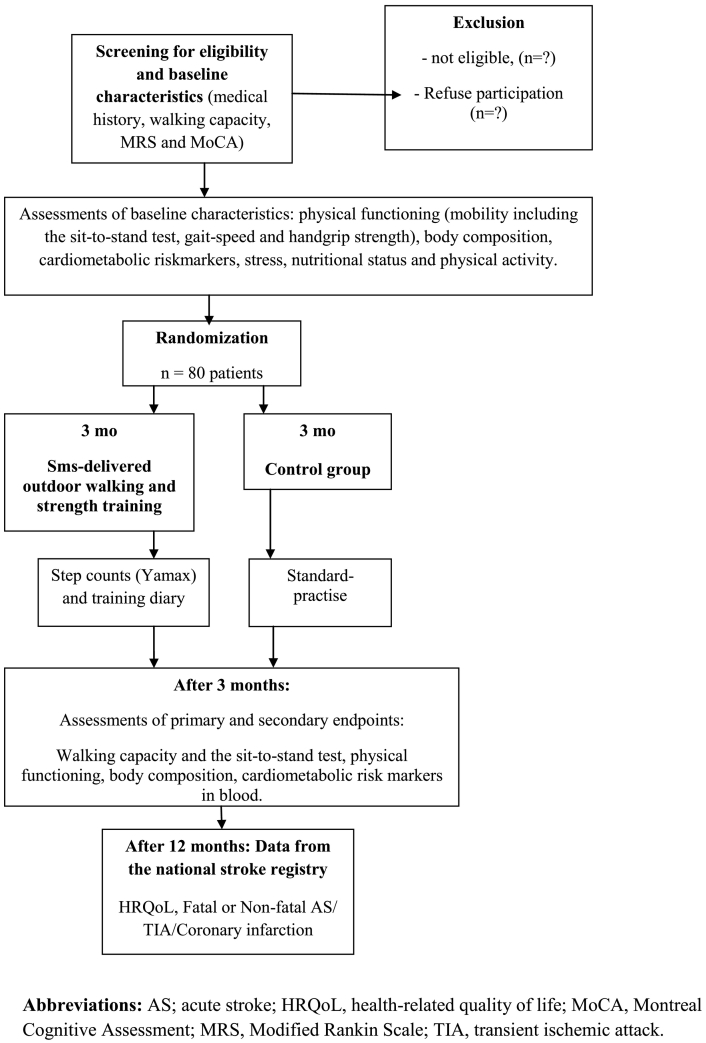
Physical activity in community-living individuals after a stroke is usually scarce. This protocol describes a study that will evaluate a method to increase physical activity by performing a 3-month outdoor walking and muscle strengthening program and will examine the 3-month and 1-year effects of this program on individuals with acute stroke (AS) or transient ischemic attack (TIA). In a prospective randomized controlled trial in Uppsala, Sweden, 80 individuals with AS or TIA who maintained cognitive and motor function will be randomized into groups for continuous training for three months or for regular standard care. The training will be supervised by daily cellphone-delivered messages (short message services; SMS), and the intensity, duration and workload will be gradually increased. The primary outcome is a change in walking capacity according to the 6-Minute Walk Test and chair-rising at three months. Secondary outcomes include mobility, gait speed, handgrip strength, body composition (fat mass and muscle mass), biochemical risk-markers, health-related quality of life, and cardiovascular events. Adherence to the training program will be documented with a self-reported diary and step counts over two weeks. The major study started in November 2016, and results are expected in 2019. In a pilot study of 15 subjects post-stroke (mean-age 65 years), we observed improved walking capacity (increasing from 23 to 255 m) and chair-rising (decreasing 2.42 s) from baseline to three months. SMS-guided outdoor training will be tested as a potential therapeutic strategy to increase physical activity and thereby improve walking capacity and physical function following a stroke.
Keywords: Acute stroke; Body composition; Mobility; Physical activity; Transient ischemic attack; Walking capacity.
Figures
References
-
- ATS statement: guidelines for the six-minute walk testAm. J. Respir. Crit. Care Med. 2002;166(1):111–117. - PubMed
-
- Banks J.L., Marotta C.A. Outcomes validity and reliability of the modified Rankin scale: implications for stroke clinical trials: a literature review and synthesis. Stroke. 2007;38(3):1091–1096. - PubMed
-
- Bellace J.V., Healy D., Besser M.P., Byron T., Hohman L. Validity of the Dexter Evaluation System's Jamar dynamometer attachment for assessment of hand grip strength in a normal population. J. Hand Ther. 2000;13(1):46–51. - PubMed
-
- Billinger S.A., Arena R., Bernhardt J. Physical activity and exercise recommendations for stroke survivors: a statement for healthcare professionals from the American Heart Association/American Stroke Association. Stroke. 2014;45(8):2532–2553. - PubMed
-
- Borg G.A. Psychophysical bases of perceived exertion. Med. Sci. Sports Exerc. 1982;14(5):377–381. - PubMed
LinkOut - more resources
Full Text Sources
Other Literature Sources
Research Materials
