Opioid Overdose Mortality Among Former North Carolina Inmates: 2000-2015
- PMID: 30024795
- PMCID: PMC6085027
- DOI: 10.2105/AJPH.2018.304514
Opioid Overdose Mortality Among Former North Carolina Inmates: 2000-2015
Abstract
Objectives: To examine differences in rates of opioid overdose death (OOD) between former North Carolina (NC) inmates and NC residents and evaluate factors associated with postrelease OOD.
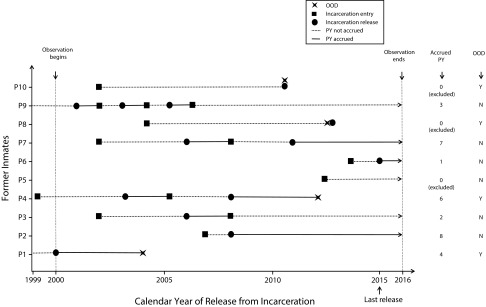
Methods: We linked NC inmate release data to NC death records, calculated OOD standardized mortality ratios to compare former inmates with NC residents, and calculated hazard ratios to identify predictors of time to OOD.
Results: Of the 229 274 former inmates released during 2000 to 2015, 1329 died from OOD after release. At 2-weeks, 1-year, and complete follow-up after release, the respective OOD risk among former inmates was 40 (95% confidence interval [CI] = 30, 51), 11 (95% CI = 9.5, 12), and 8.3 (95% CI = 7.8, 8.7) times as high as general NC residents; the corresponding heroin overdose death risk among former inmates was 74 (95% CI = 43, 106), 18 (95% CI = 15, 21), and 14 (95% CI = 13, 16) times as high as general NC residents, respectively. Former inmates at greatest OOD risk were those within the first 2 weeks after release, aged 26 to 50 years, male, White, with more than 2 previous prison terms, and who received in-prison mental health and substance abuse treatment.
Conclusions: Former inmates are highly vulnerable to opioids and need urgent prevention measures.
Figures

References
-
- Centers for Disease Control and Prevention. Annual Surveillance Report of Drug-Related Risks and Outcomes—United States, 2017. Available at: https://www.cdc.gov/drugoverdose/pdf/pubs/2017-cdc-drug-surveillance-rep.... Accessed August 30, 2017.
-
- Rudd RA, Seth P, David F, Scholl L. Increases in drug and opioid-involved overdose deaths—United States, 2010–2015. MMWR Morb Mortal Wkly Rep. 2016;65(5051):1445–1452. - PubMed
-
- Wildeman C, Wang EA. Mass incarceration, public health, and widening inequality in the USA. Lancet. 2017;389(10077):1464–1474. - PubMed
-
- Kaeble D, Glaze L. Correctional populations in the United States, 2015 (NCJ 250374). US Department of Justice, Office of Justice Programs, Bureau of Justice Statistics. 2016. Available at: https://www.bjs.gov/content/pub/pdf/cpus15.pdf. Accessed August 5, 2017.
Publication types
MeSH terms
Substances
Grants and funding
LinkOut - more resources
Full Text Sources
Other Literature Sources