Review
. 2018 Jul;97(3):795-806.

Shared mechanisms among neurodegenerative diseases: from genetic factors to gene networks

Affiliations
Review

Shared mechanisms among neurodegenerative diseases: from genetic factors to gene networks

Douglas Arneson et al. J Genet. 2018 Jul.

Abstract

Neurodegenerative diseases such as Alzheimer's disease, Parkinson's disease, and amyotrophic lateral sclerosis are pressing health concerns in modern societies for which effective therapies are still lacking. Recent high-throughput genomic technologies have enabled genome-scale, multidimensional investigations to facilitate a better understanding of the underlying mechanisms and the identification of novel targets. Here we review the molecular insights gained through such studies, and compare the similarities and differences between neurodegenerative diseases revealed by systems genomics and gene network modelling approaches. We focus specifically on the shared mechanisms at multiple molecular scales ranging from genetic factors to gene expression to network-level features of gene regulation, and whenever possible also point out mechanisms that distinguish one disease from another. Our review sets the stage for similar genomewide inspection in the future on shared/distinct features of neurodegenerative diseases at the levels of cellular, proteomic or epigenomic signatures, and how these features may interact to determine the progression and treatment response of different diseases afflicting the same individual.


Figures

Figure 1.
Figure 1.
Overlap among GWAS genetic signals of AD, ALS and PD at SNP, candidate gene and pathway levels. Overlap among different diseases based on overlap among each disease’s (a) GWAS-associated genomewide significant (P<5 × 10⁻⁸) SNPs, (b) candidate genes mapped to the genomewide significant disease SNPs, and (c) pathways over-represented in the candidate disease genes. (d) Q–Q plot showing that the significant PD SNPs (P ≤ 5 × 10⁻⁸) collectivelyin demonstrate more significant association with AD AD GWAS (based on the full summary statistics from the IGAP stage1 study (Lambert et al. 2013)) compared to random expectation (P = 0.01 based on the Kolmogorov–Smirnov or KS test). (e) Q–Q plot showing that the significant ALS SNPs (P ≤ 5 × 10⁻⁸) do not collectively demonstrate more significant association with AD in AD GWAS (based on the full summary statistics from the IGAP stage1 study (Lambert et al. 2013)) compared to random expectation (P = 0.59 based on KS test).
Figure 2.
Figure 2.
Overlap of differentially expressed genes in neurodegenerative diseases. Overlap of meta analyses of all possible combinations of three of the following diseases: AD, ALS, HD and PD. Three hundred and twenty two genes were consistently found across all four meta-analyses, and the enriched pathways of these conserved genes are shown. Note that these 322 conserved genes differ from the 243 consistent genes reported in the original study (Li et al. 2014) due to some differences in methodology, i.e. our approach of overlapping genes from the four meta analyses shown in this figure (as necessitated by the lack of ready availability of individual disease gene signatures from the original study) differs from the original study’s approach of a single meta-analysis of all four diseases followed by validation in a replication cohort to derive the consistent genes.
Figure 3.
Figure 3.
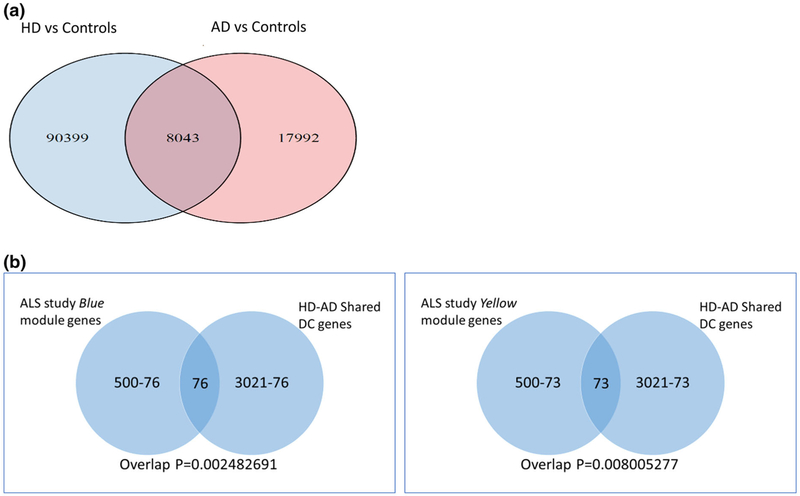
Shared network-level dysregulation in AD, HD and ALS. (a) The number of transcriptional network disruptions (DC or differential coexpression gene–gene relations) that were identified in our previous study (Narayanan et al. 2014) as AD-specific, HD-specific, or shared between both diseases are shown. The shared DC network comprised 8043 DC relations as shown (involving 3021 genes), and contained a majority of LOC relations, since the proportion of LOC among all DC relations in the AD, HD and shared DC networks were 33%, 19% and 51%, respectively. (b) Overlap of two coexpression network module genes identified from blood gene expression analysis of multiple ALS cohorts (Saris et al. 2009) with the HD–AD shared DC network genes (Narayanan et al. 2014). The hypergeometric distribution based overlap P values compare the overlap of the module genes against the overlap rate of background genes (note that 1711 of the 15,462 ALS study background genes overlapped with the set of 3021 HD–AD shared DC genes).

References

    1. Al-Chalabi A, Fang F., Hanby MF, Leigh PN, Shaw CE et al. 2010. An estimate of amyotrophic lateral sclerosis heritability using twin data. J. Neurol. Neurosurg. Psychiatry 81, 1324–1326. - PMC - PubMed
    1. Bertram L and Tanzi RE 2005. The genetic epidemiology of neurodegenerative disease. J. Clin. Invest 115, 1449–1457. - PMC - PubMed
    1. Brown BC, A. G. E. N. Type 2 Diabetes Consortium, Ye CJ,Price AL and Zaitlen N 2016. Transethnic genetic-correlation estimates from summary statistics. Am. J. Hum. Genet 99, 76–88. - PMC - PubMed
    1. Cooper-Knock J, Kirby J, Ferraiuolo L, Heath PR, Rattray M and Shaw PJ 2012. Gene expression profiling in human neurodegenerative disease. Nat. Rev. Neurol 8, 518–530. - PubMed
    1. Fortune MD, Guo H, Burren O, Schofield E, Walker NM and Ban M 2015. Statistical colocalization of genetic risk variants for related autoimmune diseases in the context of common controls. Nat. Genet 47, 839–846. - PMC - PubMed

MeSH terms