Review
. 2018 Jul 19;10(7):921.
doi: 10.3390/nu10070921.

l-Citrulline Supplementation: Impact on Cardiometabolic Health

Affiliations
Review

l-Citrulline Supplementation: Impact on Cardiometabolic Health

Timothy D Allerton et al. Nutrients. .

Abstract

Diminished bioavailability of nitric oxide (NO), the gaseous signaling molecule involved in the regulation of numerous vital biological functions, contributes to the development and progression of multiple age- and lifestyle-related diseases. While l-arginine is the precursor for the synthesis of NO by endothelial-nitric oxide synthase (eNOS), oral l-arginine supplementation is largely ineffective at increasing NO synthesis and/or bioavailability for a variety of reasons. l-citrulline, found in high concentrations in watermelon, is a neutral alpha-amino acid formed by enzymes in the mitochondria that also serves as a substrate for recycling l-arginine. Unlike l-arginine, l-citrulline is not quantitatively extracted from the gastrointestinal tract (i.e., enterocytes) or liver and its supplementation is therefore more effective at increasing l-arginine levels and NO synthesis. Supplementation with l-citrulline has shown promise as a blood pressure lowering intervention (both resting and stress-induced) in adults with pre-/hypertension, with pre-clinical (animal) evidence for atherogenic-endothelial protection. Preliminary evidence is also available for l-citrulline-induced benefits to muscle and metabolic health (via vascular and non-vascular pathways) in susceptible/older populations. In this review, we examine the impact of supplementing this important urea cycle intermediate on cardiovascular and metabolic health outcomes and identify future directions for investigating its therapeutic impact on cardiometabolic health.

Keywords: adipocytes; aging; arginine; cardiovascular disease; diabetes; endothelial function; enterocytes; flow mediated dilation; hypertension; immune cells; inflammation; insulin resistance; interventions; liver; mitochondria; muscle; nitric oxide; obesity; supplements; therapeutics; watermelon.


Conflict of interest statement

The authors declare no conflict of interest.

Figures
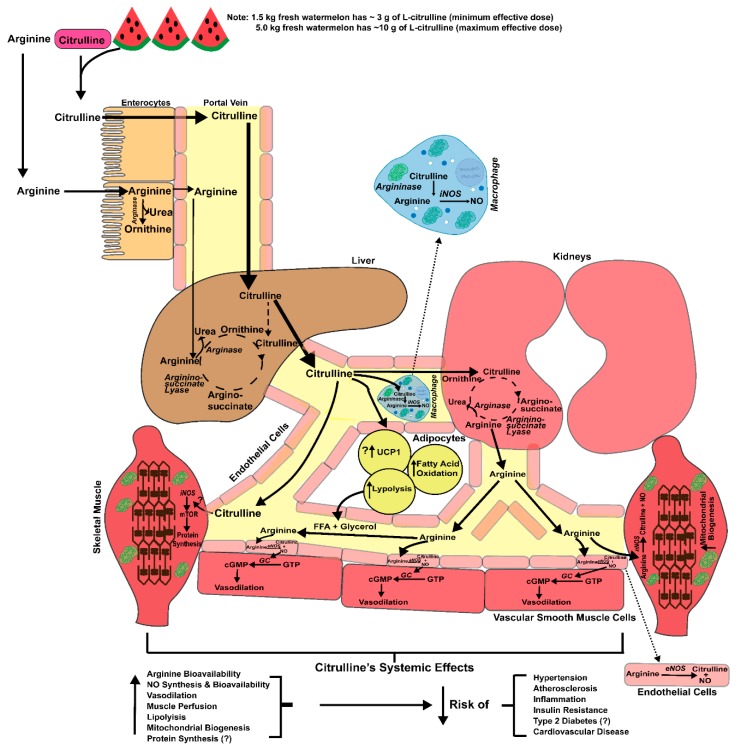
Figure 1
Figure 1
Comparison of oral l-citrulline (via pharmaceutical/nutraceutical grade l-citrulline or watermelon products) versus oral l-arginine. The activity of the arginase enzyme located in the enterocytes of intestines and liver (first-pass extraction) substantially reduces the availability of oral l-arginine, instead yielding increased urea and l-ornithine production. l-citrulline is not acted on by arginase enzyme or first-pass extraction but is converted to l-arginine by argininosuccinate lyase in the kidneys. Increased circulating l-arginine serves a substrate for the eNOS to produce nitric oxide (NO) and increase smooth muscle vasodilation. l-citrulline may directly activate inducible nitric oxide synthase (iNOS) in skeletal muscle and increase protein synthesis via mTOR activation. l-citrulline may indirectly activate neuronal nitric oxide synthase (nNOS) in skeletal muscle leading to increases in NO and stimulation of mitochondrial biogenesis. l-citrulline has reported actions on adipose tissue to increase lipolysis, fatty acid oxidation, and uncoupling protein 1 (UCP1) expression. l-citrulline has also been reported to indirectly activate iNOS in activated macrophages and increase NO production. l-citrulline’s systemic effects positively impact hypertension, atherosclerosis, inflammation, insulin resistance, type 2 diabetes, and cardiovascular disease. Emerging evidence also suggests that l -citrulline itself can positively impact skeletal muscle and adipose tissue to improve metabolic syndrome. This figure was partially modified from Irving and Spielmann (2016) [13].
Figure 2
Figure 2
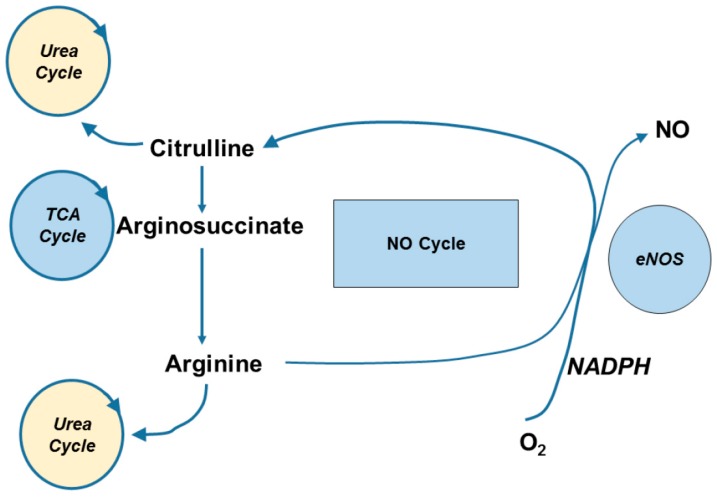
Nitric Oxide (NO) Cycle. Schematic representation of the NO cycle.

References

    1. Brandes R.P., Fleming I., Busse R. Endothelial aging. Cardiovasc. Res. 2005;66:286–294. doi: 10.1016/j.cardiores.2004.12.027. - DOI - PubMed
    1. Forte P., Copland M., Smith L.M., Milne E., Sutherland J., Benjamin N. Basal nitric oxide synthesis in essential hypertension. Lancet. 1997;349:837–842. doi: 10.1016/S0140-6736(96)07631-3. - DOI - PubMed
    1. Rajapakse N.W., Karim F., Straznicky N.E., Fernandez S., Evans R.G., Head G.A., Kaye D.M. Augmented endothelial-specific l-arginine transport prevents obesity-induced hypertension. Acta Physiol. 2014;212:39–48. doi: 10.1111/apha.12344. - DOI - PubMed
    1. Halcox J.P., Schenke W.H., Zalos G., Mincemoyer R., Prasad A., Waclawiw M.A., Nour K.R., Quyyumi A.A. Prognostic value of coronary vascular endothelial dysfunction. Circulation. 2002;106:653–658. doi: 10.1161/01.CIR.0000025404.78001.D8. - DOI - PubMed
    1. Hardy T.A., May J.M. Coordinate regulation of l-arginine uptake and nitric oxide synthase activity in cultured endothelial cells. Free Radic. Biol. Med. 2002;32:122–131. doi: 10.1016/S0891-5849(01)00781-X. - DOI - PubMed

MeSH terms

LinkOut - more resources