Platelet transfusions improve hemostasis and survival in a substudy of the prospective, randomized PROPPR trial
- PMID: 30030268
- PMCID: PMC6058234
- DOI: 10.1182/bloodadvances.2018017699
Platelet transfusions improve hemostasis and survival in a substudy of the prospective, randomized PROPPR trial
Abstract
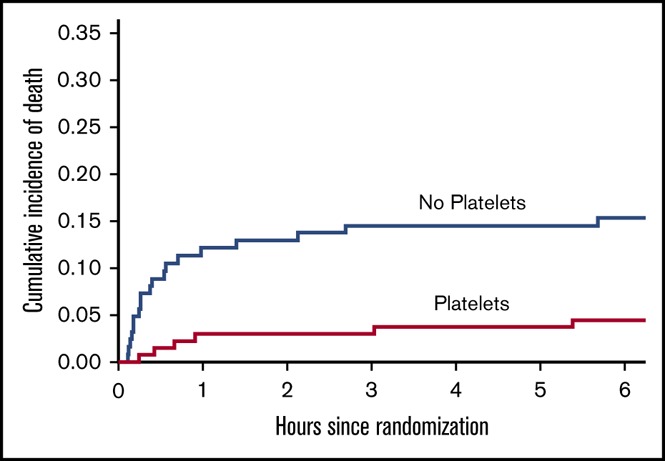
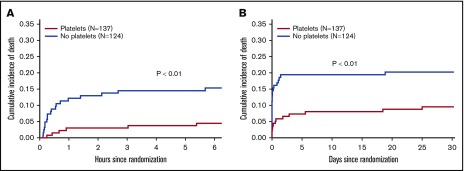
Transfusing platelets during massive hemorrhage is debated because of a lack of high-quality evidence concerning outcomes in trauma patients. The objective of this study was to examine the effect of platelet transfusions on mortality in severely injured trauma patients. This work analyzed PROPPR (Pragmatic, Randomized Optimal Platelet and Plasma Ratios) trial patients who received only the first cooler of blood products, which either did or did not contain platelets. Primary outcomes were all-cause mortality at 24 hours and 30 days and hemostasis. Secondary outcomes included cause of death, complications, and hospital-, intensive care unit (ICU)-, and ventilator-free days. Continuous variables were compared using Wilcoxon rank sum tests. Categorical variables were compared using Fisher's exact tests. There were 261 PROPPR patients who achieved hemostasis or died before receiving a second cooler of blood products (137 received platelets and 124 did not). Patients who received platelets also received more total plasma (median, 3 vs 2 U; P < .05) by PROPPR intervention design. There were no differences in total red blood cell transfusions between groups. After controlling for plasma volume, patients who received platelets had significantly decreased 24-hour (5.8% vs 16.9%; P < .05) and 30-day mortality (9.5% vs 20.2%; P < .05). More patients in the platelet group achieved hemostasis (94.9% vs 73.4%; P < .01), and fewer died as a result of exsanguination (1.5% vs 12.9%; P < .01). Patients who received platelets had a shorter time on mechanical ventilation (P < .05); however, no differences in hospital- or ICU-free days were observed. In conclusion, early platelet administration is associated with improved hemostasis and reduced mortality in severely injured, bleeding patients. This trial was registered at www.clinicaltrials.gov as # NCT01545232.
© 2018 by The American Society of Hematology.
Conflict of interest statement
Conflict-of-interest disclosure: The authors declare no competing financial interests.
Figures
References
-
- Sauaia A, Moore FA, Moore EE, et al. Epidemiology of trauma deaths: a reassessment. J Trauma. 1995;38(2):185-193. - PubMed
-
- D’Angelo MR, Dutton RP. Management of trauma-induced coagulopathy: trends and practices. AANA J. 2010;78(1):35-40. - PubMed
-
- Brohi K. Trauma induced coagulopathy. J R Army Med Corps. 2009;155(4):320-322. - PubMed
-
- Brohi K, Cohen MJ, Davenport RA. Acute coagulopathy of trauma: mechanism, identification and effect. Curr Opin Crit Care. 2007;13(6):680-685. - PubMed
-
- Brohi K, Cohen MJ, Ganter MT, et al. Acute coagulopathy of trauma: hypoperfusion induces systemic anticoagulation and hyperfibrinolysis. J Trauma. 2008;64(5):1211-1217, discussion 1217. - PubMed
Publication types
MeSH terms
Associated data
Grants and funding
LinkOut - more resources
Full Text Sources
Other Literature Sources
Medical