Incident Atrial Fibrillation and the Risk of Stroke in Adults with Chronic Kidney Disease: The Stockholm CREAtinine Measurements (SCREAM) Project
- PMID: 30030271
- PMCID: PMC6140568
- DOI: 10.2215/CJN.04060318
Incident Atrial Fibrillation and the Risk of Stroke in Adults with Chronic Kidney Disease: The Stockholm CREAtinine Measurements (SCREAM) Project
Abstract
Background and objectives: Patients with CKD have a high risk of atrial fibrillation. Both CKD and atrial fibrillation are associated with higher risk of stroke and death. However, the effect of incident atrial fibrillation on stroke risk among patients with CKD is unknown.
Design, setting, participants, & measurements: Our study included adults with CKD (eGFR<60 ml/min per 1.73 m2) without previously documented atrial fibrillation who had been in contact with health care in Stockholm, Sweden during 2006-2011. Incident atrial fibrillation was identified by administrative diagnostic codes in outpatient or inpatient care and treated as a time-updated exposure in the analysis of stroke and death risk. Stroke events and deaths were ascertained from regional and national registers with complete coverage. Covariates included demographics, comorbidities, therapeutic procedures, and medications. Multivariable Cox regression analysis and competing risk analysis (accounting for death) were used to estimate the association between incident atrial fibrillation and stroke.
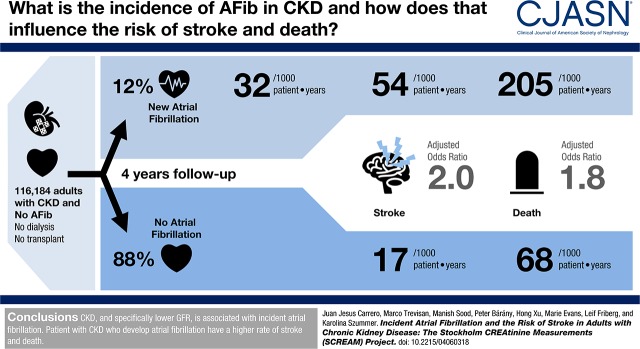
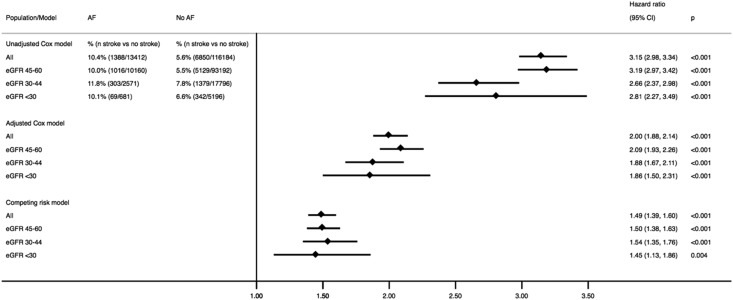
Results: Among 116,184 adults with CKD, 13,412 (12%) developed clinically recognized atrial fibrillation during a mean follow-up of 3.9 years (interquartile range, 2.3-5.7 years). Incidence of atrial fibrillation increased across lower eGFR strata: from 29.4 to 46.3 atrial fibrillations per 1000 person-years in subjects with eGFR=45-60 and <30 ml/min per 1.73 m2, respectively; 1388 (53.8 per 1000 person-years) cases of stroke and 5592 (205.1 per 1000 person-years) deaths occurred after incident atrial fibrillation compared with 6850 (16.6 per 1000 person-years) cases of stroke and 28,613 (67.5 per 1000 person-years) deaths during periods without atrial fibrillation. After adjustment, incident atrial fibrillation was associated with higher risk of stroke (hazard ratio, 2.00; 95% confidence interval, 1.88 to 2.14) and death (hazard ratio, 1.76; 95% confidence interval, 1.71 to 1.82). This was attributed to both ischemic stroke (hazard ratio, 2.11; 95% confidence interval, 1.96 to 2.28) and intracranial bleeds (hazard ratio, 1.64; 95% confidence interval, 1.42 to 1.90). Stroke risk was similar across all eGFR strata. In competing risk analyses accounting for death, the association between incident atrial fibrillation and stroke was attenuated but remained higher (subhazard ratio, 1.49; 95% confidence interval, 1.39 to 1.60).
Conclusions: Patients with CKD who develop atrial fibrillation are at higher risk of stroke and death.
Keywords: Atrial Fibrillation; Brain Ischemia; Follow-Up Studies; Incidence; Intracranial Hemorrhages; Patient Care; Renal Insufficiency, Chronic; Risk; Stroke; cardiovascular disease; chronic kidney disease; glomerular filtration rate.
Copyright © 2018 by the American Society of Nephrology.
Figures
References
-
- Eckardt KU, Coresh J, Devuyst O, Johnson RJ, Köttgen A, Levey AS, Levin A: Evolving importance of kidney disease: From subspecialty to global health burden. Lancet 382: 158–169, 2013 - PubMed
-
- Bonde AN, Lip GY, Kamper AL, Fosbøl EL, Staerk L, Carlson N, Torp-Pedersen C, Gislason G, Olesen JB: Renal function and the risk of stroke and bleeding in patients with atrial fibrillation: An observational cohort study. Stroke 47: 2707–2713, 2016 - PubMed
-
- Go AS, Fang MC, Udaltsova N, Chang Y, Pomernacki NK, Borowsky L, Singer DE; ATRIA Study Investigators : Impact of proteinuria and glomerular filtration rate on risk of thromboembolism in atrial fibrillation: The anticoagulation and risk factors in atrial fibrillation (ATRIA) study. Circulation 119: 1363–1369, 2009 - PMC - PubMed
Publication types
MeSH terms
Substances
LinkOut - more resources
Full Text Sources
Other Literature Sources
Medical
Research Materials
Miscellaneous