


Euploidy in relation to blastocyst sex and morphology
- PMID: 30030712
- PMCID: PMC6133810
- DOI: 10.1007/s10815-018-1262-x
Euploidy in relation to blastocyst sex and morphology
Abstract
Purpose: The objective of our study is to assess the relationship of embryo ploidy status in relation to embryo sex, morphological characteristics, and transfer parameters.
Methods: This is a retrospective cohort study at an academic medical center of patients who underwent in vitro fertilization with preimplantation genetic screening (PGS) from 2010 to 2015. Embryos were screened with 24-chromosome preimplantation genetic screening with day 5/6 trophectoderm biopsy. We investigated embryo euploidy in relation to morphology (expansion, inner cell mass, trophectoderm), embryo sex, biopsy day, and blastocyst cohort size. We used multivariate logistic regression to calculate odds ratios of euploidy in relation to these parameters.
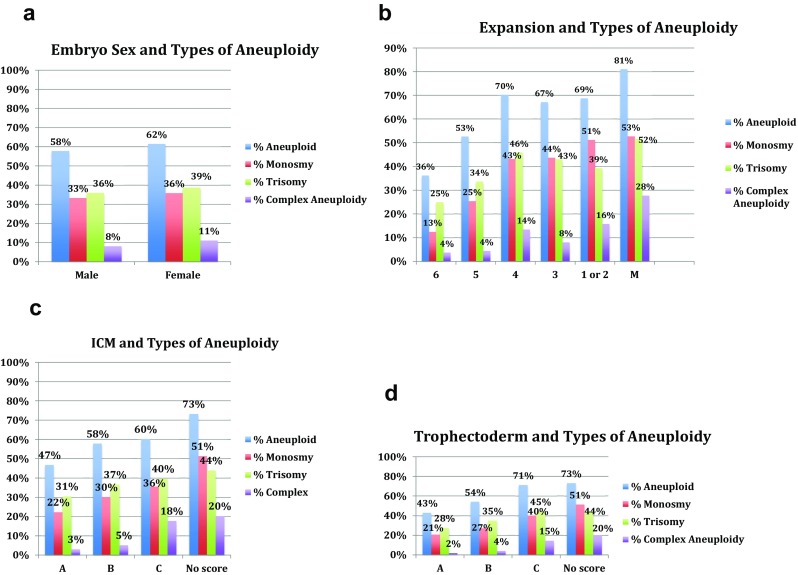
Results: A total of 1559 embryos from 316 cycles and 233 patients (mean maternal age = 37.8 ± 4.2 years) were included in the analysis. Six hundred and twenty-eight blastocysts (40.3%) were found to be euploid. Expansion (p < 0.001), inner cell mass (ICM) (p < 0.01), and trophectoderm grade (p < 0.001) were significantly associated with embryo ploidy in bivariate models controlling for maternal age, while embryo sex, biopsy day, and blastocyst cohort size were not associated with embryo ploidy. In a multivariate model, we found that maternal age (p < 0.001), higher grade of expansion (p < 0.01), and better quality trophectoderm (p < 0.001 for A compared to C grade) remained significantly associated with increased embryo euploidy, but ICM grade was no longer significant. Embryo sex was not associated with ploidy status, though male embryos were found to be associated with higher trophectoderm scores (p < 0.02).
Conclusions: This is the largest study to date to investigate PGS-tested embryo sex and ploidy status. While maternal age and some morphological parameters (expansion, trophectoderm grade) are associated with euploidy in our cohort, other parameters such as embryo sex, biopsy day, and cohort size are not. Though embryo sex was not associated with euploidy, male embryos were found to be associated with higher trophectoderm grades. Additional investigation in larger studies is warranted.
Keywords: Embryo sex; Euploidy; Inner cell mass; Morphology; Preimplantation genetic screening; Trophectoderm.
Conflict of interest statement
Conflict of interest
The authors declare that they have no conflict of interest.
Ethical approval
IRB approval was obtained through Stanford University.
Figures
References
-
- Capalbo A, Rienzi L, Cimadomo D, Maggiulli R, Elliott T, Wright G, Nagy ZP, Ubaldi FM. Correlation between standard blastocyst morphology, euploidy and implantation: an observational study in two centers involving 956 screened blastocysts. Hum Reprod. 2014;29:1173–1181. doi: 10.1093/humrep/deu033. - DOI - PubMed
-
- Forman EJ, Hong KH, Ferry KM, Tao X, Taylor D, Levy B, Treff NR, Scott Jr RT In vitro fertilization with single euploid blastocyst transfer: a randomized controlled trial. Fertil Steril 2013;100:100–7 e1, 107.e1. - PubMed
-
- Yang Z, Liu J, Collins GS, Salem SA, Liu X, Lyle SS, Peck AC, Sills E, Salem RD. Selection of single blastocysts for fresh transfer via standard morphology assessment alone and with array CGH for good prognosis IVF patients: results from a randomized pilot study. Mol Cytogenet. 2012;5:24. doi: 10.1186/1755-8166-5-24. - DOI - PMC - PubMed
MeSH terms
LinkOut - more resources
Full Text Sources
Other Literature Sources
Molecular Biology Databases
