


Widespread ancient whole-genome duplications in Malpighiales coincide with Eocene global climatic upheaval
- PMID: 30030969
- PMCID: PMC6265113
- DOI: 10.1111/nph.15357
Widespread ancient whole-genome duplications in Malpighiales coincide with Eocene global climatic upheaval
Abstract
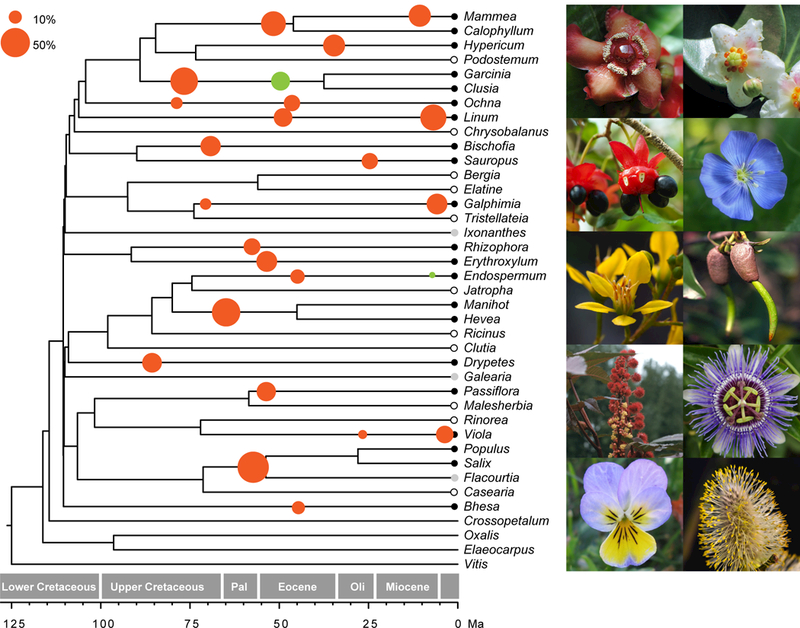
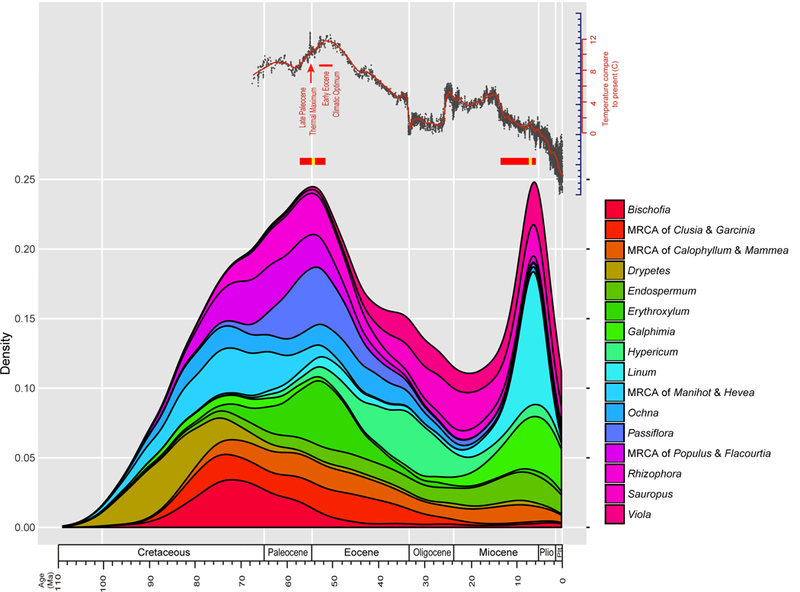
Whole-genome duplications (WGDs) are widespread and prevalent in vascular plants and frequently coincide with major episodes of global and climatic upheaval, including the mass extinction at the Cretaceous-Tertiary boundary (c. 65 Ma) and during more recent periods of global aridification in the Miocene (c. 10-5 Ma). Here, we explore WGDs in the diverse flowering plant clade Malpighiales. Using transcriptomes and complete genomes from 42 species, we applied a multipronged phylogenomic pipeline to identify, locate, and determine the age of WGDs in Malpighiales using three means of inference: distributions of synonymous substitutions per synonymous site (Ks ) among paralogs, phylogenomic (gene tree) reconciliation, and a likelihood-based gene-count method. We conservatively identify 22 ancient WGDs, widely distributed across Malpighiales subclades. Importantly, these events are clustered around the Eocene-Paleocene transition (c. 54 Ma), during which time the planet was warmer and wetter than any period in the Cenozoic. These results establish that the Eocene Climatic Optimum likely represents a previously unrecognized period of prolific WGDs in plants, and lends further support to the hypothesis that polyploidization promotes adaptation and enhances plant survival during episodes of global change, especially for tropical organisms like Malpighiales, which have tight thermal tolerances.
Keywords: climatic upheaval; flowering plants; genome evolution; global change; phylogenomics; speciation.
© 2018 The Authors. New Phytologist © 2018 New Phytologist Trust.
Figures
Comment in
-
Polyploidy as a mechanism for surviving global change.New Phytol. 2019 Jan;221(1):5-6. doi: 10.1111/nph.15513. New Phytol. 2019. PMID: 30488604 No abstract available.
References
-
- Andrews S 2010. FastQC: a quality control tool for high throughput sequence data. https://www.bioinformatics.babraham.ac.uk/projects/fastqc/.
-
- Arakaki M, Christin P- A, Nyffeler R, Lendel A, Eggli U, Ogburn RM, Spriggs E, Moore MJ, Edwards EJ. 2011. Contemporaneous and recent radiations of the world’s major succulent plant lineages. Proceedings of the National Academy of Sciences of the United States of America 108(20): 8379–8384. - PMC - PubMed
-
- Barker MS, Arrigo N, Baniaga AE, Li Z, Levin DA. 2016. On the relative abundance of autopolyploids and allopolyploids. New Phytologist 210(2): 391–398. - PubMed
-
- Barker MS, Kane NC, Matvienko M, Kozik A, Michelmore RW, Knapp SJ, Rieseberg LH. 2008. Multiple paleopolyploidizations during the evolution of the Compositae reveal parallel patterns of duplicate gene retention after millions of years. Molecular Biology and Evolution 25(11): 2445–2455. - PMC - PubMed
Publication types
MeSH terms
Grants and funding
- 310717/2015-9/Research Productivity Fellowship grant/International
- DEB-0622764/National Science Foundation/International
- 440543/2015-0/Brazil National Council for Scientific and Technological Development/International
- DEB-0544039/National Science Foundation/International
- R01 GM108904/GM/NIGMS NIH HHS/United States
LinkOut - more resources
Full Text Sources
Other Literature Sources
