


Additive effects of household food insecurity during pregnancy and infancy on maternal infant feeding styles and practices
- PMID: 30031787
- PMCID: PMC6815209
- DOI: 10.1016/j.appet.2018.07.016
Additive effects of household food insecurity during pregnancy and infancy on maternal infant feeding styles and practices
Abstract
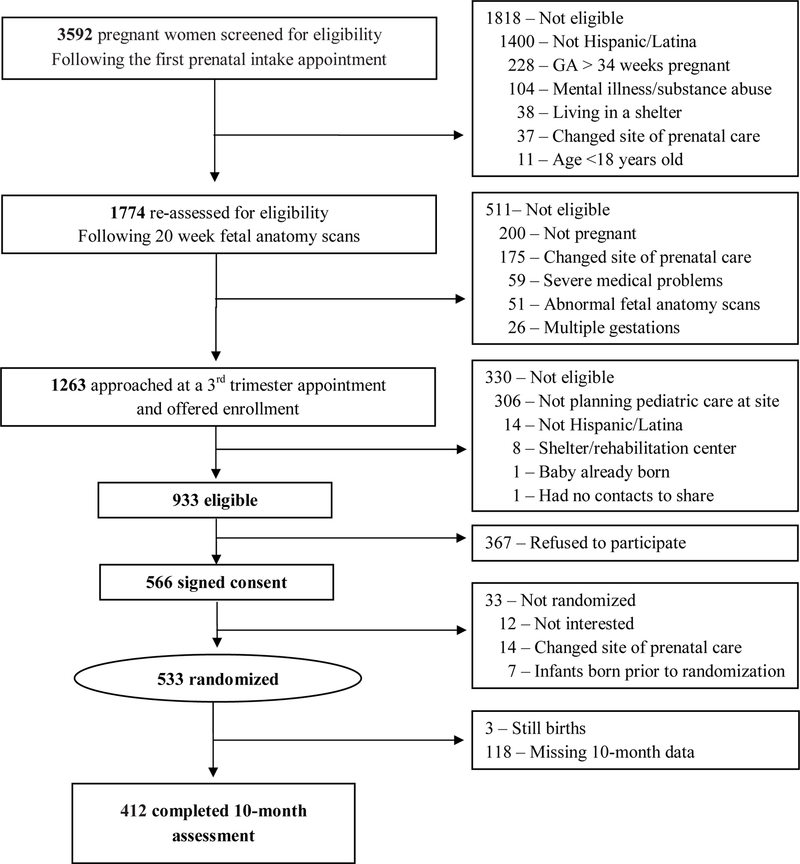
Food insecurity, or the limited access to food, has been associated with maternal child feeding styles and practices. While studies in other parenting domains suggest differential and additive impacts of poverty-associated stressors during pregnancy and infancy, few studies have assessed relations between food insecurity during these sensitive times and maternal infant feeding styles and practices. This study sought to analyze these relations in low-income Hispanic mother-infant pairs enrolled in a randomized controlled trial of an early obesity prevention program (Starting Early). Food insecurity was measured prenatally and during infancy at 10 months. Food insecurity timing was categorized as never, prenatal only, infancy only, or both. Regression analyses were used to determine relations between food insecurity timing and styles and practices at 10 months, using never experiencing food insecurity as the reference, adjusting for family characteristics and material hardships. 412 mother-infant pairs completed 10-month assessments. Prolonged food insecurity during both periods was associated with greater pressuring, indulgent and laissez-faire styles compared to never experiencing food insecurity. Prenatal food insecurity was associated with less vegetable and more juice intake. If food insecurity is identified during pregnancy, interventions to prevent food insecurity from persisting into infancy may mitigate the development of obesity-promoting feeding styles and practices.
Keywords: Feeding styles; Food insecurity; Hispanic; Infancy; Pregnancy.
Copyright © 2018 Elsevier Ltd. All rights reserved.
Figures
References
-
- Anderson SA (1990). Core indicators of nutritional state for difficult-to-sample populations. Journal of Nutrition, 120(Suppl 11), 1559–1600. - PubMed
-
- Bickel G, Nord M, Price C, Hamilton W, & Cook J (2000). Guide to measuring household food security. Washington, DC: United States Department of Agriculture.
-
- Birch LL, Fisher JA. Appetite and eating behavior in children. (1995) Pediatr Clin North Am, 42(4), 931–953. - PubMed
Publication types
MeSH terms
Grants and funding
LinkOut - more resources
Full Text Sources
Other Literature Sources
