


Social skills group training in children with autism spectrum disorder: a randomized controlled trial
- PMID: 30032394
- PMCID: PMC6407743
- DOI: 10.1007/s00787-018-1205-1
Social skills group training in children with autism spectrum disorder: a randomized controlled trial
Abstract
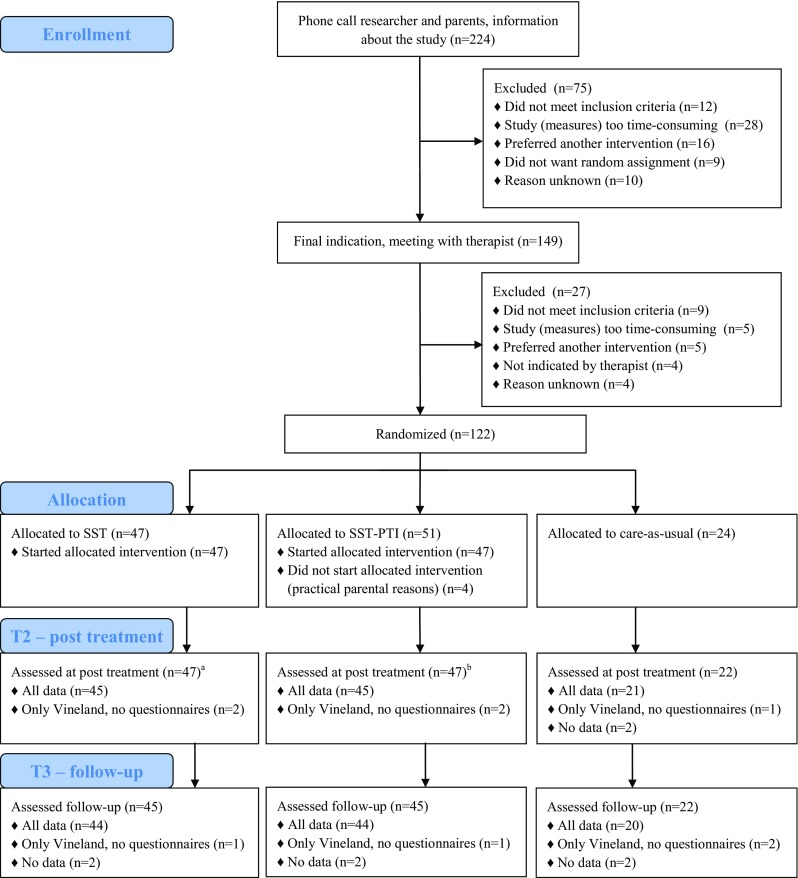
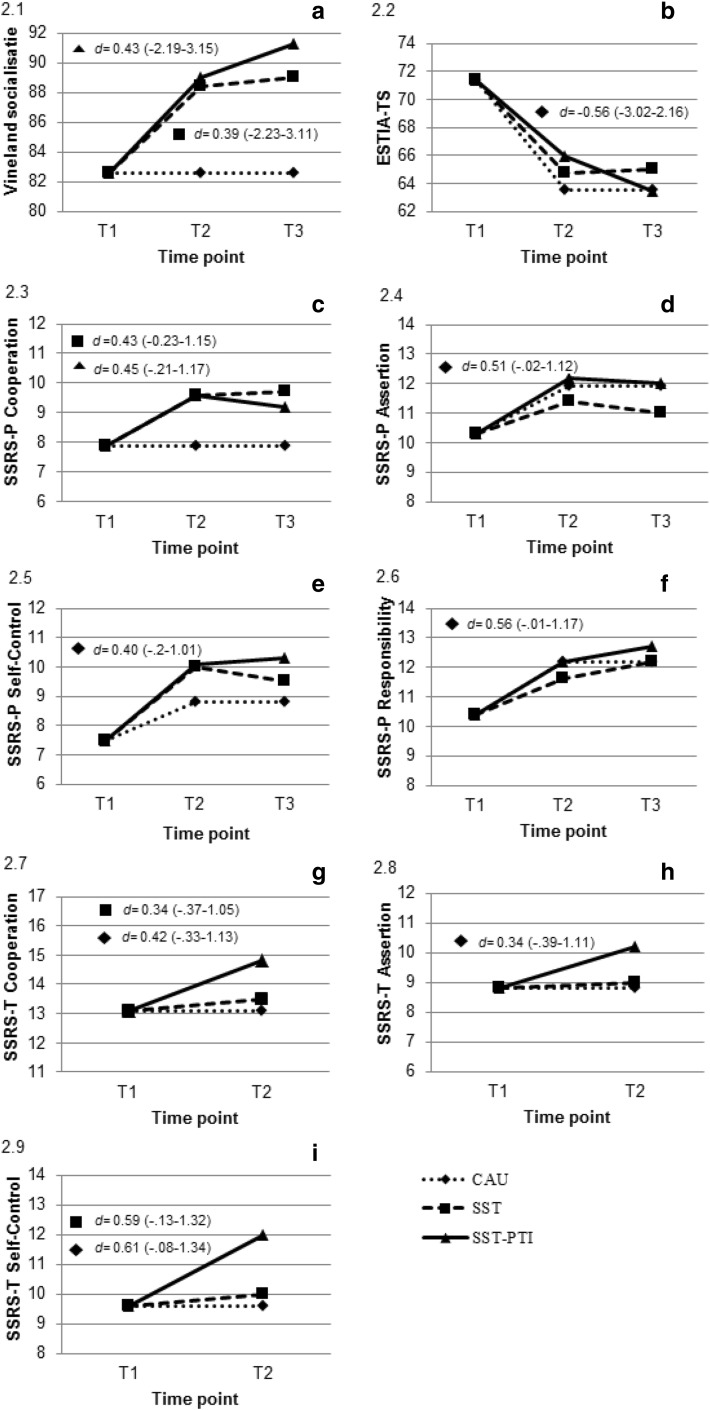
In 122 high-functioning children with autism spectrum disorder (ASD; 9-13 years; 19 girls), we investigated the effectiveness of a 15-session social skills group training (SST) with and without parent and teacher involvement (PTI) in a randomized controlled trial with three conditions: SST (n = 47), SST-PTI (n = 51), and care-as-usual (CAU, n = 24). Hierarchical linear modeling was used for immediate and 6-month follow-up analyses. Measures were administered before randomization (blind), post-treatment and at follow-up (not blind). Trial registration: Dutch Trial Register; http://www.trialregister.nl ; NTR2405. At post-treatment, children in both SSTs had improved significantly more than CAU on the primary outcome, Vineland Socialization (SST: Cohen's d = 0.39; 95% CI - 2.23 to 3.11 and SST-PTI: d = 0.43; 95% CI - 2.19 to 3.15) and on the secondary outcome parent-SSRS "Cooperation" (SST: d = 0.43; 95% CI - 0.23 to 1.15 and SST-PTI: d = 0.45; 95% CI - 0.21 to 1.17), with no difference between post-treatment and follow-up. Additionally, children in SST-PTI improved significantly more on the teacher-SSRS than in CAU ["Cooperation" d =0.42 (95% CI - 0.33 to 1.13); "Assertion" d =0.34 (95% CI - 0.39 to 1.11); "Self-Control" d =0.61 (95% CI - 0.08 to 1.34)] and in SST ["Cooperation" d =0.34 (95% CI - 0.37 to 1.05); "Self-Control" d =0.59 (95% CI - 0.13 to 1.32)]. The current study corroborates earlier findings in smaller samples and wider age ranges, with small but statistically significant effects of SST for high-functioning pre-adolescent children with ASD. Parental and teacher involvement intensified treatment, yet did not yield an additional effect relative to SST for children only, as reported by parents. 6 months after training, no further improvement or decline was found.
Keywords: Autism spectrum disorder; Effectiveness; Randomized controlled trial; Social skills training.
Conflict of interest statement
Author AdB received the grant that funded this study (the Netherlands Organization for Health Research and Development; ZonMw, nr 157003005). The agency had no role in data analyses, the decision to publish, or the preparation of the manuscript. She also is first author on the Dutch ADOS manual for which Accare receives enumeration. SvW, LV, BvdH and LvdV were authors of the SST manual, and LV and SvW were authors of the SST–PTI manual, both used in the current study. The manuals are not commercially available, hence the authors do not have a financial interest in the outcomes of the current study. The other authors declare that they have no conflict of interest.
Figures
References
-
- Gresham FM, Elliott SN. Social skills rating system. Circle Pines: American Guidance Service; 1990.
-
- Constantino JN, Gruber CP. Social Responsiveness Scale (SRS-2) Torrance: WPS; 2012.
-
- Soorya LV, Siper PM, Beck T, Soffes S, Halpern D, Gorenstein M, Kolevzon A, Buxbaum J, Wang AT. Randomized comparative trial of a social cognitive social skills group for children with autism spectrum disorder. J Am Acad Child Adolesc Psychiatry. 2015;54(3):208–216. doi: 10.1016/j.jaac.2014.12.005. - DOI - PMC - PubMed
Publication types
MeSH terms
Grants and funding
LinkOut - more resources
Full Text Sources
Other Literature Sources
Medical
