


Development (of Walking): 15 Suggestions
- PMID: 30032744
- PMCID: PMC6145857
- DOI: 10.1016/j.tics.2018.05.010
Development (of Walking): 15 Suggestions
Abstract
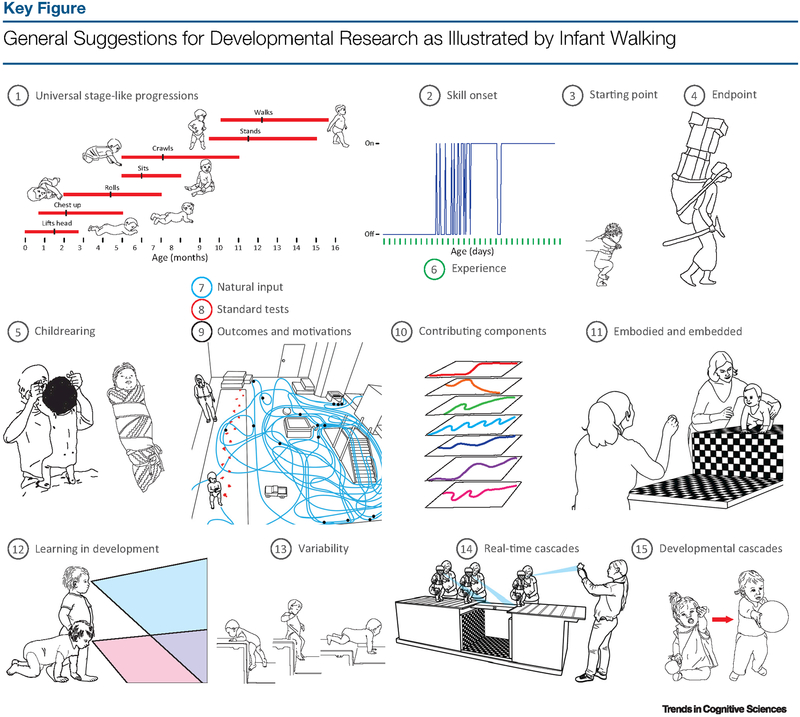
Although a fundamental goal of developmental science is to identify general processes of change, developmental scientists rarely generalize beyond their specific content domains. As a first step toward a more unified approach to development, we offer 15 suggestions gleaned from a century of research on infant walking. These suggestions collectively address the multi-leveled nature of change processes, cascades of real-time and developmental events, the diversity of developmental trajectories, inter- and intraindividual variability, starting and ending points of development, the natural input for learning, and the roles of body, environment, and sociocultural context. We argue that these 15 suggestions are not limited to motor development, and we encourage researchers to consider them within their own areas of research.
Keywords: behavior; exploration; infant; locomotion.
Copyright © 2018 Elsevier Ltd. All rights reserved.
Figures
References
-
- Gesell A (1939) Reciprocal interweaving in neuromotor development. J. Comp. Neurol 70, 161–180
-
- Gesell A (1946) The ontogenesis of infant behavior In Manual of Child Psychology (Carmichael L, ed.), pp. 295–331, John Wiley
-
- Gibson EJ (1997) An ecological psychologist’s prolegomena for perceptual development: a functional approach In Evolving Explanations of Development: Ecological Approaches to Organism–Environment Systems (Dent-Read C and Zukow-Goldring P, eds), pp. 23–45, American Psychological Association
-
- McGraw MB (1935) Growth: A Study of Johnny and Jimmy, Appleton-Century Crofts
-
- McGraw MB (1945) The Neuromuscular Maturation of the Human Infant, Columbia University Press
Publication types
MeSH terms
Grants and funding
LinkOut - more resources
Full Text Sources
Other Literature Sources
Medical
