


Outcome of Nonsurgical Management of Extra-Abdominal, Trunk, and Abdominal Wall Desmoid-Type Fibromatosis: A Population-Based Study in the Netherlands
- PMID: 30034268
- PMCID: PMC6032644
- DOI: 10.1155/2018/5982575
Outcome of Nonsurgical Management of Extra-Abdominal, Trunk, and Abdominal Wall Desmoid-Type Fibromatosis: A Population-Based Study in the Netherlands
Abstract
Introduction: Nonsurgical management of patients with desmoid-type fibromatosis (DF) is increasing. This study tries to provide insight on type, usage, and outcome of first-line nonsurgical management strategies.
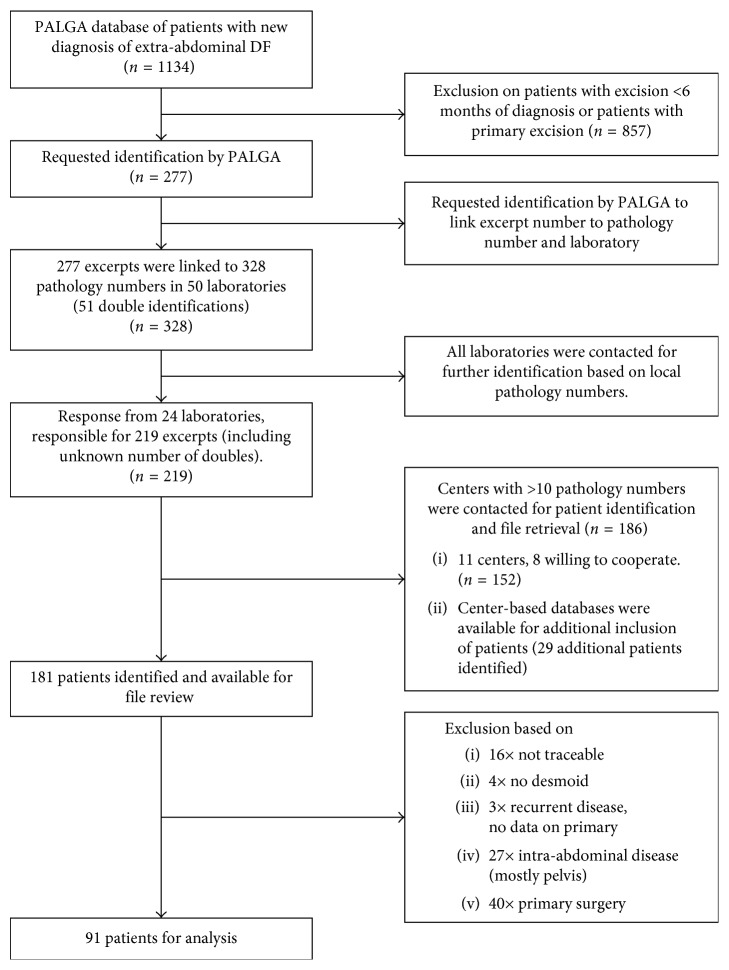
Patients and methods: From the Dutch Pathology Registry (PALGA), patients with extra-abdominal or trunk/abdominal wall DF, diagnosed between 1993 and 2013, were identified. First-line treatment was analyzed. Best response (BR) using RECIST criteria from start of treatment/surveillance until change of treatment or last follow-up was analyzed.
Results: Ninety-one of the 1141 identified patients had first-line nonsurgical management. The percentage of patients treated nonsurgically increased from 0.6% in 1993-1998 to 12.8% in 2009-2013. Thirty-seven patients had surveillance (41%), 35 radiotherapy (38%), and 19 systemic treatment (21%). BR for surveillance was complete response (CR) in 2/37, partial response (PR) in 4/37, stable disease (SD) in 21/37, progressive disease (PD) in 5/37, and unknown in 5/37 patients. BR for radiotherapy was CR in 4/35, PR in 11/35, SD in 16/35, and unknown in 4/35. BR for systemic treatment was CR in 1/19, PR in 1/19, SD in 10/19, PD in 2/19, and unknown in 5/19. Totally, 91% of patients did not progress.
Discussion: Given the low percentage (9%) of PD of nonsurgical management, these data can be used in shared decision making with the patient regarding optimal treatment.
Figures
References
-
- Fletcher C. D. M., Bridge J. A., Hogendoorn P., Mertens F. WHO Classification of Tumours of Soft Tissue and Bone. 4th. Lyon, France: IARC Press; 2013.
-
- Salas S., Dufresne A., Bui B., et al. Prognostic factors influencing progression-free survival determined from a series of sporadic desmoid tumors: a wait-and-see policy according to tumor presentation. Journal of clinical oncology. Journal of Clinical Oncology. 2011;29(26):3553–3558. doi: 10.1200/jco.2010.33.5489. - DOI - PubMed
-
- van Broekhoven D. L., Grünhagen D. J., den Bakker M. A., van Dalen T., Verhoef C. Time trends in the incidence and treatment of extra-abdominal and abdominal aggressive fibromatosis: a population-based study. Annals of Surgical Oncology. 2015;22(9):2817–2823. doi: 10.1245/s10434-015-4632-y. - DOI - PMC - PubMed
-
- Kasper B., Baumgarten C., Bonvalot S., et al. Management of sporadic desmoid-type fibromatosis: a European consensus approach based on patients’ and professionals’ expertise–a sarcoma patients EuroNet and European Organisation for Research and Treatment of Cancer/Soft Tissue and Bone Sarcoma Group initiative. European Journal of Cancer. 2015;51(2):127–136. doi: 10.1016/j.ejca.2014.11.005. - DOI - PubMed
LinkOut - more resources
Full Text Sources
Other Literature Sources
Research Materials
Miscellaneous
