


doi: 10.1021/acsmedchemlett.8b00149.
eCollection 2018 Jul 12.
Structure-Activity Relationship of Novel and Selective Biaryl-Chroman GPR40 AgoPAMs
Affiliations
- PMID: 30034601
- PMCID: PMC6047031
- DOI: 10.1021/acsmedchemlett.8b00149
Item in Clipboard
Structure-Activity Relationship of Novel and Selective Biaryl-Chroman GPR40 AgoPAMs
ACS Med Chem Lett.
.
Abstract
A series of biaryl chromans exhibiting potent and selective agonism for the GPR40 receptor with positive allosteric modulation of endogenous ligands (AgoPAM) were discovered as potential therapeutics for the treatment of type II diabetes. Optimization of physicochemical properties through modification of the pendant aryl rings resulted in the identification of compound AP5, which possesses an improved metabolic profile while demonstrating sustained glucose lowering.
Conflict of interest statement
The authors declare no competing financial interest.
Figures
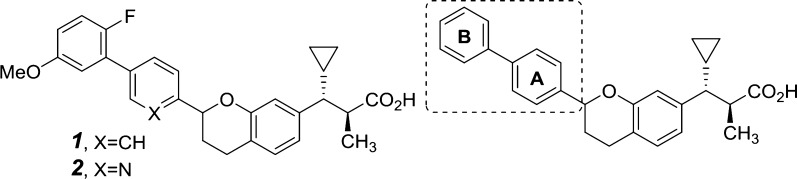
GPR40 AgoPAM structural
leads.

Reagents
and conditions: (a)
R-B(OH)2, 2 M K2CO3, Pd(dtbpf)Cl2, dioxane, 90 °C, 3 h; (b) 1 N NaOH, MeOH, rt, 3 h (8–44%
yield over 2 steps).
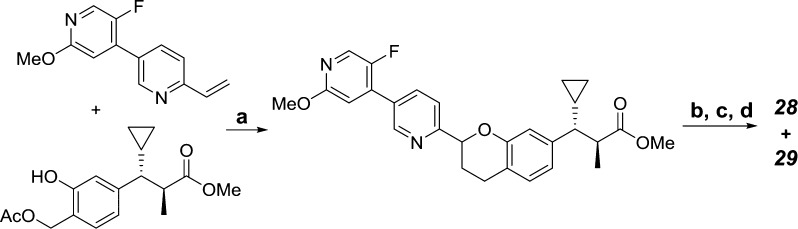
Reagents and conditions: (a)
xylenes, 170 °C, 50 min, 41%; (b) 1 M aqueous LiOH, MeOH/THF,
65 °C, 19 h, 89%; (c) SFC separation: Chiral-pak AD-H (50 ×
250 mm; 65% MeOH/CO2, 67%; (d) 1 M aqueous NaOH, MeCN/H2O, 95%.
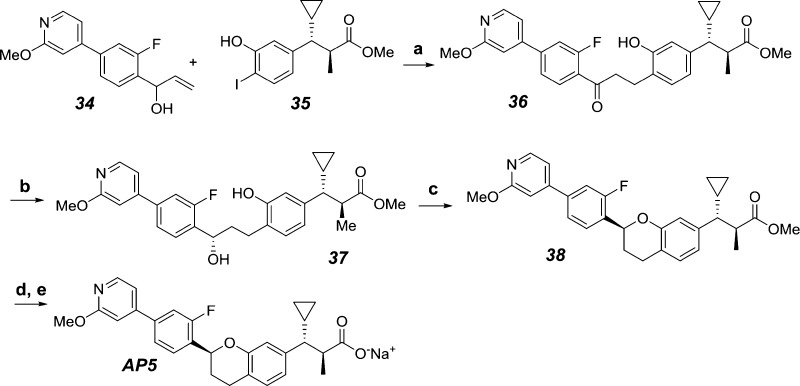
Reagents and conditions: (a) t-BuX-Phos Palladacycle, Cy2NMe, toluene, 90
°C, 18 h, 49%; (b) formic acid, NEt3, RuCl[(R,R)-Tsdpen](Mesitylene), EtOAc, 22 h, quant.; (c) tBu3P, DIAD, THF, 1 h, 94%; purity upgrade by
SFC, 74%; (d) 1 M aqueous LiOH, MeOH/THF, 55–58 °C, 17
h, 96%; (e) 1 M aqueous NaOH, MeCN/H2O, 95%.
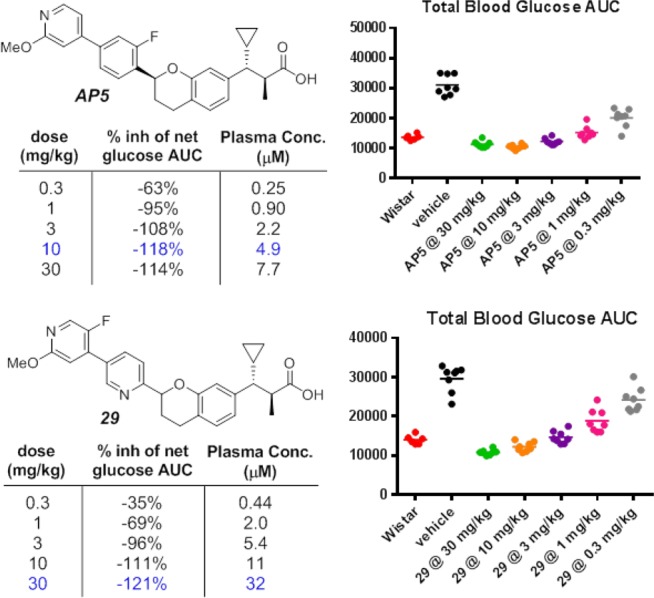
GK rat oGTT titrations for AP5 and 29.
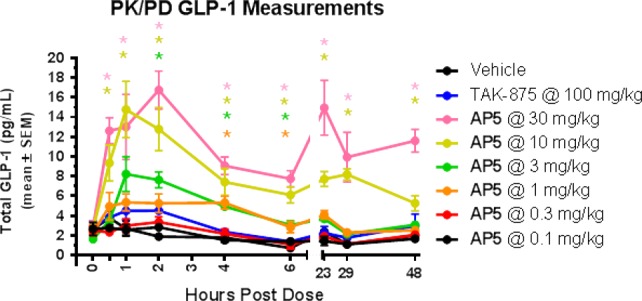
Dose-dependent
GLP-1 secretion with AP5.
References
-
- Itoh Y.; Kawamata Y.; Harada M.; Kobayashi M.; Fujii R.; Fukusumi S.; Ogi K.; Hosoya M.; Tanaka Y.; Uejima H.; Tanaka H.; Maruyama M.; Satah R.; Okubo S.; Kizawa H.; Komatsu H.; Matsumura F.; Moguchi Y.; Shinohara T.; Hinuma S.; Fujisawa Y.; Fujino M. Free fatty acids regulate insulin secretion from pancreatic β cells through GPR40. Nature 2003, 422, 173–176. 10.1038/nature01478. - DOI - PubMed
-
- Negoro N.; Sasaki S.; Mikami S.; Ito M.; Suzuki M.; Tsujihata Y.; Ito R.; Harada A.; Takeuchi K.; Suzuki N.; Miyazaki J.; Santou T.; Odani T.; Kanzaki N.; Funami M.; Tanaka T.; Kogame A.; Matsunaga S.; Yasuma T.; Momose Y. Discovery of TAK-875: A potent, selective, and orally bioavailable GPR40 agonist. ACS Med. Chem. Lett. 2010, 1, 290–294. 10.1021/ml1000855. - DOI - PMC - PubMed
-
- Christiansen E.; Due-Hansen M. E.; Urban C.; Merten N.; Pfleiderer M.; Karlsen K. K.; Rasmussen S. S.; Steensgaard M.; Hamacher A.; Schmidt J.; Drewke C.; Petersen R. K.; Kristiansen K.; Ullrich S.; Kostenis E.; Kassack M. U.; Ulven T. Structure activity study of dihydrocinnamic acids and the discovery of the potent FFA1 (GPR40) agonist TUG-469. ACS Med. Chem. Lett. 2010, 1, 345–349. 10.1021/ml100106c. - DOI - PMC - PubMed
LinkOut - more resources
Full Text Sources
Other Literature Sources
