Review
. 2018 Jul 20;19(7):2114.
doi: 10.3390/ijms19072114.

Dynamic DNA Origami Devices: from Strand-Displacement Reactions to External-Stimuli Responsive Systems

Affiliations
Review

Dynamic DNA Origami Devices: from Strand-Displacement Reactions to External-Stimuli Responsive Systems

Heini Ijäs et al. Int J Mol Sci. .

Abstract

DNA nanotechnology provides an excellent foundation for diverse nanoscale structures that can be used in various bioapplications and materials research. Among all existing DNA assembly techniques, DNA origami proves to be the most robust one for creating custom nanoshapes. Since its invention in 2006, building from the bottom up using DNA advanced drastically, and therefore, more and more complex DNA-based systems became accessible. So far, the vast majority of the demonstrated DNA origami frameworks are static by nature; however, there also exist dynamic DNA origami devices that are increasingly coming into view. In this review, we discuss DNA origami nanostructures that exhibit controlled translational or rotational movement when triggered by predefined DNA sequences, various molecular interactions, and/or external stimuli such as light, pH, temperature, and electromagnetic fields. The rapid evolution of such dynamic DNA origami tools will undoubtedly have a significant impact on molecular-scale precision measurements, targeted drug delivery and diagnostics; however, they can also play a role in the development of optical/plasmonic sensors, nanophotonic devices, and nanorobotics for numerous different tasks.

Keywords: DNA nanotechnology; DNA origami; mechanical movement; molecular devices; robotics; self-assembly.


Conflict of interest statement

The authors declare no conflict of interest.

Figures
Scheme 1
Scheme 1
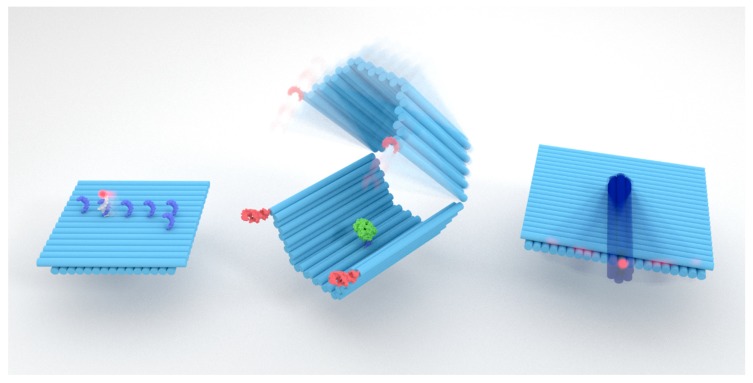
Artistic rendering of selected examples of dynamic DNA origami devices: (Left) a cargo-sorting robot walking on a DNA origami-templated track [42]; (Middle) a logic-gated DNA origami “nanopill” that selectively displays the loaded cargo [12]; (Right) a DNA origami robotic arm that performs rotational movement under an electric field [43].
Figure 1
Figure 1
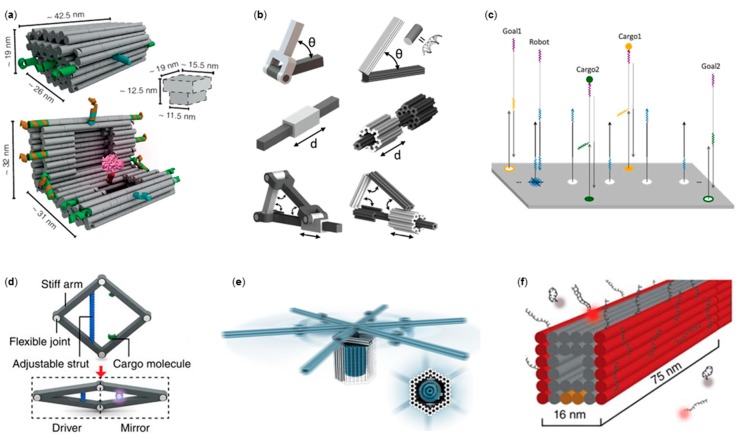
DNA origami mechanics via DNA–DNA interaction. (a) A DNA nanovault that displays cargo when opened via strand displacement [61]; (b) DNA origami nanomechanics [67]; (c) A robot that picks up cargo and delivers it to a goal on top of a DNA origami [42]; (d) A DNA origami actuator; movement on the left (driver) side is mirrored to the right side [70] (e) A DNA origami rotary apparatus constructed from tight-fitting components [78]; (f) Super-resolution imaging with DNA origami by taking advantage of transient DNA binding [81] (a) is reproduced with permission from the authors of [61], published by Nature Publishing Group, 2017; (b) is reproduced with permission from the authors of [67], copyright National Academy of Sciences 2015; (c) is reproduced with permission from the authors of [42], copyright The American Association for the Advancement of Science, 2017; (d) is reproduced with permission from the authors of [70], published by Nature Publishing Group, 2016; (e) is reproduced with permission from the authors of [78], published by The American Association for the Advancement of Science, 2016; (f) is reproduced with permission from the authors of [81], copyright Nature Publishing Group, 2014.
Figure 2
Figure 2
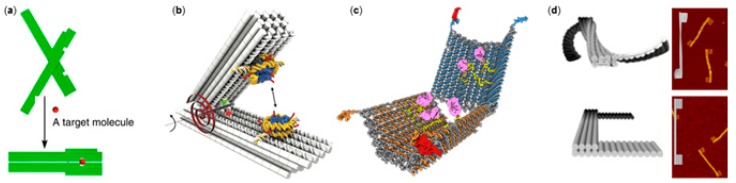
DNA origami devices with molecular interactions. (a) DNA origami pliers or forceps that exhibit conformational change upon a target molecule binding [84]; (b) A DNA origami measurement device equipped by nucleosomes to probe nucleosome–nucleosome interaction [85]; (c) A logic-gated nanorobot that displays cargo when specific antigens bind to aptamer-encoded DNA locks [12]; (d) DNA origami twisting and rotation through the application of DNA intercalating molecules [94]; (a) is reproduced with permission from the authors of [84], published by Nature Publishing Group, 2011; (b) is reproduced with permission from the authors of [85], published by The American Association for the Advancement of Science, 2017; (c) is reproduced with permission from the authors of [12], copyright The American Association for the Advancement of Science, 2012; (d) is reproduced with permission from the authors of [94], copyright American Chemical Society, 2016.
Figure 3
Figure 3
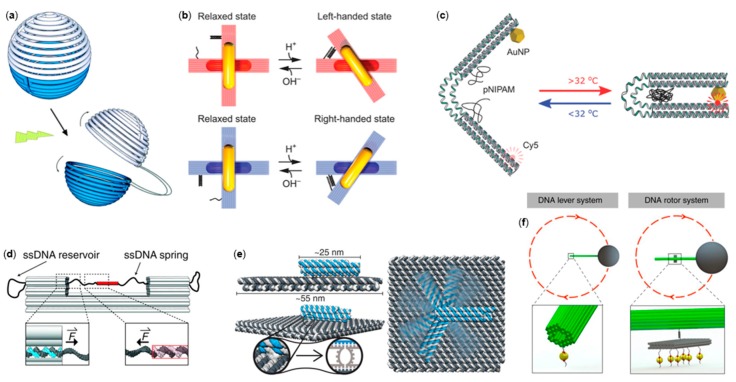
DNA origami movement using stimuli. (a) A spherical DNA origami container that can be opened by light [100]; (b) Reconfigurable chiral plasmonic metamolecules [103]; (c) A thermoresponsive actuator [106]; (d) An autonomous nanoscopic force clamp [107]. (e) An electric-field-directed robotic arm [43]. (f) Magnetic actuators; a lever system and a rotor [111]. (a) is reproduced with permission from the authors of [100], copyright The Royal Society of Chemistry, 2015; (b) is reproduced with permission from the authors of [103], published by The American Association for the Advancement of Science, 2017; (c) is reproduced with permission from the authors of [106], copyright John Wiley and Sons, 2018; (d) is reproduced with permission from the authors of [107], copyright The American Association for the Advancement of Science, 2016; (e) is reproduced with permission from the authors of [43], copyright The American Association for the Advancement of Science, 2018; (f) is reproduced with permission from the authors of [111], published by Nature Publishing Group, 2018.

References

    1. Feynman R.P. There’s plenty of room at the bottom. Eng. Sci. 1960;23:22–36.
    1. Watson J.D., Crick F.H.C. Molecular structure of nucleic acids. Nature. 1953;171:737–738. doi: 10.1038/171737a0. - DOI - PubMed
    1. Jones M.R., Seeman N.C., Mirkin C.A. Programmable materials and the nature of the DNA bond. Science. 2015;347:1260901. doi: 10.1126/science.1260901. - DOI - PubMed
    1. Seeman N.C. Nucleic acid junctions and lattices. J. Theor. Struct. Biol. 1982;99:237–247. doi: 10.1016/0022-5193(82)90002-9. - DOI - PubMed
    1. Wang P., Meyer T.A., Pan V., Dutta P.K., Ke Y. The beauty and utility of DNA origami. Chem. 2017;2:359–382. doi: 10.1016/j.chempr.2017.02.009. - DOI