Comment
doi: 10.15252/embr.201846294.
Epub 2018 Jul 23.
Dosage compensation in human pre-implantation embryos: X-chromosome inactivation or dampening?
Affiliations
- PMID: 30037898
- PMCID: PMC6073072
- DOI: 10.15252/embr.201846294
Item in Clipboard
Comment
Dosage compensation in human pre-implantation embryos: X-chromosome inactivation or dampening?
EMBO Rep.
2018 Aug.
Abstract
Recent studies support either X‐dampening or X‐inactivation as the mechanism of dosage compensation in human embryos. The data and possible underlying causes for these conflicting models are discussed here.
Figures
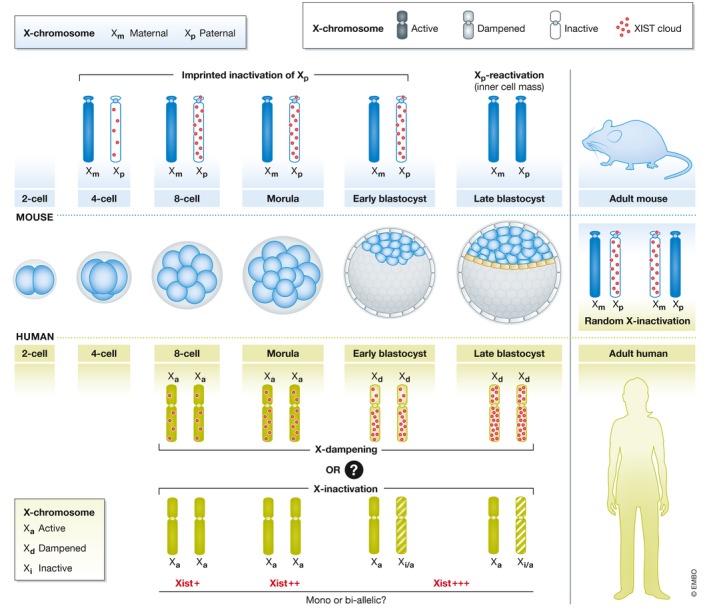
Schematic representation of X‐chromosome dynamics in early embryonic mouse and human development. In mouse, paternal‐X (Xp) (imprinted) gets inactivated initially. Later in the epiblast progenitor cells of the late blastocyst, inactive‐Xp is reactivated. The embryo proper then undergoes random X‐inactivation. However, in humans there is no imprinted X‐inactivation. Recent studies have inferred contradictory models of X‐chromosome dynamics in human pre‐implantation embryos: X‐chromosome dampening versus inactivation. According to the dampening model, following the biallelic Xist expression initiation at the 8‐cell stage, expression of X‐linked genes is downregulated while maintaining biallelic expression until the late blastocyst stage. On the contrary, another study suggests the initiation of X‐inactivation in human pre‐implantation development as they found Xist expression was followed by a majority of X‐linked genes showing monoallelic expression.
Comment on
-
Single-Cell RNA-Seq Reveals Lineage and X Chromosome Dynamics in Human Preimplantation Embryos.Cell. 2016 May 5;165(4):1012-26. doi: 10.1016/j.cell.2016.03.023. Epub 2016 Apr 7. Cell. 2016. PMID: 27062923 Free PMC article.
-
Early X chromosome inactivation during human preimplantation development revealed by single-cell RNA-sequencing.Sci Rep. 2017 Sep 7;7(1):10794. doi: 10.1038/s41598-017-11044-z. Sci Rep. 2017. PMID: 28883481 Free PMC article.
References
Publication types
MeSH terms
Substances
LinkOut - more resources
Full Text Sources
Other Literature Sources