


First clinical evaluation of the new single-use flexible and semirigid Pusen ureteroscopes
- PMID: 30038812
- PMCID: PMC6051369
- DOI: 10.5173/ceju.2018.1620
First clinical evaluation of the new single-use flexible and semirigid Pusen ureteroscopes
Abstract
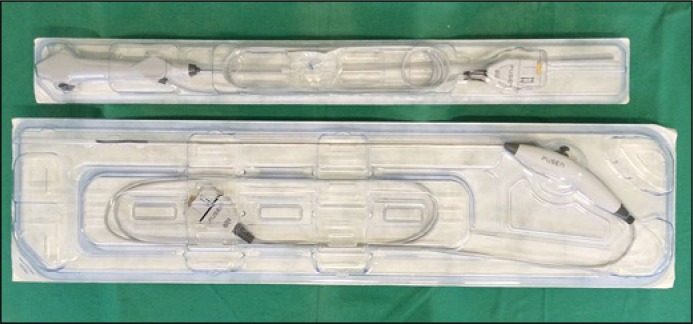
Introduction: The purpose of the present study was to clinically evaluate two new single-use Pusen ureteroscopes, one semirigid with a flexible tip (srURS) and one flexible (fURS).
Materials and methods: During ten consecutive procedures (five srURS and five fURS), we subjectively evaluated on a scale from 0 (poor) to 10 (excellent), the scope's deflection, image quality, and maneuverability prior to, during and after the surgery. Patient demographics, complications with the devices, and troubleshooting were recorded.
Results: There were a total of ten patients, five of which were female while the other five were male. Mean age was 58.9 years. Seven patients had a single kidney stone with mean size of 9.6 mm (1.6-20 mm). Half of the patients were pre-stented. For the fURS, the preoperative image quality rating was 8.4 (8-10), compared with 6.8 (4-9) during surgery. The preoperative deflection rating was 9.6+ 0.9 (8-10), while during surgery this decreased to 8.0 (6-10) and to 6.0 (4-8) when using a laser fiber. The srURS had a preoperative image quality rating of 9.2 (8-10), which decreased to 7.6 (6-9) while using the scope. The deflection rating decreased from 9.4 (7-10) preoperatively to 7.0 (1-10) postoperatively, and a similar reduction was observed in the maneuverability rating, from 9.6 (8-10) to 7.4 (1-10). Ureteroscopy was considered as a standard in four of the fURS and three of the srURS procedures. The mean overall satisfaction rating was 6.
Conclusions: The two new single-use ureteroscopes, one flexible and one semirigid, were considered to have allowed standard ureteroscopy in four and three out of the five procedures for each scope, respectively. The image quality, deflection, and maneuverability ratings decreased during the procedure for both scopes.
Keywords: Pusen; flexible ureteroscope; semirigid ureteroscope; single-use ureteroscope; ureteroscopy; urolithiasis.
Figures
References
-
- Türk C, Petřík A, Sarica K, et al. EAU Guidelines on Interventional Treatment for Urolithiasis. Eur Urol. 2016;69:475–482. - PubMed
-
- Somani BK, Al-Qahtani SM, de Medina SD, Traxer O. Outcomes of flexible ureterorenoscopy andlaser fragmentation for renal stones: comparison between digital and conventional ureteroscope. Urology. 2013;82:1017–1019. - PubMed
-
- Emiliani E, Traxer O. Single use and disposable flexible ureteroscopes. Curr Opin Urol. 2017;27:176–181. - PubMed
-
- Traxer O, Thomas A. Prospective evaluation and classification of ureteral wall injuries resulting from insertion of a ureteral access sheath during retrograde intrarenal surgery. J Urol. 2013;189:580–584. - PubMed
LinkOut - more resources
Full Text Sources
Other Literature Sources