. 2015 Dec 30;99(2):61-64.
doi: 10.5334/jbr-btr.970.

Hepatic Artery Pseudoaneurysm: A Life-Threatening Complication of Liver Transplantation

Affiliations

Hepatic Artery Pseudoaneurysm: A Life-Threatening Complication of Liver Transplantation

Selcuk Parlak et al. J Belg Soc Radiol. .

Abstract

Hepatic artery pseudoaneurysm is a rare but serious complication following liver transplantation. A 50-year-old male patient with ulcerative colitis, sclerosing cholangitis, and end-stage liver disease underwent right lobe transplantation from a living donor. The patient was hospitalized because of impairment in liver function tests and massive pretibial edema three months after surgery. In color Doppler ultrasound and multidetector computed tomography, a pseudoaneurysm with peripheral large thrombus was detected at the anastomosis site extending anterior to the hepatic artery. The patient died as a result of unstable hemodynamic conditions.

Keywords: Computed Tomography; Hepatic arteries; Liver transplantations; Multidetector.


Figures

Figure 1
Figure 1
CDUS showing the classic yin-yang flowpattern within the pseudoaneurysm (arrowhead) originating from hepatic artery (arrow). Note that the peripheral partial thrombus in the pseudoaneurysm.
Figure 2
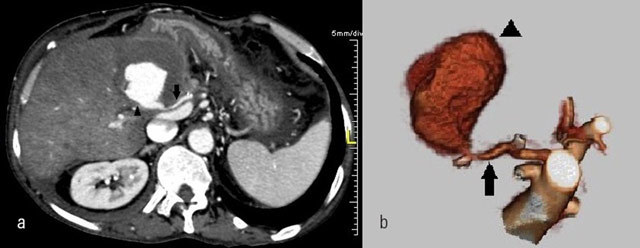
Figure 2
a) MDCT angiogram and b) Volume rendered images show the pseudoaneurysm (arrowhead) originating from hepatic artery (arrow). Hypodense peripheral partial thrombus is also seen around contrastmedia on a).
Figure 3
Figure 3
MDCT shows loculated fluid collections thougt as biloma (arrows).

References

    1. Kim HJ, et al. Hepatic artery pseudoaneurysms in adult living-donor liver transplantation: efficacy of CT and Doppler sonography. AJR Am J Roentgenol. 2005;184(5):1549–55. doi: 10.2214/ajr.184.5.01841549. PMid: 15855114. - DOI - PubMed
    1. Marshall MM, et al. Hepatic artery pseudoaneurysms following liver transplantation: incidence, presenting features and management. Clin Radiol. 2001;56(7):579–87. doi: 10.1053/crad.2001.0650. PMid: 11446757. - DOI - PubMed
    1. Zhao JC, et al. Incidence and treatment of hepatic artery complications after orthotopic liver transplantation. World J Gastroenterol. 2003;9(12):2853–5. doi: 10.3748/wjg.v9.i12.2853. PMid: 14669351; PMCid: PMC4612070. - DOI - PMC - PubMed
    1. Volpin E, et al. Preservation of the arterial vascularisation after hepatic artery pseudoaneurysm following orthotopic liver transplantation: long-term results. Ann Transplant. 2014;19:346–52. doi: 10.12659/AOT.890473. PMid: 25034853. - DOI - PubMed
    1. Turrion VS, et al. Incidence and results of arterial complications in liver transplantation: experience in a series of 400 transplants. Transplant Proc. 2002;34(1):292–3. doi: 10.1016/S0041-1345(01)02767-1. - DOI - PubMed

LinkOut - more resources