Effects of a 1-Time Nurse-Led Telephone Call After Pediatric Discharge: The H2O II Randomized Clinical Trial
- PMID: 30039161
- PMCID: PMC6143054
- DOI: 10.1001/jamapediatrics.2018.1482
Effects of a 1-Time Nurse-Led Telephone Call After Pediatric Discharge: The H2O II Randomized Clinical Trial
Abstract
Importance: Families often struggle after discharge of a child from the hospital. Postdischarge challenges can lead to increased use of urgent health care services.
Objective: To determine whether a single nurse-led telephone call after pediatric discharge decreased the 30-day reutilization rate for urgent care services and enhanced overall transition success.
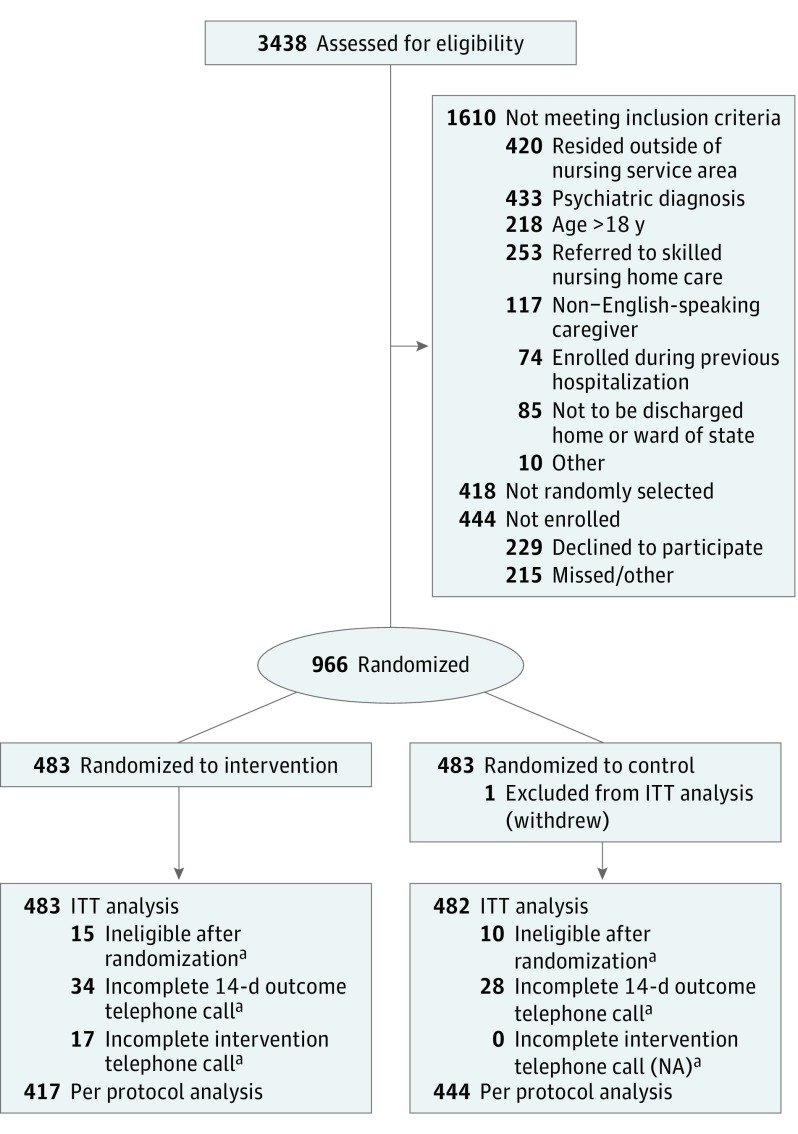
Design, setting, and participants: This Hospital-to-Home Outcomes (H2O) randomized clinical trial included 966 children and adolescents younger than 18 years (hereinafter referred to as children) admitted to general medicine services at a free-standing tertiary care children's hospital from May 11 through October 31, 2016. Data were analyzed as intention to treat and per protocol.
Interventions: A postdischarge telephone call within 4 days of discharge compared with standard discharge.
Main outcomes and measures: The primary outcome was the 30-day reutilization rate for urgent health care services (ie, unplanned readmission, emergency department visit, or urgent care visit). Secondary outcomes included additional utilization measures, as well as parent coping, return to normalcy, and understanding of clinical warning signs measured at 14 days.
Results: A total of 966 children were enrolled and randomized (52.3% boys; median age [interquartile range], 2.4 years [0.5-7.8 years]). Of 483 children randomized to the intervention, the nurse telephone call was completed for 442 (91.5%). Children in the intervention and control arms had similar reutilization rates for 30-day urgent health care services (intervention group, 77 [15.9%]; control group, 63 [13.1%]; P = .21). Parents of children in the intervention group recalled more clinical warning signs at 14 days (mean, 1.8 [95% CI, 1.7-2.0] in the intervention group; 1.5 [95% CI, 1.4-1.6] in the control group; ratio of intervention to control, 1.2 [95% CI, 1.1-1.3]).
Conclusions and relevance: Although postdischarge nurse contact did not decrease the reutilization rate of postdischarge urgent health care services, this method shows promise to bolster postdischarge education.
Trial registration: ClinicalTrials.gov Identifier: NCT02081846.
Conflict of interest statement
Figures
Comment in
-
Negative Studies and the Science of Deimplementation.JAMA Pediatr. 2018 Sep 1;172(9):807-809. doi: 10.1001/jamapediatrics.2018.2077. JAMA Pediatr. 2018. PMID: 30039164 No abstract available.
-
Telephone Call After Pediatric Discharge.JAMA Pediatr. 2019 Feb 1;173(2):196. doi: 10.1001/jamapediatrics.2018.4552. JAMA Pediatr. 2019. PMID: 30556820 No abstract available.
-
Telephone Call After Pediatric Discharge-Reply.JAMA Pediatr. 2019 Feb 1;173(2):196-197. doi: 10.1001/jamapediatrics.2018.4555. JAMA Pediatr. 2019. PMID: 30556834 No abstract available.
References
Publication types
MeSH terms
Associated data
Grants and funding
LinkOut - more resources
Full Text Sources
Other Literature Sources
Medical
Miscellaneous