Quantitative Susceptibility MRI to Detect Brain Iron in Amyotrophic Lateral Sclerosis
- PMID: 30040038
- PMCID: PMC6166868
- DOI: 10.1148/radiol.2018180112
Quantitative Susceptibility MRI to Detect Brain Iron in Amyotrophic Lateral Sclerosis
Abstract
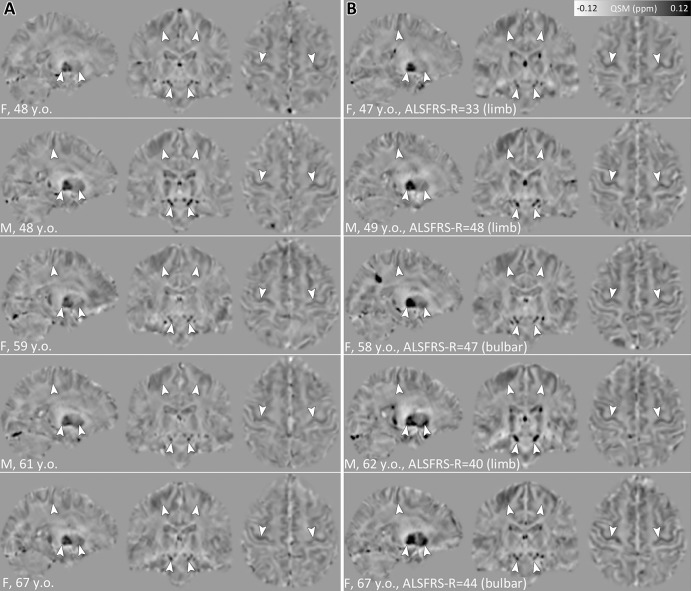
Purpose To investigate the whole-brain landscape of iron-related abnormalities in amyotrophic lateral sclerosis (ALS) by using the in vivo MRI technique of quantitative susceptibility mapping (QSM). Materials and Methods For this prospective study, 28 patients with ALS (mean age, 61 years; age range, 43-77 years; 18 men [mean age, 61 years; range, 43-77 years] and 10 women [mean age, 61 years; range, 47-74 years]) recruited between January 17, 2014, and September 4, 2015, and 39 matched control subjects (mean age, 61 years; age range, 39-77 years; 24 men [mean age, 62 years; range, 39-77 years] and 15 women [mean age, 59 years; range, 39-73 years]) were examined by using structural and susceptibility 3.0-T MRI techniques. Group data were cross sectionally compared with family-wise error (FWE) corrections by using voxel-based morphometry (random-field theory), cortical thickness analysis (Monte Carlo simulated), subcortical volumetry (Bonferroni-corrected Wilcoxon rank-sum testing), and QSM analysis (cluster-enhanced whole-brain permutation testing and Bonferroni-corrected rank-sum testing in regions of interest). In patients with ALS, a potential relationship between diffusion and susceptibility measurements in the corticospinal tracts (CSTs) was also examined by using Spearman rank-correlation tests. Results Conventional structural measures failed to identify atrophy in the present cohort (FWE P > .05). However, QSM identified several whole-brain abnormalities (FWE P < .05) in ALS. Regionally, higher susceptibility (expressed as means in parts per million ± standard errors of the mean) was confirmed in the motor cortex (ALS = 0.0188 ± 0.0003, control = 0.0173 ± 0.0003; P < .001), the left substantia nigra (ALS = 0.127 ± 0.004, control = 0.113 ± 0.003; P = .008), the right substantia nigra (ALS = 0.141 ± 0.005, control = 0.120 ± 0.003; P < .001), the globus pallidus (ALS = 0.086 ± 0.003, control = 0.075 ± 0.002; P = .003), and the red nucleus (ALS = 0.115 ± 0.004, control = 0.098 ± 0.003; P < .001). Lower susceptibility was found in CST white matter (ALS = -0.047 ± 0.001, control = -0.043 ± 0.001; P = .01). Nigral and pallidal QSM values were cross correlated in ALS (ρ2 = 0.42, P < .001), a phenomenon visually traceable in many individual patients. QSM in the CST in ALS also correlated with diffusion-tensor metrics in this tract (ρ2 = 0.25, P = .007). Conclusion Whole-brain MRI quantitative susceptibility mapping analysis is sensitive to tissue alterations in amyotrophic lateral sclerosis that may be relevant to pathologic changes. © RSNA, 2018.
Figures


References
-
- Lomen-Hoerth C, Murphy J, Langmore S, Kramer JH, Olney RK, Miller B. Are amyotrophic lateral sclerosis patients cognitively normal? Neurology 2003;60(7):1094–1097. - PubMed
-
- Neumann M, Sampathu DM, Kwong LK, et al. . Ubiquitinated TDP-43 in frontotemporal lobar degeneration and amyotrophic lateral sclerosis. Science 2006;314(5796):130–133. - PubMed
-
- Wang Q, Zhang X, Chen S, et al. . Prevention of motor neuron degeneration by novel iron chelators in SOD1(G93A) transgenic mice of amyotrophic lateral sclerosis. Neurodegener Dis 2011;8(5):310–321. - PubMed
Publication types
MeSH terms
Substances
Grants and funding
LinkOut - more resources
Full Text Sources
Other Literature Sources
Medical
Miscellaneous