. 2018 Jul 10:9:1549.
doi: 10.3389/fmicb.2018.01549. eCollection 2018.

Characterization of NDM-Encoding Plasmids From Enterobacteriaceae Recovered From Czech Hospitals

Affiliations

Characterization of NDM-Encoding Plasmids From Enterobacteriaceae Recovered From Czech Hospitals

Veronika Paskova et al. Front Microbiol. .

Abstract

The aim of the present study was to characterize sporadic cases and an outbreak of NDM-like-producing Enterobacteriaceae recovered from hospital settings, in Czechia. During 2016, 18 Entrobacteriaceae isolates including 10 Enterobacter cloacae complex (9 E. xiangfangensis and 1 E. asburiae), 4 Escherichia coli, 1 Kluyvera intermedia, 1 Klebsiella pneumoniae, 1 Klebsiella oxytoca, and 1 Raoultella ornithinolytica that produced NDM-like carbapenemases were isolated from 15 patients. Three of the patients were colonized or infected by two different NDM-like producers. Moreover, an NDM-4-producing isolate of E. cloacae complex, isolated in 2012, was studied for comparative purposes. All isolates of E. cloacae complex, except the E. asburiae, recovered from the same hospital, were assigned to ST182. Additionally, two E. coli belonged to ST167, while the remaining isolates were not clonally related. Thirteen isolates carried blaNDM-4, while six isolates carried blaNDM-1 (n = 3) or blaNDM-5 (n = 3). Almost all isolates carried blaNDM-like-carrying plasmids being positive for the IncX3 allele, except ST58 E. coli and ST14 K. pneumoniae isolates producing NDM-1. Analysis of plasmid sequences revealed that all IncX3 blaNDM-like-carrying plasmids exhibited a high similarity to each other and to previously described plasmids, like pNDM-QD28, reported from worldwide. However, NDM-4-encoding plasmids differed from other IncX3 plasmids by the insertion of a Tn3-like transposon. On the other hand, the ST58 E. coli and ST14 K. pneumoniae isolates carried two novel NDM-1-encoding plasmids, pKpn-35963cz, and pEsco-36073cz. Plasmid pKpn-35963cz that was an IncFIB(K) molecule contained an acquired sequence, encoding NDM-1 metallo-β-lactamase (MβL), which exhibited high similarity to the mosaic region of pS-3002cz from an ST11 K. pneumoniae from Czechia. Finally, pEsco-36073cz was a multireplicon A/C2+R NDM-1-encoding plasmid. Similar to other type 1 A/C2 plasmids, the blaNDM-1 gene was located within the ARI-A resistance island. These findings underlined that IncX3 plasmids have played a major role in the dissemination of blaNDM-like genes in Czech hospitals. In combination with further evolvement of NDM-like-encoding MDR plasmids through reshuffling, NDM-like producers pose an important public threat.

Keywords: Enterobacter xiangfangensis; IncX3; NDM; ST182; metallo-β-lactamases.


Figures
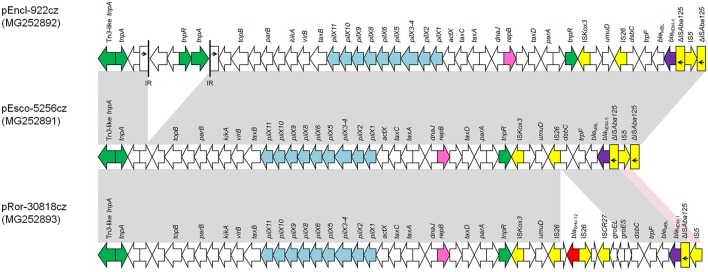
Figure 1
Figure 1
Comparison of linear maps of the NDM-like-encoding IncX3 plasmids pEncl-922cz, pEsco-5256cz, and pRor-30818cz. Arrows show the direction of transcription of open reading frames (ORFs), while truncated ORFs appear as rectangles (arrows within rectangles indicate the direction of transcription). Replicons of the plasmids are shown in pink. blaNDM-like genes are shaded purple, while other resistance genes are shown in red. IS elements and transposases are shown in yellow and green, respectively. Light blue arrows indicate genes responsible for the conjugative transfer of the plasmids. The remaining genes, including plasmid scaffold regions, are shown in white. Homologous segments (representing ≥99% sequence identity) are indicated by light gray shading, while pink shading shows inverted homologous segments.
Figure 2
Figure 2
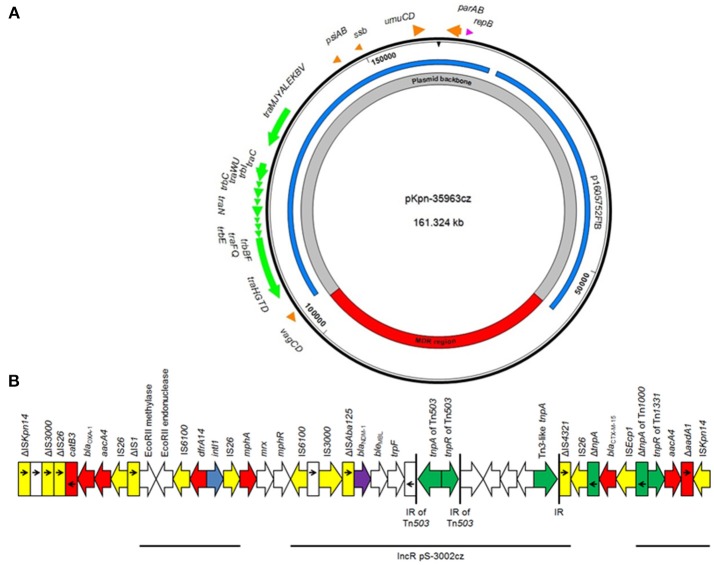
(A) Overview of the plasmid pKpn-35963cz. The innermost circles show the main regions of the plasmids. Similarities with other plasmids are shown in the next circle; each color represents a unique plasmid. In the outer circle, indicative genes and the direction of transcription are shown by arrows. Replicons of the plasmid are indicated as pink arrows. Genes responsible for plasmid transfer and maintenance are shown in green and orange, respectively. (B) Linear map of the multidrug resistance region (MDR) of the plasmid pKpn-35963cz. Arrows show the direction of transcription of open reading frames (ORFs), while truncated ORFs appear as rectangles (arrows within rectangles indicate the direction of transcription). blaNDM-like genes are shaded purple, while other resistance genes are shown in red. IS elements and transposases are shown in yellow and green, respectively. intI1 genes are shaded blue. The remaining genes are shown in white. Thin lines below the map correspond to highly similar sequences from other plasmids.
Figure 3
Figure 3
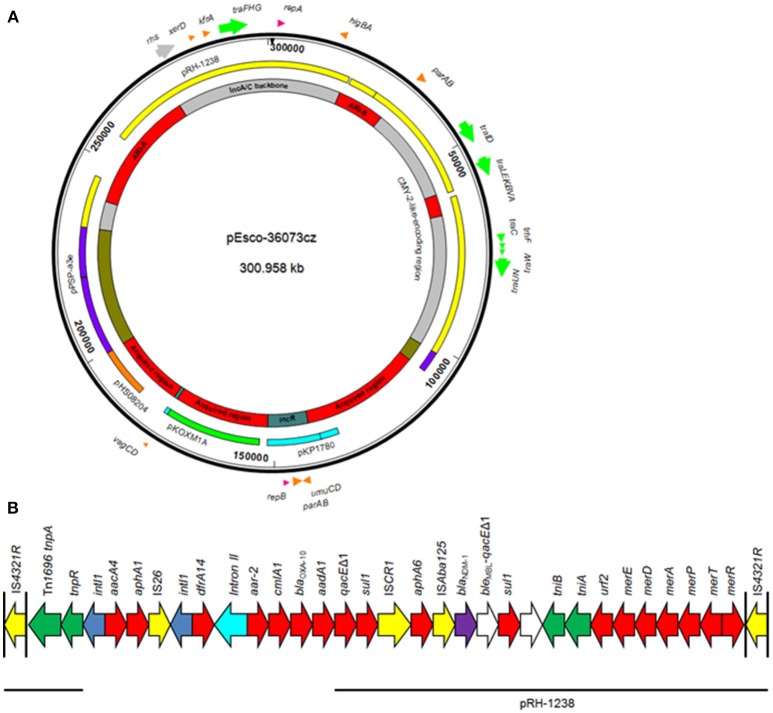
(A) Overview of the plasmid pEsco-36073cz. The innermost circles show the main regions of the plasmids. Similarities with other plasmids are shown in the next circle; each color represents a unique plasmid. In the outer circle, indicative genes and the direction of transcription are shown by arrows. Replicons of the plasmid are indicated as pink arrows. Genes responsible for plasmid transfer and maintenance are shown in green and orange, respectively. (B) Linear map of the ARI-A resistance island of the plasmid pEsco-36073cz. Arrows show the direction of transcription of open reading frames (ORFs), while truncated ORFs appear as rectangles (arrows within rectangles indicate the direction of transcription). blaNDM-like genes are shaded purple, while other resistance genes are shown in red. IS elements and transposases are shown in yellow and green, respectively. intI1 genes are shaded blue; teal blue arrow indicates the group II intron. The remaining genes are shown in white. Thin lines below the map correspond to highly similar sequences from other plasmids.

References

    1. Bankevich A., Nurk S., Antipov D., Gurevich A. A., Dvorkin M., Kulikov A. S., et al. . (2012). SPAdes: a new genome assembly algorithm and its applications to single-cell sequencing. J. Comp. Biol. 19,455–477. 10.1089/cmb.2012.0021 - DOI - PMC - PubMed
    1. Barton B. M., Harding G. P., Zuccarelli A. J. (1995). A general method for detecting and sizing large plasmids. Anal. Biochem. 226, 235–240. 10.1006/abio.1995.1220 - DOI - PubMed
    1. Bocanegra-Ibarias P., Garza-González E., Morfín-Otero R., Barrios H., Villarreal-Treviño L., Rodríguez-Noriega E., et al. . (2017). Molecular and microbiological report of a hospital outbreak of NDM-1-carrying Enterobacteriaceae in Mexico. PLoS ONE 12:e0179651. 10.1371/journal.pone.0179651 - DOI - PMC - PubMed
    1. Bolger A. M., Lohse M., Usadel B. (2014). Trimmomatic: a flexible trimmer for illumina sequence data. Bioinformatics 30, 2114–2120. 10.1093/bioinformatics/btu170 - DOI - PMC - PubMed
    1. Carattoli A., Bertini A., Villa L., Falbo V., Hopkins K. L., Threlfall E. J. (2005). Identification of plasmids by PCR-based replicon typing. J. Microbiol. Methods 63, 219–228. 10.1016/j.mimet.2005.03.018 - DOI - PubMed

LinkOut - more resources