


The peptide glycyl-ʟ-histidyl-ʟ-lysine is an endogenous antioxidant in living organisms, possibly by diminishing hydroxyl and peroxyl radicals
- PMID: 30042814
- PMCID: PMC6055086
The peptide glycyl-ʟ-histidyl-ʟ-lysine is an endogenous antioxidant in living organisms, possibly by diminishing hydroxyl and peroxyl radicals
Abstract
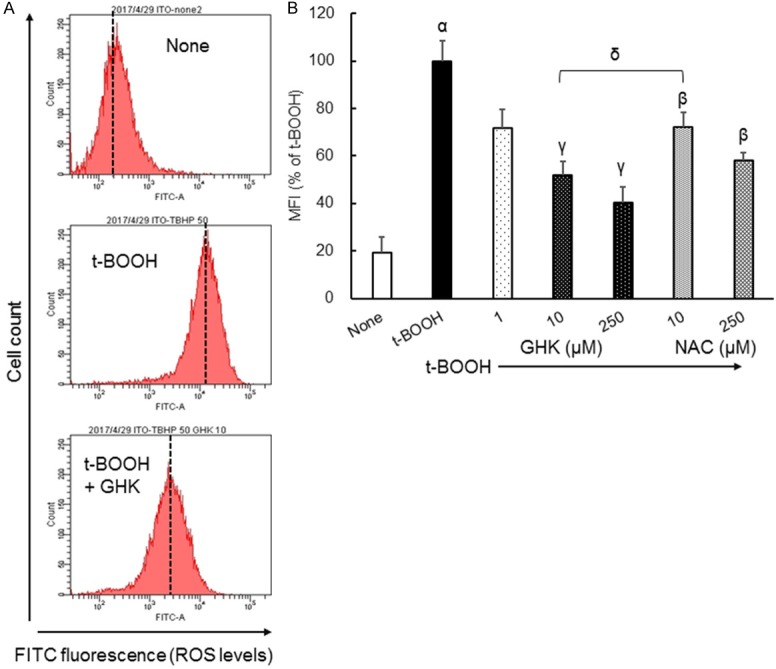
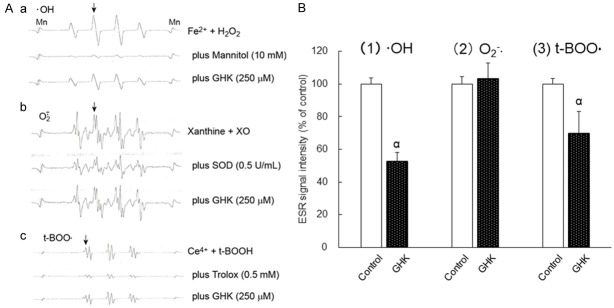
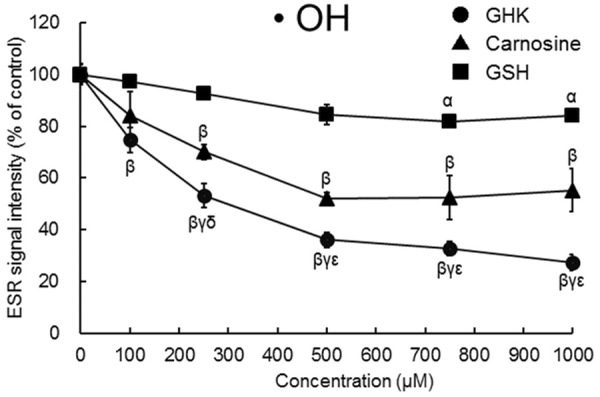
Despite evidence that tripeptide glycyl-ʟ-histidyl-ʟ-lysine (GHK) is an endogenous antioxidant, its mechanism and importance are not fully understood. In the present study, the ability of GHK to reduce levels of reactive oxygen species (ROS) in Caco-2 cells was evaluated by flow cytometry with the oxidation-sensitive fluorescent dye 2',7'-dichlorodihydrofluorescein diacetate. Further, types of ROS diminished by GHK were assessed by utilizing an electron spin resonance (ESR) spin-trapping technique. GHK reduced the tert-butyl hydroperoxide-induced increase in ROS levels in Caco-2 cells at concentrations of 10 µM or less. Experiments utilizing an ESR spin-trapping technique revealed that, among hydroxyl (·OH), superoxide (O2-·), and peroxyl (ROO·) radicals generated by respective chemical reaction systems, GHK diminished signals of both ·OH and ROO·, but not O2-·. Additionally, the GHK effect on the signal of ·OH was much stronger than those of other well-known antioxidative, endogenous peptides, carnosine and reduced glutathione. These results suggest that GHK can function as an endogenous antioxidant in living organisms, possibly by diminishing ·OH and ROO·.
Keywords: Glycyl-ʟ-histidyl-ʟ-lysine; endogenous antioxidant; hydroxyl radical; oxidative stress; peroxyl radical.
Conflict of interest statement
None.
Figures
References
-
- Pickart L, Thaler MM. Tripeptide in human serum which prolongs survival of normal liver cells and stimulates growth in neoplastic liver. Nat New Biol. 1973;234:85–87. - PubMed
-
- Kukowska M, Dzierzbicka K. Developments in the synthesis and biological activity of Glycyl-L-Histydyl-L-Lysine derivatives. Curr Med Chem. 2014;221:1505–1521. - PubMed
-
- Kukowska M, Kukowska-Kaszuba M, Dzierzbicka K. In vitro studies of antimicrobial activity of Gly-His-Lys conjugates as potential and promising candidates for therapeutics in skin and tissue infections. Bioorg Med Chem Lett. 2015;25:542–546. - PubMed
-
- Pickart L. The human tri-peptide GHK and tissue remodeling. J Biomater Sci Polym Ed. 2008;19:969–988. - PubMed
LinkOut - more resources
Full Text Sources
Miscellaneous