


Development of a comprehensive noninvasive prenatal test
- PMID: 30043834
- PMCID: PMC6136382
- DOI: 10.1590/1678-4685-GMB-2017-0177
Development of a comprehensive noninvasive prenatal test
Abstract
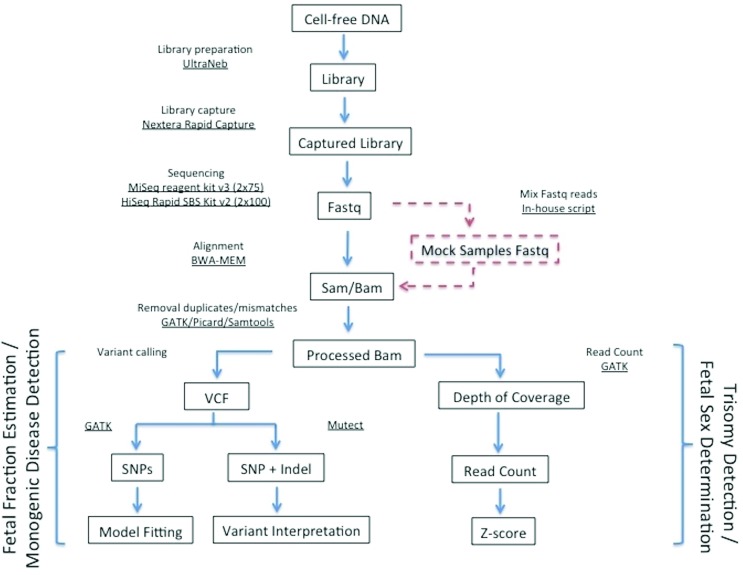
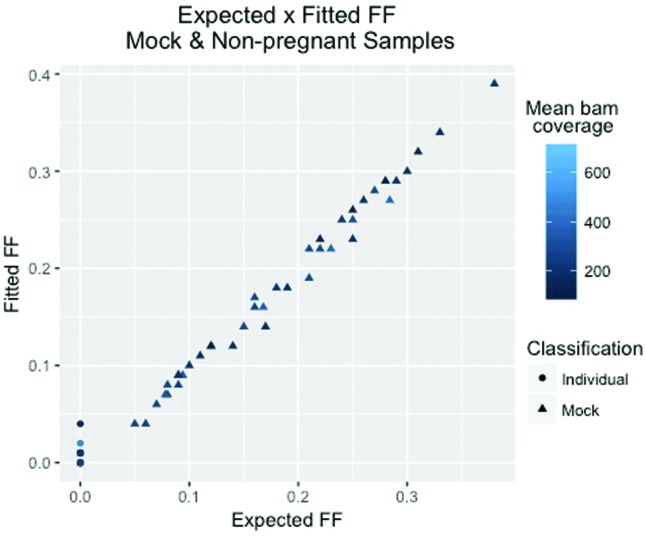
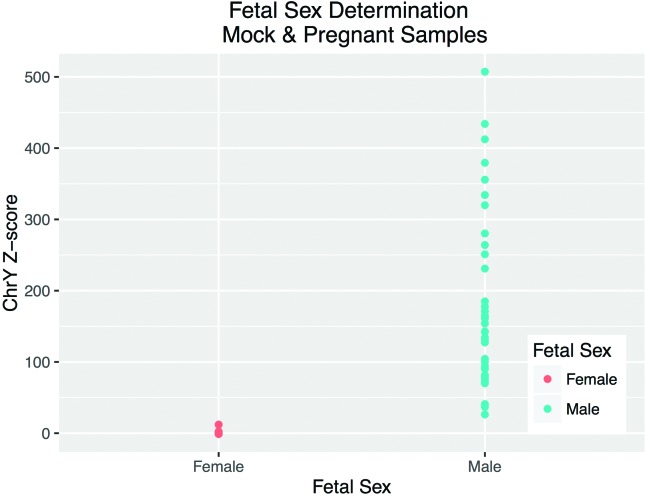
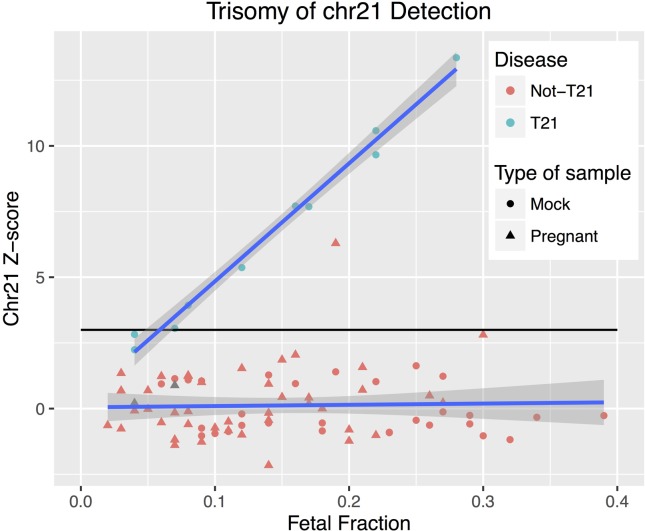
Our aim was to develop and apply a comprehensive noninvasive prenatal test (NIPT) by using high-coverage targeted next-generation sequencing to estimate fetal fraction, determine fetal sex, and detect trisomy and monogenic disease without parental genotype information. We analyzed 45 pregnancies, 40 mock samples, and eight mother-child pairs to generate 35 simulated datasets. Fetal fraction (FF) was estimated based on analysis of the single nucleotide polymorphism (SNP) allele fraction distribution. A Z-score was calculated for trisomy of chromosome 21 (T21), and fetal sex detection. Monogenic disease detection was performed through variant analysis. Model validation was performed using the simulated datasets. The novel model to estimate FF was robust and accurate (r2= 0.994, p-value < 2.2e-16). For samples with FF > 0.04, T21 detection had 100% sensitivity (95% CI: 63.06 to 100%) and 98.53% specificity (95% CI: 92.08 to 99.96%). Fetal sex was determined with 100% accuracy. We later performed a proof of concept for monogenic disease diagnosis of 5/7 skeletal dysplasia cases. In conclusion, it is feasible to perform a comprehensive NIPT by using only data from high coverage targeted sequencing, which, in addition to detecting trisomies, also make it possible to identify pathogenic variants of the candidate genes for monogenic diseases.
Figures
References
-
- Ashoor G, Poon L, Syngelaki A, Mosimann B, Nicolaides KH. Fetal fraction in maternal plasma cell-free DNA at 11-13 weeks' gestation: Effect of maternal and fetal factors. Fetal Diagn Ther. 2012;31:237–243. - PubMed
-
- Bianchi DW, Chudova D, Sehnert AJ, Bhatt S, Murray K, Prosen TL, Garber JE, Wilkins-Haug L, Vora NL, Warsof S, et al. Noninvasive prenatal testing and incidental detection of occult maternal malignancies. JAMA. 2015;314:162. - PubMed
-
- Bonafe L, Cormier-Daire V, Hall C, Lachman R, Mortier G, Mundlos S, Nishimura G, Sangiorgi L, Savarirayan R, Sillence D, et al. Nosology and classification of genetic skeletal disorders: 2015 revision. Am J Med Genet Part A. 2015;167:2869–2892. - PubMed
-
- Chiu RWK, Sun H, Akolekar R, Clouser C, Lee C, McKernan K, Zhou D, Nicolaides KH, Lo YMD. Maternal plasma DNA analysis with massively parallel sequencing by ligation for noninvasive prenatal diagnosis of trisomy 21. Clin Chem. 2010;56:459–463. - PubMed
LinkOut - more resources
Full Text Sources
Other Literature Sources
