


Overnight memory consolidation facilitates rather than interferes with new learning of similar materials-a study probing NMDA receptors
- PMID: 30046156
- PMCID: PMC6135744
- DOI: 10.1038/s41386-018-0139-0
Overnight memory consolidation facilitates rather than interferes with new learning of similar materials-a study probing NMDA receptors
Abstract
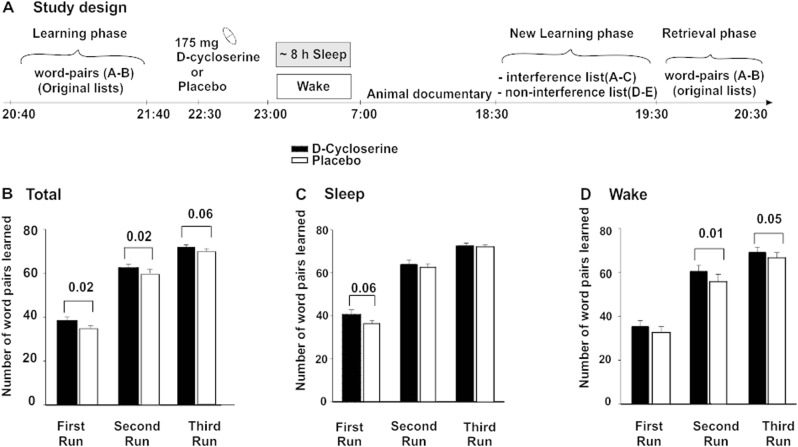
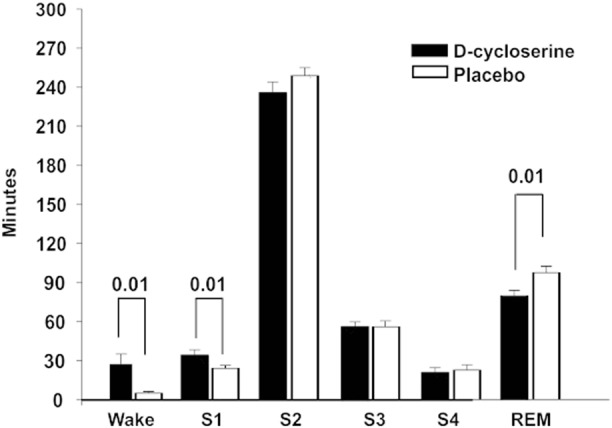
Although sleep-dependent consolidation and its neurochemical underpinnings have been strongly researched, less is known about how consolidation during sleep affects subsequent learning. Since sleep enhances memory, it can be expected to pro-actively interfere with learning after sleep, in particular of similar materials. This pro-active interference should be enhanced by substances that benefit consolidation during sleep, such as D-cycloserine. We tested this hypothesis in two groups (Sleep, Wake) of young healthy participants receiving on one occasion D-cycloserine (175 mg) and on another occasion placebo, according to a double-blind balanced crossover design. Treatment was administered after participants had learned a set of word pairs (A-B list) and before nocturnal retention periods of sleep vs. wakefulness. After D-cycloserine blood plasma levels had dropped to negligible amounts, i.e., the next day in the evening, participants learned, in three sequential runs, new sets of word pairs. One list-to enhance interference-consisted of the same cue words as the original set paired with a new target word (A-C list) and the other of completely new cue words (D-E set). Unexpectedly, during post-retention learning the A-C interference list was generally better learned than the completely new D-E list, which suggests that consolidation of previously encoded similar material enhances memory integration rather than pro-active interference. Consistent with this view, new learning of word pairs was better after sleep than wakefulness. Similarly, D-cycloserine generally enhanced learning of new word pairs, compared to placebo. This effect being independent of sleep or wakefulness, leads us to speculate that D-cycloserine, in addition to enhancing sleep-dependent consolidation, might mediate a time-dependent process of active forgetting.
Conflict of interest statement
The authors declare no competing interests.
Figures
References
Publication types
MeSH terms
Substances
Grants and funding
LinkOut - more resources
Full Text Sources
Other Literature Sources
