


Factors Associated with Prescribing Broad-Spectrum Antibiotics for Children with Upper Respiratory Tract Infections in Ambulatory Care Settings
- PMID: 30046262
- PMCID: PMC6055249
- DOI: 10.1177/1179556518784300
Factors Associated with Prescribing Broad-Spectrum Antibiotics for Children with Upper Respiratory Tract Infections in Ambulatory Care Settings
Erratum in
-
Corrigendum.Clin Med Insights Pediatr. 2018 Dec 27;12:1179556518800765. doi: 10.1177/1179556518800765. eCollection 2018. Clin Med Insights Pediatr. 2018. PMID: 30627003 Free PMC article.
Abstract
Objectives: Broad-spectrum antibiotics are frequently prescribed for children with upper respiratory tract infections (URI). Excessive use of broad-spectrum antibiotics leads to the emergence of resistant bacteria. This study aimed to identify factors associated with prescribing broad-spectrum antibiotics among children younger than 18 years presenting with URI in outpatient settings.
Methods: We conducted a cross-sectional analysis of the National Ambulatory Medical Care Survey (NAMCS) and the National Hospital Ambulatory Medical Care Survey-Outpatient Departments (NHAMCS-OPD) between 2006 and 2010. Descriptive statistics of visits from children with URI were estimated. Simple and multiple logistic regression analyses were used to identify socio-demographic and clinical characteristics associated with broad-spectrum antibiotic prescribing. We also completed a stratified analysis by age (⩽2 vs >2).
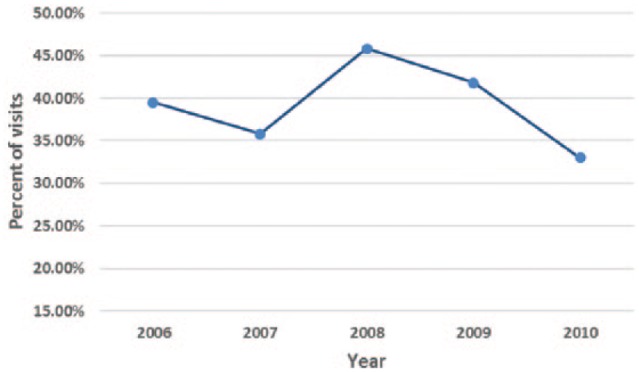
Results: A total of 4013 outpatient visits for children with URI from both NAMCS and NHAMCS-0PD data were examined. Broad-spectrum antibiotics were prescribed in 39% of the visits, accounting for an estimated 6.8 million visits annually. Multivariable analysis showed that visits in the South region (odds ratio [OR] = 2.38; 95% confidence interval [CI]: 1.38-4.10) compared with the West region and visits with diagnoses of acute sinusitis (OR = 2.77; 95% CI: 1.65-4.63) and acute otitis media (OR = 1.90; 95% CI: 1.32-2.74) compared with those with acute pharyngitis were associated with greater odds of broad-spectrum antibiotic prescribing.
Conclusions: The prescribing of broad-spectrum antibiotics is common for children with URI in ambulatory care settings. Diagnosis and management of URI remain a critical area for awareness campaigns promoting judicious use of antibiotics.
Keywords: Antibiotics; pediatrics; prescribing patterns; respiratory tract infections.
Conflict of interest statement
Declaration of conflicting interests:The author(s) declared no potential conflicts of interest with respect to the research, authorship, and/or publication of this article.
Figures
References
-
- Centers for Disease Control and Prevention. Get smart campaign. http://www.cdc.gov/getsmart/campaign-materials/about-campaign.html. Published 2013. Accessed May 2, 2015.
-
- Cherry DK, Hing E, Woodwell DA, et al. National Ambulatory Medical Care Survey: 2006 summary. Natl Health Stat Report. 2008;3:1–39. - PubMed
LinkOut - more resources
Full Text Sources
Other Literature Sources
