


doi: 10.1371/journal.ppat.1007082.
eCollection 2018 Jul.
Beyond the myths: Novel findings for old paradigms in the history of the smallpox vaccine
Affiliations
- PMID: 30048524
- PMCID: PMC6062137
- DOI: 10.1371/journal.ppat.1007082
Item in Clipboard
Beyond the myths: Novel findings for old paradigms in the history of the smallpox vaccine
PLoS Pathog.
.
No abstract available
Conflict of interest statement
The authors have declared that no competing interests exist.
Figures
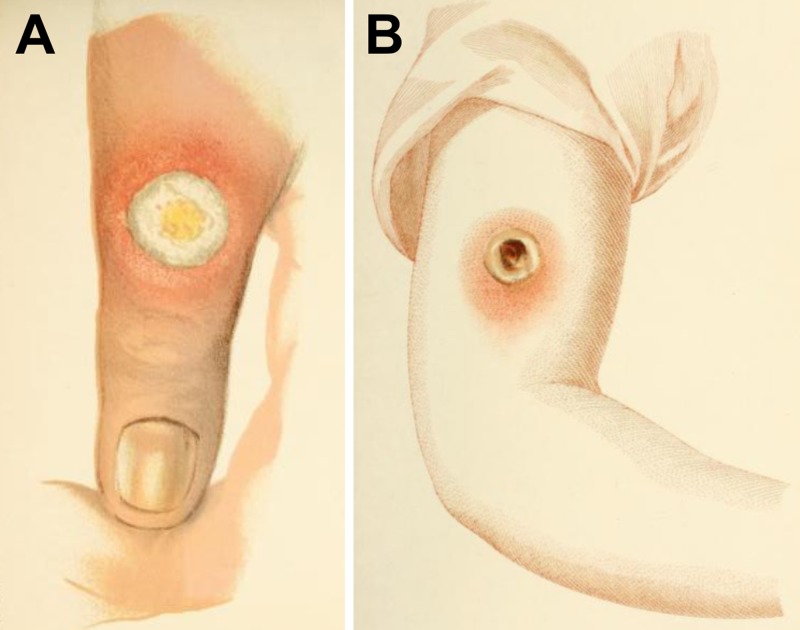
(A) Old illustration depicting a cowpox lesion on the finger of milker William Plowman 5 days after the onset of vesicle formation. December 2, 1887. (B) Old illustration depicting a horsepox lesion on the arm of 5-year-old John Baker, who was inoculated with the material taken from a horsepox lesion (equination) on the hand of a stableman by Edward Jenner. March 16, 1798. Reproduced for noncommercial research purposes from reference [8].
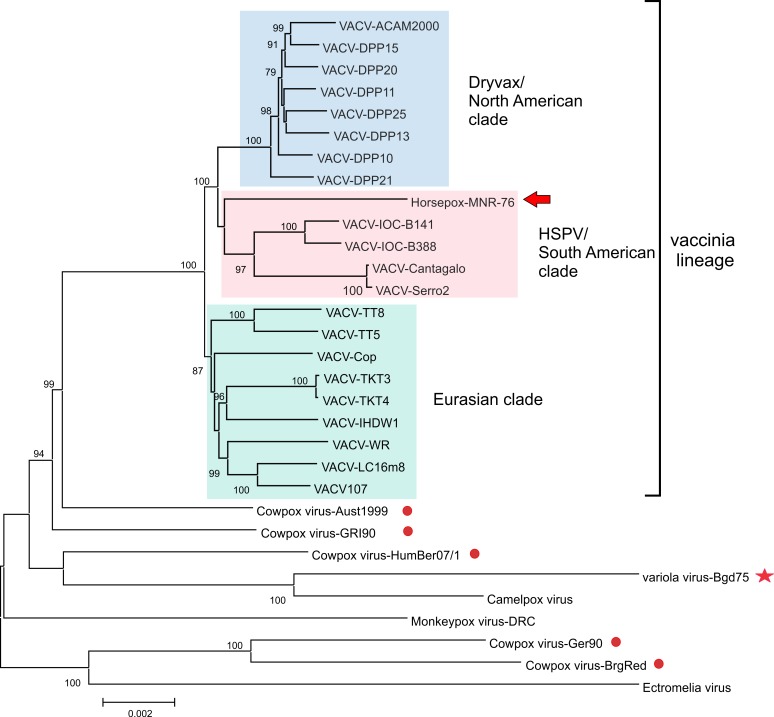
Phylogeny inference (a neighbor-joining tree with use of the Kimura 2-parameter substitution model and 1,000 bootstrap replicates) was based on the conserved region of the genome of 31 orthopoxviruses. Colored boxes highlight the 3 main clades of the vaccinia lineage. The red arrow points to HSPV, which groups within the HSPV/South American clade, together with the Brazilian IOC vaccine strain and the Brazilian field strains of vaccinia virus. The red circles indicate the position of different cowpox viruses, which are polyphyletic and group outside the vaccinia lineage. The red star indicates the position of variola virus. The scale bar indicates the number of substitutions per site. HSPV, horsepox virus; IOC, Instituto Oswaldo Cruz.
References
-
- Fenner F, Henderson DA, Arita I, Jezek Z, Ladnyi ID. Smallpox and its eradication. Geneva: World Health Organization; 1988. 1460 p.
-
- Esparza J, Schrick L, Damaso CR, Nitsche A. Equination (inoculation of horsepox): An early alternative to vaccination (inoculation of cowpox) and the potential role of horsepox virus in the origin of the smallpox vaccine. Vaccine. 2017;35(52):7222–30. Epub 2017/11/16. 10.1016/j.vaccine.2017.11.003 . - DOI - PubMed
-
- Jenner E. An inquiry into the causes and effects of the variolae vaccinae, a disease discovered in some of the western counties of England, particularly Gloucestershire, and known by the name of the cow pox. London: Sampson Low; 1798.
Publication types
MeSH terms
Substances
LinkOut - more resources
Full Text Sources
Other Literature Sources
Medical
