


The epilepsy bioinformatics study for anti-epileptogenic therapy (EpiBioS4Rx) clinical biomarker: Study design and protocol
- PMID: 30048805
- PMCID: PMC6344322
- DOI: 10.1016/j.nbd.2018.07.025
The epilepsy bioinformatics study for anti-epileptogenic therapy (EpiBioS4Rx) clinical biomarker: Study design and protocol
Abstract
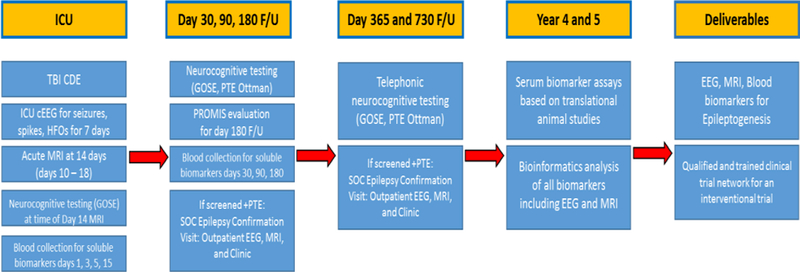
The Epilepsy Bioinformatics Study for Anti-epileptogenic Therapy (EpiBioS4Rx) is a longitudinal prospective observational study funded by the National Institute of Health (NIH) to discover and validate observational biomarkers of epileptogenesis after traumatic brain injury (TBI). A multidisciplinary approach has been incorporated to investigate acute electrical, neuroanatomical, and blood biomarkers after TBI that may predict the development of post-traumatic epilepsy (PTE). We plan to enroll 300 moderate-severe TBI patients with a frontal and/or temporal lobe hemorrhagic contusion. Acute evaluation with blood, imaging and electroencephalographic monitoring will be performed and then patients will be tracked for 2 years to determine the incidence of PTE. Validation of selected biomarkers that are discovered in planned animal models will be a principal feature of this work. Specific hypotheses regarding the discovery of biomarkers have been set forth in this study. An international cohort of 13 centers spanning 2 continents will be developed to facilitate this study, and for future interventional studies.
Copyright © 2018 Elsevier Inc. All rights reserved.
Figures
References
-
- Englander J, Bushnik T, Duong TT, et al. Analyzing risk factors for late posttraumatic seizures: a prospective, multicenter investigation. Arch Phys Med Rehabil 2003;84:365–373. - PubMed
-
- Asikainen I, Kaste M, Sarna S. Early and late posttraumatic seizures in traumatic brain injury rehabilitation patients: brain injury factors causing late seizures and influence of seizures on long-term outcome. Epilepsia 1999;40:584–589. - PubMed
-
- Annegers JF, Hauser WA, Coan SP, Rocca WA. A population-based study of seizures after traumatic brain injuries. N Engl J Med 1998;338:20–24. - PubMed
Publication types
MeSH terms
Substances
Grants and funding
LinkOut - more resources
Full Text Sources
Other Literature Sources
Medical
