


Factors Influencing Functional Heterogeneity in Human Mucosa-Associated Invariant T Cells
- PMID: 30050537
- PMCID: PMC6052907
- DOI: 10.3389/fimmu.2018.01602
Factors Influencing Functional Heterogeneity in Human Mucosa-Associated Invariant T Cells
Abstract
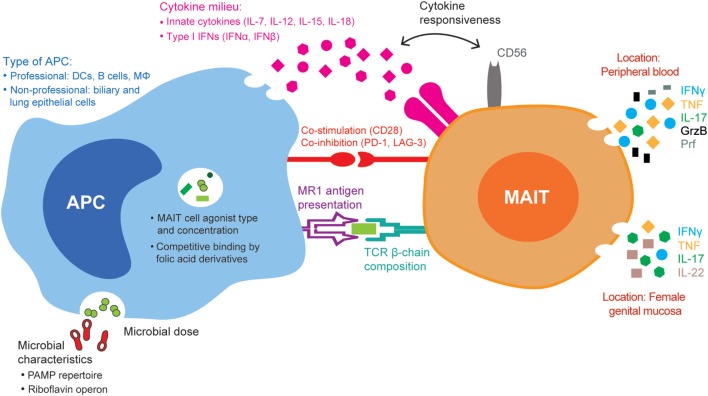
Mucosa-associated invariant T (MAIT) cells are unconventional innate-like T cells that recognize microbial riboflavin metabolites presented by the monomorphic MHC class I-related (MR1) molecule. Despite the high level of evolutionary conservation of MR1 and the limited diversity of known antigens, human MAIT cells and their responses may not be as homogeneous as previously thought. Here, we review recent findings indicating that MAIT cells display microbe-specific response patterns with multiple layers of heterogeneity. The natural killer cell receptor CD56 marks a MAIT cell subset with distinct response profile, and the T cell receptor β-chain diversity influences responsiveness at the single cell level. The MAIT cell tissue localization also influences their response profiles with higher IL-17 in tissue-resident MAIT cells. Furthermore, there is emerging evidence that the type of antigen-presenting cells, and innate cytokines produced by such cells, influence the quality of the ensuing MAIT cell response. On the microbial side, the expression patterns of MR1-presented antigenic and non-antigenic compounds, expression of other bioactive microbial products, and of innate pattern recognition ligands all influence downstream MAIT cell responses. These recent findings deepen our understanding of MAIT cell functional diversity and adaptation to the type and location of microbial challenge.
Keywords: CD56; MHC class I-related; antibacterial immunity; cytokines; microbial immunity; mucosa-associated invariant T cells; mucosal immunology.
Figures
References
-
- Tilloy F, Treiner E, Park SH, Garcia C, Lemonnier F, De La Salle H, et al. An invariant T cell receptor alpha chain defines a novel TAP-independent major histocompatibility complex class Ib-restricted alpha/beta T cell subpopulation in mammals. J Exp Med (1999) 189:1907–21.10.1084/jem.189.12.1907 - DOI - PMC - PubMed
Publication types
Grants and funding
LinkOut - more resources
Full Text Sources
Other Literature Sources
Research Materials
