Review
. 2018 Jun 29:3:36.
doi: 10.21037/tgh.2018.06.04. eCollection 2018.

Deregulation of methionine metabolism as determinant of progression and prognosis of hepatocellular carcinoma

Affiliations
Review

Deregulation of methionine metabolism as determinant of progression and prognosis of hepatocellular carcinoma

Rosa M Pascale et al. Transl Gastroenterol Hepatol. .

Abstract

The under-regulation of liver-specific MAT1A gene codifying for S-adenosylmethionine (SAM) synthesizing isozymes MATI/III, and the up-regulation of widely expressed MAT2A, MATII isozyme occurs in hepatocellular carcinoma (HCC). MATα1:MATα2 switch strongly contributes to the fall in SAM liver content both in rodent and human liver carcinogenesis. SAM administration to carcinogen-treated animals inhibits hepatocarcinogenesis. The opposite occurs in Mat1a-KO mice, in which chronic SAM deficiency is followed by HCC development. This review focuses upon the changes, induced by the MATα1:MATα2 switch, involved in HCC development. In association with MATα1:MATα2 switch there occurs, in HCC, global DNA hypomethylation, decline of DNA repair, genomic instability, and deregulation of different signaling pathways such as overexpression of c-MYC (avian myelocytomatosis viral oncogene homolog), increase of polyamine (PA) synthesis and RAS/ERK (Harvey murine sarcoma virus oncogene homolog/extracellular signal-regulated kinase), IKK/NF-kB (I-k kinase beta/nuclear factor kB), PI3K/AKT, and LKB1/AMPK axes. Furthermore, a decrease in MATα1 expression and SAM level induces HCC cell proliferation and survival. SAM treatment in vivo and enforced MATα1 overexpression or MATα2 inhibition, in cultured HCC cells, prevent these changes. A negative correlation of MATα1:MATα2 and MATI/III:MATII ratios with cell proliferation and genomic instability and a positive correlation with apoptosis and global DNA methylation are present in human HCC. Altogether, these data suggest that the decrease of SAM level and the deregulation of MATs are potential therapeutic targets for HCC.

Keywords: Hepatocarcinogenesis; S-adenosylmethionine (SAM); methionine metabolism; prognosis; signal transduction.


Conflict of interest statement

Conflicts of Interest: The authors have no conflicts of interest to declare.

Figures
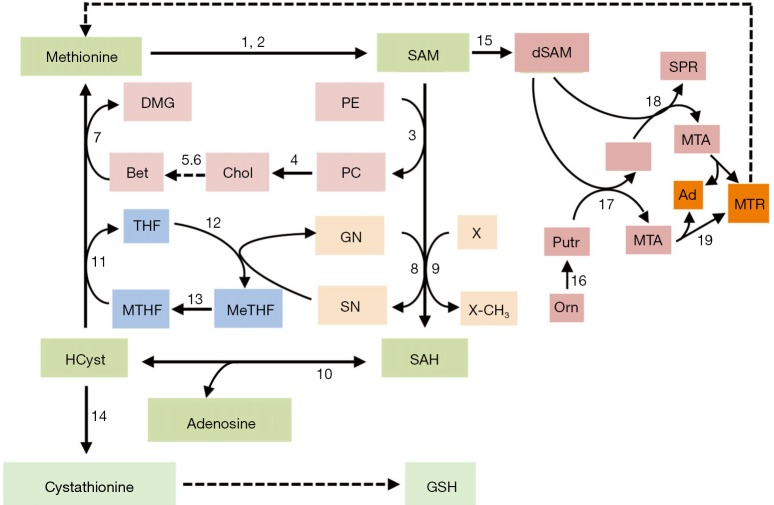
Figure 1
Figure 1
Metabolic cycles involved in methionine metabolism. Substrates: Ad, adenine; Bet, betaine; Chol, choline; DMG, dimethylglycine; dSAM, decarboxylated S-adenosylmethionine; GN, glycine; GSG, reduced glutathione; HCyst, homocysteine; MTHF, 5-methyltetrahydrofolate; MeTHF, 5-methenyltetrahydrofolate; MTA, 5'-methylthioadenosine; MTR, methylthioribose; Orn, ornithine; PC, phosphatidylcholine; PE, phosphatidylethanolamine; Putr, putrescine; SAH, S-adenosylhomocysteine; SAM S-adenosylmethionine; SN, sarcosine; SPD, spermidine; SPR, spermine; THF, tetrahydrofolate. Enzymes: 1, MATI/III; 2, MATII; 3, phospholipid N-methyltransferase; 4, various phospholipases; 5, choline oxidase; 6, betaine aldehyde dehydrogenase; 7, betaine homocysteine methyltransferase; 8, glycine N-methyltransferase; 9, various methyltransferases; 10, S-adenosylhomocysteine hydroxylase; 11, methyltetrahydrofolate reductase; 12, sarcosine dehydrogenase; 13, 5,10-methenyl-tetrahydrofolate reductase; 14, cystathionine synthetase; 15, S-adenosylmethionine decarboxylase; 16, ornithine decarboxylase; 17, spermine synthetase; 18, spermidine synthetase; 19, 5-methylthioadenosine nucleosidase. The dotted arrow indicates the “salvage pathway” for methionine resynthesis.
Figure 2
Figure 2
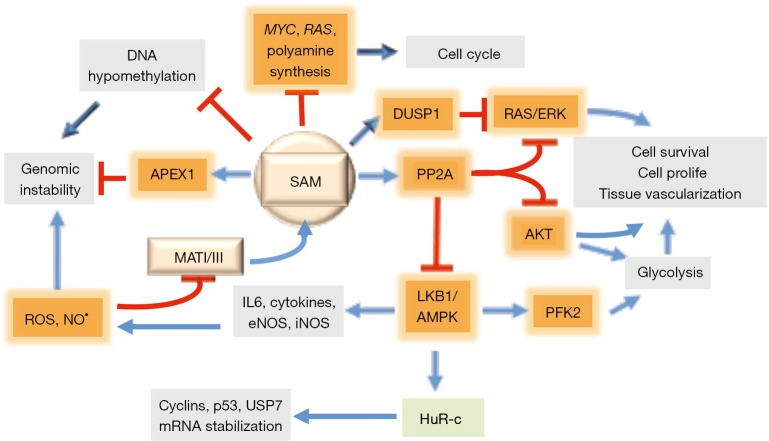
Effects of SAM treatment during hepatocarcinogenesis. SAM is involved in DNA methylation and stabilization of the DNA repair enzyme APEX1. SAM antioxidant activity reduces genomic instability. The inhibition by SAM of LKB1/AMPK axis increases cytoplasmic concentration of HuR, which stabilizes p53 and USP7 mRNAs. Through the control of the LKB1/AMPK axis, SAM impedes the production of IL6 and cytokines and the activation of iNOS and eNOS, thus limiting the oxidative damage. SAM also controls cell growth and survival by inducing PPA2 expression that phosphorylates and inactivates AKT and its targets. Moreover, PPA2 activation and DUSP1 stabilization inhibit RAS/ERK pathway. Finally, SAM affects cell cycle by inhibiting c-MYC expression and polyamine synthesis. SAM, S-adenosylmethionine. Adapted with permission from Frau et al., 2013.
Figure 3
Figure 3
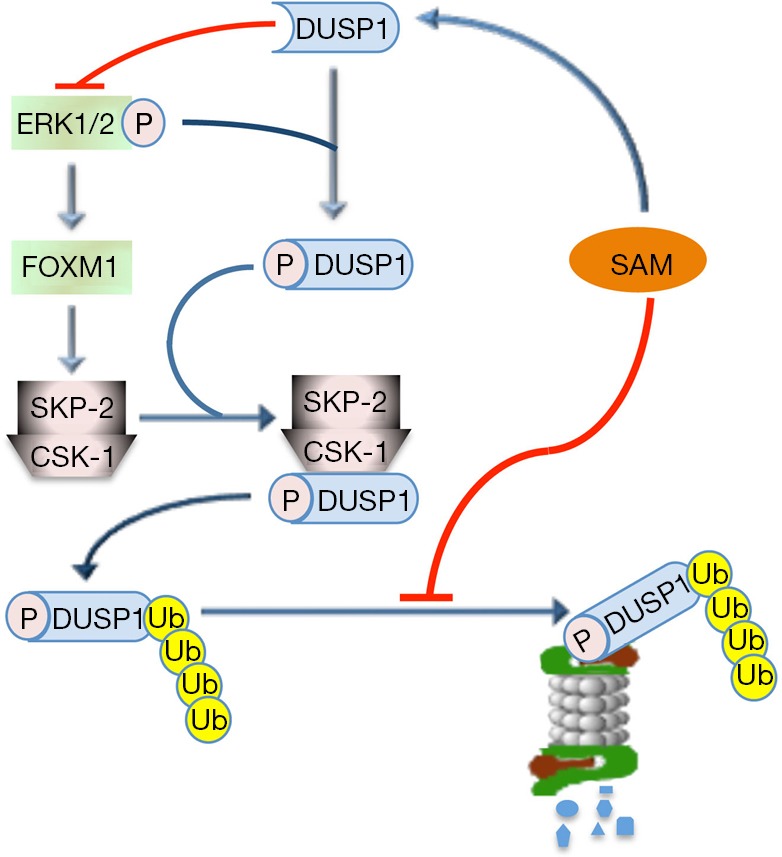
Interference of SAM with ERK1/2 inhibition by DUSP1. ERK1/2 inhibition by DUSP1 is controlled by DUSP1 phosphorylation at the Ser296 residue, followed by its ubiquitination by the SKP2–CKS1 ubiquitin ligase and proteasomal degradation. A control is also operated by FOXM1, an ERK1/2 target, that activates SKP2-CKS1. SAM enhances DUSP1 inhibitory effect by increasing DUSP1 mRNA transcription, and contributing to the increase in DUSP1 protein at post-translational levels, probably through inhibition of its proteasomal degradation. SAM, S-adenosylmethionine. Adapted with permission from Frau et al., 2013.

References

    1. Cavuoto P, Fenech MF. A review of methionine dependency and the role of methionine restriction in cancer growth control and life-span extension. Cancer Treat Rev 2012;38:726-36. 10.1016/j.ctrv.2012.01.004 - DOI - PubMed
    1. González B, Pajares MA, Hermoso JA, et al. The crystal structure of tetrameric methionine adenosyltransferase from rat liver reveals the methionine-binding site. J Mol Biol 2000;300:363-75. 10.1006/jmbi.2000.3858 - DOI - PubMed
    1. Mato JM, Lu SC. Role of S-adenosyl-l-methionine in liver health and injury. Hepatology 2007;45:1306-12. 10.1002/hep.21650 - DOI - PubMed
    1. Mato JM, Lu SC. Role of S-adenosylmethionine. In: Coates PM, Blackman MR, Levine M, et al. editors. Encyclopedia of Dietary Supplements 2nd ed. Dekker, New York, 2010:1-6.
    1. Lu SC. Glutathione synthesis. Biochim Biophys Acta 2013;1830:3143-53. 10.1016/j.bbagen.2012.09.008 - DOI - PMC - PubMed