. 2018 Sep 17;84(19):e01057-18.
doi: 10.1128/AEM.01057-18. Print 2018 Oct 1.

iac Gene Expression in the Indole-3-Acetic Acid-Degrading Soil Bacterium Enterobacter soli LF7

Affiliations

iac Gene Expression in the Indole-3-Acetic Acid-Degrading Soil Bacterium Enterobacter soli LF7

Isaac V Greenhut et al. Appl Environ Microbiol. .

Abstract

We show for soil bacterium Enterobacter soli LF7 that the possession of an indole-3-acetic acid catabolic (iac) gene cluster is causatively linked to the ability to utilize the plant hormone indole-3-acetic acid (IAA) as a carbon and energy source. Genome-wide transcriptional profiling by mRNA sequencing revealed that these iac genes, chromosomally arranged as iacHABICDEFG and coding for the transformation of IAA to catechol, were the most highly induced (>29-fold) among the relatively few (<1%) differentially expressed genes in response to IAA. Also highly induced and immediately downstream of the iac cluster were genes for a major facilitator superfamily protein (mfs) and enzymes of the β-ketoadipate pathway (pcaIJD-catBCA), which channels catechol into central metabolism. This entire iacHABICDEFG-mfs-pcaIJD-catBCA gene set was constitutively expressed in an iacR deletion mutant, confirming the role of iacR, annotated as coding for a MarR-type regulator and located upstream of iacH, as a repressor of iac gene expression. In E. soli LF7 carrying the DNA region upstream of iacH fused to a promoterless gfp gene, green fluorescence accumulated in response to IAA at concentrations as low as 1.6 μM. The iacH promoter region also responded to chlorinated IAA, but not other aromatics tested, indicating a narrow substrate specificity. In an iacR deletion mutant, gfp expression from the iacH promoter region was constitutive, consistent with the predicted role of iacR as a repressor. A deletion analysis revealed putative -35/-10 promoter sequences upstream of iacH, as well as a possible binding site for the IacR repressor.IMPORTANCE Bacterial iac genes code for the enzymatic conversion of the plant hormone indole-3-acetic acid (IAA) to catechol. Here, we demonstrate that the iac genes of soil bacterium Enterobacter soli LF7 enable growth on IAA by coarrangement and coexpression with a set of pca and cat genes that code for complete conversion of catechol to central metabolites. This work contributes in a number of novel and significant ways to our understanding of iac gene biology in bacteria from (non-)plant environments. More specifically, we show that LF7's response to IAA involves derepression of the MarR-type transcriptional regulator IacR, which is quite fast (less than 25 min upon IAA exposure), highly specific (only in response to IAA and chlorinated IAA, and with few genes other than iac, cat, and pca induced), relatively sensitive (low micromolar range), and seemingly tailored to exploit IAA as a source of carbon and energy.

Keywords: Enterobacter asburiae LF7a; Enterobacter soli LF7; IAA; auxin; iac genes; indole-3-acetic acid catabolism.


Figures

FIG 1
FIG 1
Graphical representation of the region of the E. soli LF7 chromosome (CP003026) which harbors the iacR-iacHABICDEFG gene cluster. Individual genes are represented as block arrows, and shown for each gene are its relative size, direction, and location, as well as the last two digits of its NCBI locus_tag Entas_24xx (e.g., for iacH, xx equals 83 because its locus tag is Entas_2483). Highlighted in black are the iac genes, in gray are the pcaIJD and catBCA genes. Line arrows indicate the size and direction of transcriptional units (operons) as predicted by FGENESB.
FIG 2
FIG 2
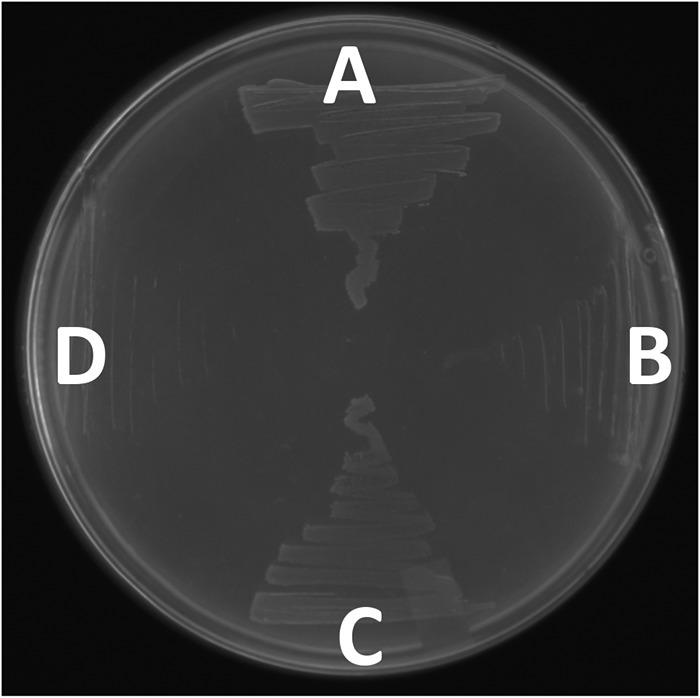
Wild-type E. soli LF7 (A), E. soli LF7 ΔiacA::cat (B), E. soli LF7 ΔiacR::cat (C), and negative control E. coli TOP10 (D) streaked on M9 minimal agar containing 5 mM IAA as the sole source of carbon and energy.
FIG 3
FIG 3
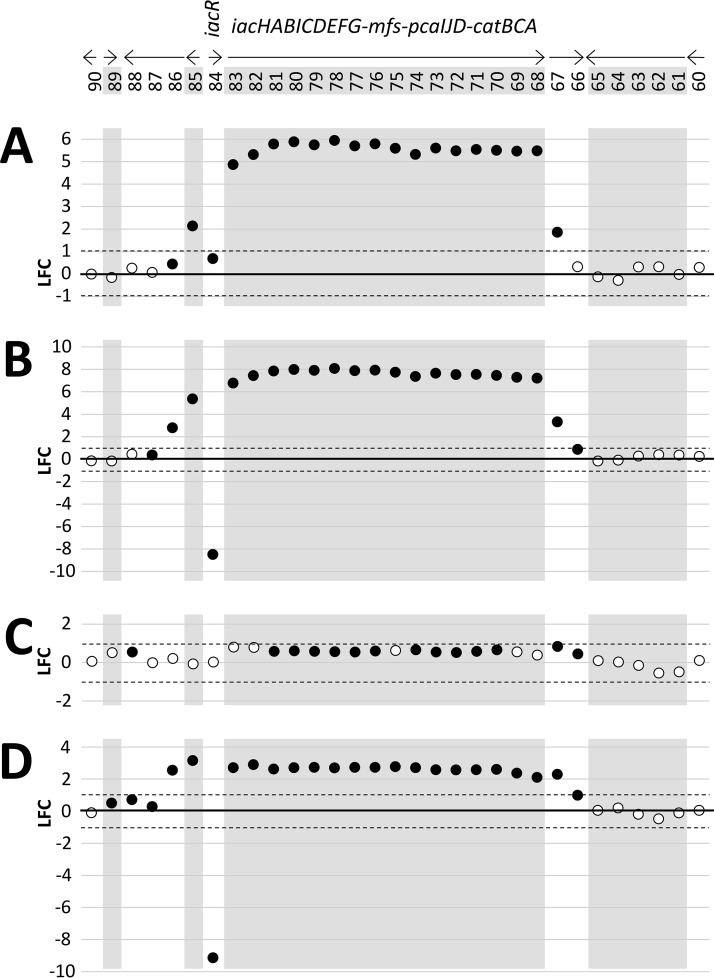
Relative differences in the transcript levels of genes within or near the iac gene cluster of succinate-grown E. soli LF7 wild-type (wt) and its ΔiacR derivative (mut), exposed (+) or not exposed (−) to IAA. Shown are log2-fold changes (LFC; see the text) for the following comparisons: (A) wt+IAA versus wt−IAA, (B) mut−IAA versus wt−IAA, (C) mut+IAA versus mut−IAA, and (D) mut+IAA versus wt+IAA. Genes are identified by the last two digits of their Entas_24xx locus tag number (see Fig. 1). Filled symbols represent genes for which the adjusted P values were <0.05. Dashed lines mark LFC = 1 and LFC = −1 (i.e., 2-fold higher or lower transcript levels, respectively).
FIG 4
FIG 4
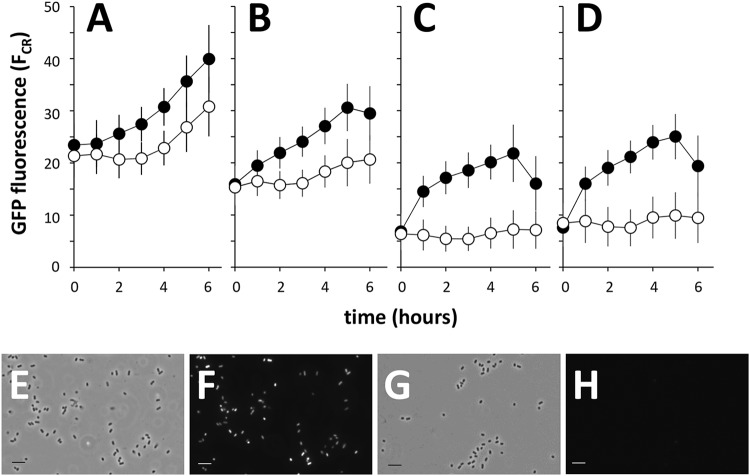
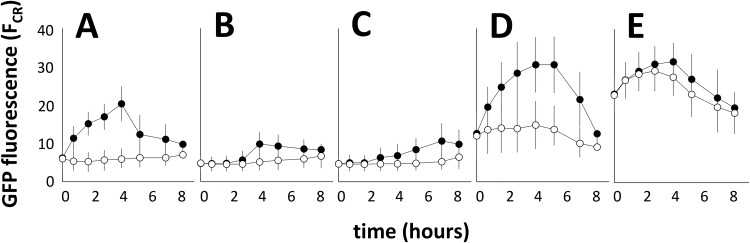
IAA-induced GFP fluorescence in E. soli LF7 cells carrying the iacH promoter region (PiacH) fused to the promoterless gfp gene variants tagless (A), ASV (B), AAV (C), or LVA (D). Shown as a function of time since induction with 200 μM IAA (•) or water (control, ○) are the means and standard deviations of single-cell GFP fluorescence (measured by flow cytometry and expressed as the cube root of FL-1, or FCR) in bacterial cultures growing exponentially on M9 with succinate. Fluorescence microscope images of E. soli LF7(pPiacH-gfp[AAV]) cells growing exponentially in M9 liquid medium containing 5 mM IAA (E, F) or 12.55 mM succinate (G, H). Shown are representative phase contrast (E, G) or GFP channel (F, H) images. Bars, 5 μm.
FIG 5
FIG 5
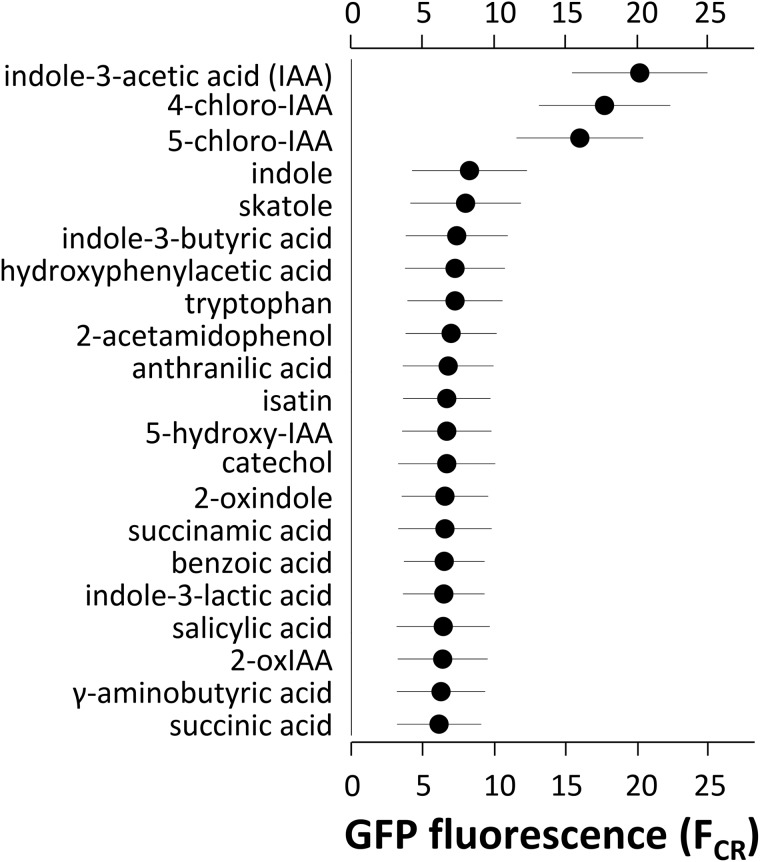
Means and standard deviations of single-cell GFP fluorescence of E. soli LF7(pPiacH-gfp[AAV]) growing in M9 liquid medium with succinate and exposed for 4 to 5 h to 200 μM IAA or one of the other compounds listed, before analysis of single-cell GFP fluorescence by flow cytometry. FCR, cube root of the mean of 30,000 cells registered by the FL-1 channel output in flow cytometry.
FIG 6
FIG 6
Mean GFP fluorescence (and standard deviation) in single cells of E. soli LF7(pPiacH-gfp[AAV]) growing exponentially on 12.55 mM succinate (A), 8.33 mM glucose (B), 8.33 mM fructose (C), 7.14 mM benzoate (D), or 5 mM IAA (E), and spiked at t = 0 with 200 μM IAA (•) or water control (○).
FIG 7
FIG 7
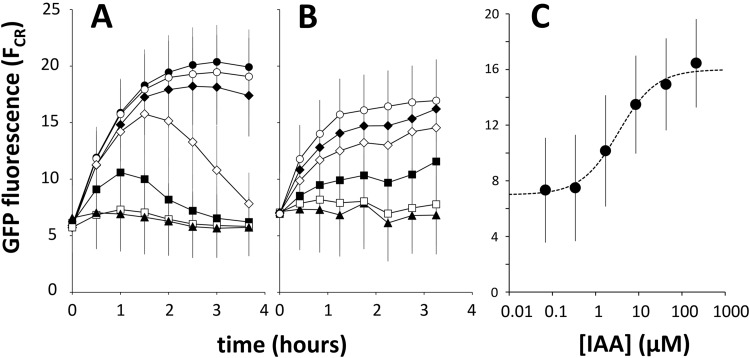
Accumulation of GFP fluorescence in E. soli LF7(pPiacH-gfp[AAV]) cells (A) or in E. soli LF7 ΔiacA::cat(pPiacH-gfp[AAV]) cells (B) in response to a range of IAA concentrations. Cells were growing exponentially in M9 medium supplemented with 12.55 mM succinate when they were exposed to IAA at time t = 0. IAA concentrations were as follows: •, 1 mM; ○, 200 μM; ◆, 40 μM, ♢ 8 μM; ■, 1.6 μM; ◽, 0.32 μM; ▲, no IAA. (C) IAA dose-response curve for E. soli LF7 ΔiacA::cat(pPiacH-gfp[AAV]) cells. Shown are the GFP fluorescence averages over the time period of 1.25 to 2.75 h after IAA exposure, as a function of IAA concentration. The stippled line represents the best fit of a Hill equation with a coefficient of 1 and a half-maximal GFP fluorescence at 3.4 μM IAA.
FIG 8
FIG 8
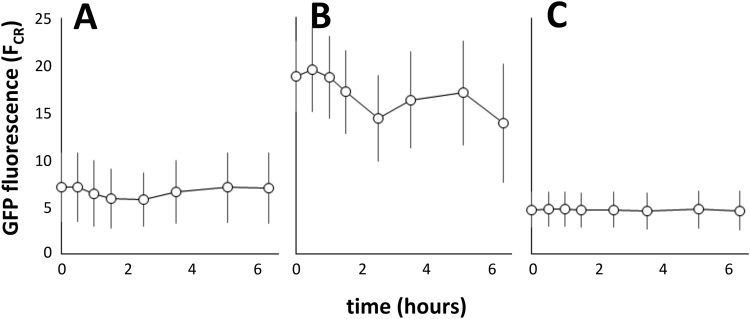
Single-cell GFP fluorescence of E. soli LF7(pPiacH-gfp[AAV]) (A), E. soli LF7 ΔiacR::cat(pPiacH-gfp[AAV]) (B), and E. soli LF7 ΔiacR::cat(piacR-PiacH-gfp[AAV]) (C) as a function of time. Cells were growing on M9 plus 12.5 mM succinate.
FIG 9
FIG 9
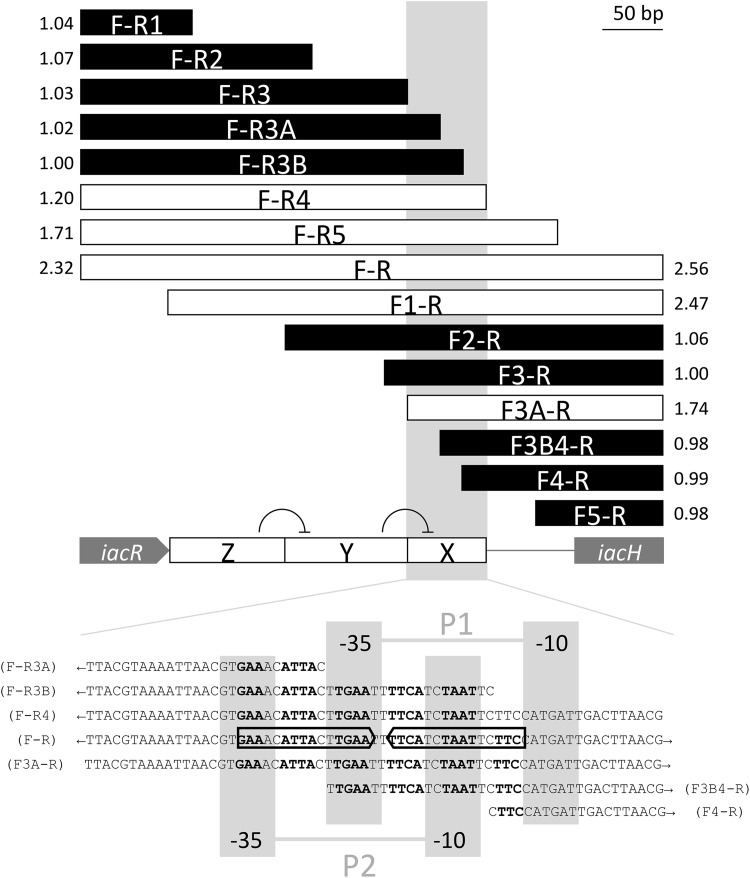
Deletion analysis of the iacR-iacH intergenic region to locate putative iacH promoters and IacR operator sites. The F-R bar represents the full 480-bp DNA fragment that was amplified from E. soli LF7 using primer pair F and R (Table 3) and fused to a promoterless gfp gene in pPROBE′-gfp[AAV] to test responsiveness to 200 μM IAA in a LF7 wild-type background. All other bars represent subfragments of F-R, using either F or R in combination with another forward or reverse primer (e.g., F-R5 represents an amplicon obtained with primers LF7iacHProm1F and LF7HpromFNDRREV5SalIR, see Table 3). White bars represent fragments that showed IAA inducibility, while black bars represent fragments that did not respond to IAA. The number next to each bar is a measure for inducibility, expressed as the ratio of mean FCR of IAA-exposed cells to the mean FCR of unexposed cells, measured 1 h after IAA exposure. The boxed gray area (also marked as region X on the iacR-iacH intergenic region) represents a sequence within F-R that is minimally required for transcriptional response to IAA. Within this sequence (shown at the bottom of the figure), we identified two possible −35/−10 promoters (P1, TTGAAT/CATGAT; and P2, GTGAAA/TCTAAT) as well as an imperfect 16-bp inverted repeat (5′-GAAnnATTAnnTGAAnnTTCAnnTAATnnTTC-3′) overlapping both promoters and possibly representing an IacR operator site. The results of the deletion analysis are consistent with a model where the presence of sequence Z on the iacR-iacH intergenic region is required to reverse the negative effect of sequence Y on the IacR-regulated expression of iacH from sequence X (see the text for more details on this proposed model).

References

    1. Proctor MH. 1958. Bacterial dissimilation of indoleacetic acid: a new route of breakdown of the indole nucleus. Nature 181:1345. doi: 10.1038/1811345a0. - DOI - PubMed
    1. Leveau JHJ, Gerards S. 2008. Discovery of a bacterial gene cluster for catabolism of the plant hormone indole 3-acetic acid. FEMS Microbiol Ecol 65:238–250. doi: 10.1111/j.1574-6941.2008.00436.x. - DOI - PubMed
    1. Leveau JHJ, Lindow SE. 2005. Utilization of the plant hormone indole-3-acetic acid for growth by Pseudomonas putida strain 1290. Appl Environ Microbiol 71:2365–2371. doi: 10.1128/AEM.71.5.2365-2371.2005. - DOI - PMC - PubMed
    1. Scott JC, Greenhut IV, Leveau JH. 2013. Functional characterization of the bacterial iac genes for degradation of the plant hormone indole-3-acetic acid. J Chem Ecol 39:942–951. doi: 10.1007/s10886-013-0324-x. - DOI - PubMed
    1. Lin GH, Chen HP, Huang JH, Liu TT, Lin TK, Wang SJ, Tseng CH, Shu HY. 2012. Identification and characterization of an indigo-producing oxygenase involved in indole 3-acetic acid utilization by Acinetobacter baumannii. Antonie Van Leeuwenhoek 101:881–890. doi: 10.1007/s10482-012-9704-4. - DOI - PubMed

Publication types

MeSH terms