


Impact of the Out-of-School Nutrition and Physical Activity (OSNAP) Group Randomized Controlled Trial on Children's Food, Beverage, and Calorie Consumption among Snacks Served
- PMID: 30055710
- PMCID: PMC7604883
- DOI: 10.1016/j.jand.2018.04.011
Impact of the Out-of-School Nutrition and Physical Activity (OSNAP) Group Randomized Controlled Trial on Children's Food, Beverage, and Calorie Consumption among Snacks Served
Abstract
Background: Afterschool interventions have been found to improve the nutritional quality of snacks served. However, there is limited evidence on how these interventions affect children's snacking behaviors.
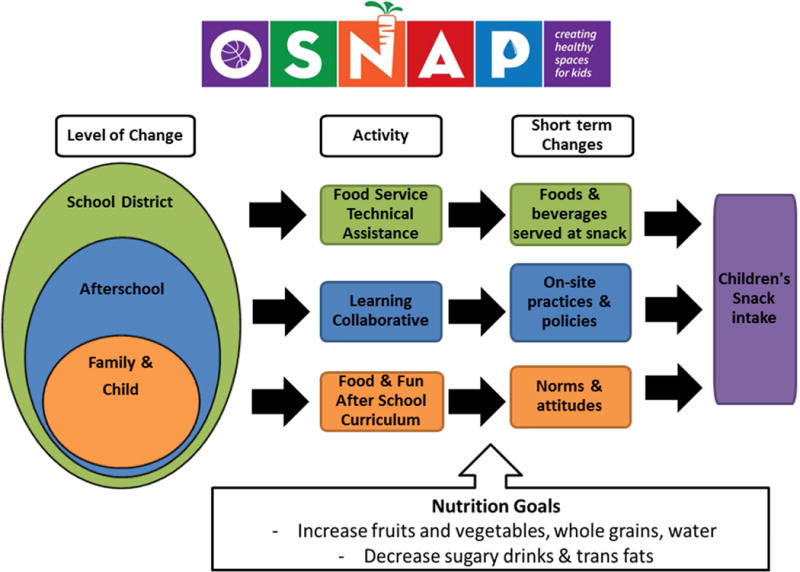
Objective: Our aim was to determine the impact of an afterschool intervention focused at the school district, site, family, and child levels on dietary consumption of foods and beverages served at snack.
Design: This was a secondary analysis of a group-randomized controlled trial.
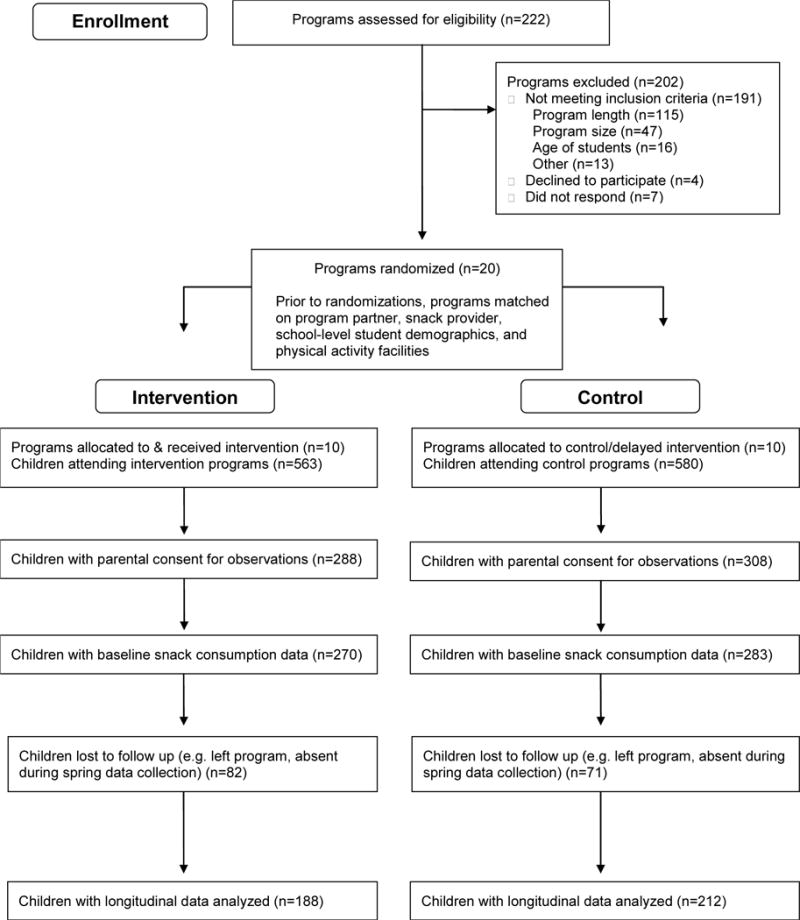
Participants/setting: Data were collected from 400 children at 20 afterschool sites in Boston, MA before (fall 2010) and after (spring 2011) intervention implementation.
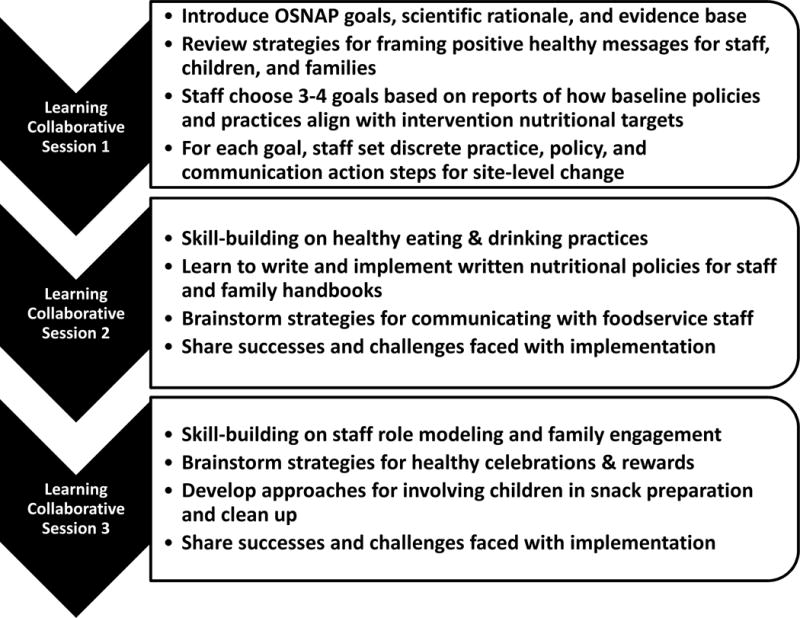
Intervention: The Out-of-School Nutrition and Physical Activity intervention aimed to promote fruits, vegetables, whole grains, and water, while limiting sugary drinks and trans fats. Researchers worked with district foodservice staff to change snack foods and beverages. Teams of afterschool staff participated in three 3-hour learning collaborative sessions to build skills and created action plans for changing site practices. The intervention included family and child nutrition education.
Main outcome measures: Research assistants observed dietary snack consumption using a validated measure on 2 days per site at baseline and follow-up.
Statistical analyses performed: This study used multivariable regression models, accounting for clustering of observations, to assess the intervention effect, and conducted post-hoc stratified analyses by foodservice type.
Results: Children in intervention sites had greater decreases in consumption of juice (-0.61 oz/snack, 95% CI -1.11 to -0.12), beverage calories (-29.1 kcal/snack, 95% CI -40.2 to 18.0), foods with trans fats (-0.12 servings/snack, 95% CI -0.19 to -0.04), total calories (-47.7 kcal/snack, 95% CI -68.2 to -27.2), and increases in consumption of whole grains (0.10 servings/snack, 95% CI 0.02 to 0.18) compared to controls. In post-hoc analyses, sites with on-site foodservice had significant improvements for all outcomes (P<0.001), with no effect for sites with satellite foodservice.
Conclusions: Results demonstrate that an afterschool intervention can improve children's dietary snack consumption, particularly at sites with on-site foodservice.
Trial registration: ClinicalTrials.gov NCT01396473.
Keywords: Afterschool; Childhood obesity; Group randomized trial; Nutrition; Snack.
Copyright © 2018 Academy of Nutrition and Dietetics. Published by Elsevier Inc. All rights reserved.
Conflict of interest statement
Rebekka M. Lee: no competing financial interests exist.
Catherine M. Giles: no competing financial interests exist.
Angie L. Cradock: no competing financial interests exist.
Karen M. Emmons: no competing financial interests exist.
Cassandra Okechukwu: no competing financial interests exist.
Erica L. Kenney: no competing financial interests exist.
J Thayer: no competing financial interests exist.
Steven L. Gortmaker: no competing financial interests exist.
Figures
References
-
- Gordon-Larsen P, Adair LS, Popkin BM. The Relationship of Ethnicity, Socioeconomic Factors, and Overweight in U.S. Adolescents. Obes Res. 2003;11(1):121–129. - PubMed
-
- Strauss RS, Pollack HA. Epidemic increase in childhood overweight, 1986–1998. JAMA. 2001;286(22):2845–2848. - PubMed
-
- Wang YC, Gortmaker SL, Sobol AM, Kuntz KM. Estimating the Energy Gap Among US Children: A Counterfactual Approach. J Pediatr. 2006;118(6):e1721–e1733. - PubMed
Publication types
MeSH terms
Associated data
Grants and funding
LinkOut - more resources
Full Text Sources
Other Literature Sources
Medical
