Review
. 2018 Aug;43(8):593-605.
doi: 10.1016/j.tibs.2018.06.005. Epub 2018 Jun 29.

Quality Control in the Endoplasmic Reticulum: Crosstalk between ERAD and UPR pathways

Affiliations
Review

Quality Control in the Endoplasmic Reticulum: Crosstalk between ERAD and UPR pathways

Jiwon Hwang et al. Trends Biochem Sci. 2018 Aug.

Abstract

Endoplasmic reticulum (ER)-associated degradation (ERAD) and the unfolded protein response (UPR) are two key quality-control machineries in the cell. ERAD is responsible for the clearance of misfolded proteins in the ER for cytosolic proteasomal degradation, while UPR is activated in response to the accumulation of misfolded proteins. It has long been thought that ERAD is an integral part of UPR because expression of many ERAD genes is controlled by UPR; however, recent studies have suggested that ERAD has a direct role in controlling the protein turnover and abundance of IRE1α, the most conserved UPR sensor. Here, we review recent advances in our understanding of IRE1α activation and propose that UPR and ERAD engage in an intimate crosstalk to define folding capacity and maintain homeostasis in the ER.

Keywords: ER chaperones; IRE1α; SEL1L-HRD1; endoplasmic reticulum (ER); protein degradation; protein folding.


Figures

Figure 1.
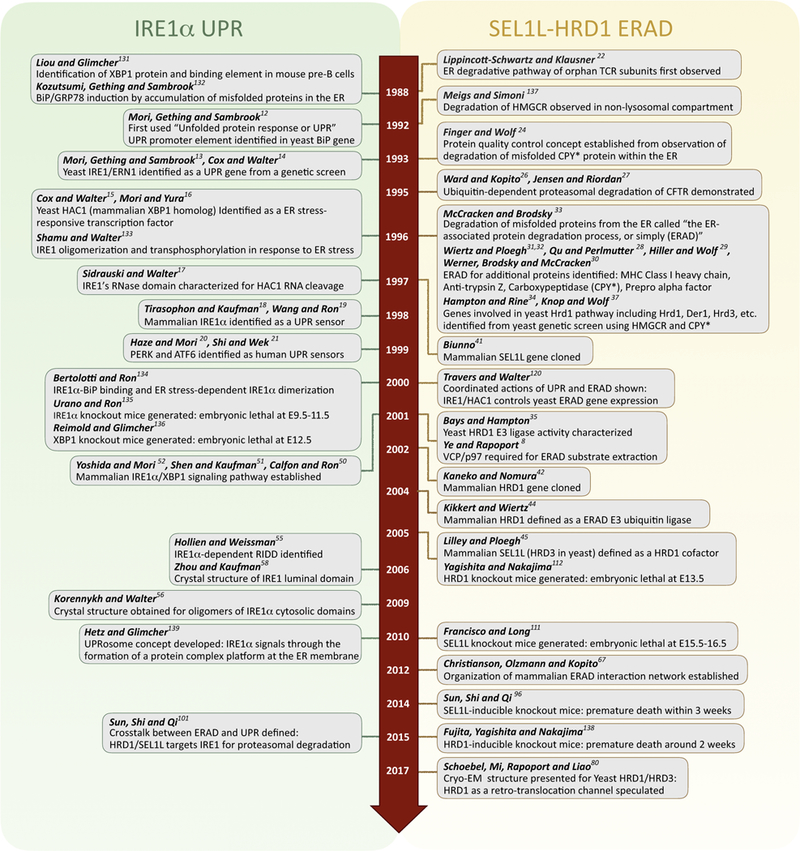
Figure 1.. Timeline for Key Discoveries in the SEL1L-HRD1 Endoplasmic Reticulum (ER)-Associated Degradation (ERAD) and Inositol-Requiring Enzyme 1 (IRE1)-α Unfolded Protein Response (UPR) Fields.
A chronology of notable events throughout the history of IRE1α UPR (A) and HRD1-SEL1L ERAD (B) over the past three decades [,–,,–,,,,,–,,,,,,,,,,,–139].
Figure 2.
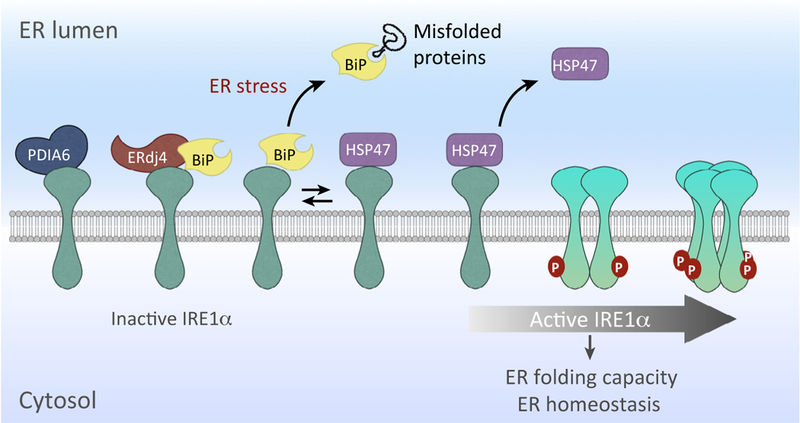
Figure 2.. Regulators of Inositol-Requiring Enzyme 1 (IRE1)-α Activation.
The activity of IRE1α is regulated through the binding of several cofactors that modulate its inhibition [BiP, ERdj4, and protein disulfide isomerase (PDI)-A6] and activation (HSP47). IRE1α is maintained as a monomer in a repressed state under basal conditions through an association with BiP. The endoplasmic reticulum (ER) chaperone HSP47 binds to IRE1, enhancing its activation by displacing BiP, which facilitates IRE1α dimerization/oligomerization for activation. Following activation, IRE1α oligomers are converted to monomers by association with PDIA6. ERdj4 represses IRE1α by recruiting BiP.
Figure 3.
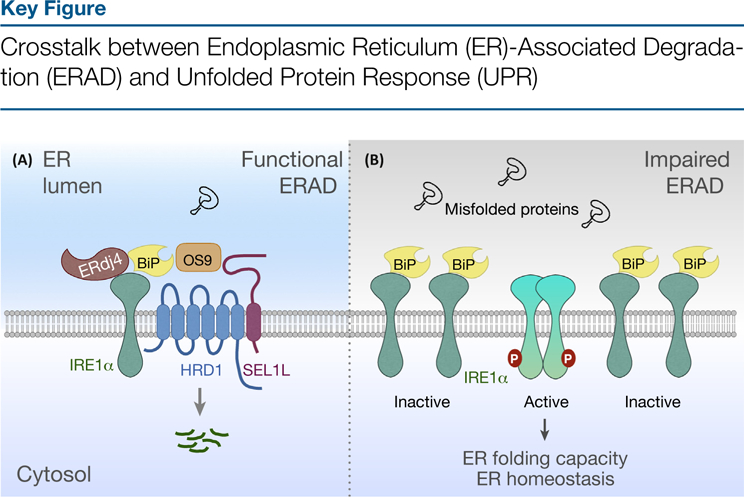
Figure 3.
Inositol-requiring enzyme 1 (IRE1)-a is degraded via SEL1L-HRD1 ERAD, a process that depends on HRD1, SEL1L, OS9, and BiP (A). ERAD deficiency results in IRE1α accumulation, leading to its activation under basal conditions (B).

References

    1. Braakman I and Hebert DN (2013) Protein folding in the endoplasmic reticulum. Cold Spring Harb. Perspect. Biol 5, a013201. - PMC - PubMed
    1. Guerriero CJ and Brodsky JL (2012) The delicate balance between secreted protein folding and endoplasmic reticulum-associated degradation in human physiology. Physiol. Rev 92, 537–576 - PMC - PubMed
    1. Hetz C (2012) The unfolded protein response: controlling cell fate decisions under ER stress and beyond. Nat. Rev. Mol. Cell Biol 13, 89–102 - PubMed
    1. Olzmann JA et al. (2013) The mammalian endoplasmic reticulum-associated degradation system. Cold Spring Harb. Perspect. Biol 5, a013185. - PMC - PubMed
    1. Christianson JC and Ye Y (2014) Cleaning up in the endoplasmic reticulum: ubiquitin in charge. Nat. Struct. Mol. Biol 21, 325–335 - PMC - PubMed

Publication types

MeSH terms

LinkOut - more resources