


The use of fentanyl in pain management in head and neck cancer patients: a narrative review
- PMID: 30057760
- PMCID: PMC6058455
- DOI: 10.1177/2049463717736787
The use of fentanyl in pain management in head and neck cancer patients: a narrative review
Abstract
Background: Head and neck (H&N) cancers account for about 5% of all malignant tumours. Pain is one of the most feared consequences of H&N neoplasms and is experienced by up to 80% of patients and worsens their quality of life inhibiting speaking, eating, drinking or swallowing. Nevertheless, pain is still often underestimated and undertreated.
Objectives: The role of opioids in cancer pain has been well established but evidences about the role and the relative effectiveness of opioids such as fentanyl in the context of H&N cancer pain remains unclear.
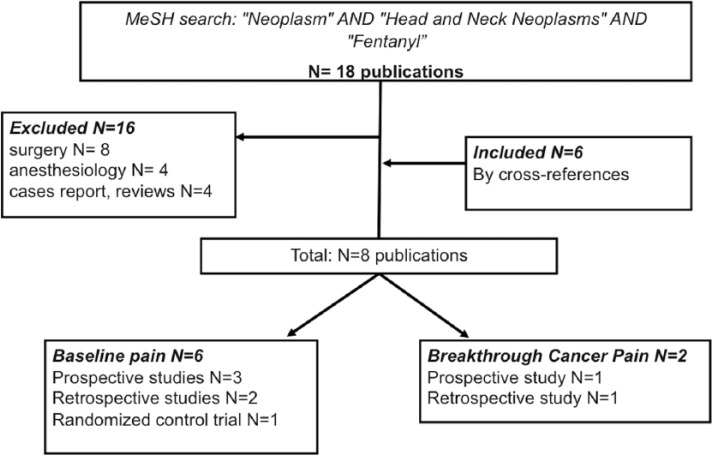
Methods: A literature review based on the guidance of the Centre for Reviews and Dissemination was conducted. An iterative approach was used starting with an electronic search in the MEDLINE database. The search terms (('Neoplasms'[Mesh]) AND 'Head and Neck Neoplasms'[Mesh]) AND 'Fentanyl'[Mesh] were used.
Results: A total of 18 publications were found by the first performed search on PubMed. Other publications concordant with our aim were found by cross-reference. Considering inclusion and exclusion criteria for our review, eight papers resulted eligible for analysis.
Conclusion: Fentanyl transdermal therapeutic system (TTS) seems to be an important option, thanks to the way of administration, the good safety and tolerability profiles to control baseline pain. For breakthrough cancer pain (BTcP), several formulations of transmucosal fentanyl are available. All the formulations seem to be active and safety but we lack head-to-head studies of fentanyl versus other strong opioids, as well as with different formulation of fentanyl, particularly for BTcP where H&N cancer population is very poorly represented.
Keywords: Head and neck cancer; breakthrough pain; fentanyl; opioids; pain.
Conflict of interest statement
Conflict of interest: The author(s) declared no potential conflicts of interest with respect to the research, authorship and/or publication of this article.
Figures
References
-
- Higginson IJ, Hearn J, Murtagh F. Epidemiology of cancer pain. In: Sykes N, Bennett MI, Yuan C-S. (eds) Clinical pain management: cancer pain, 2nd edn. London: Hodder Arnold, 2008, pp. 13–26.
-
- Bernabei R, Gambassi G, Lapane K, et al. Management of pain in elderly patients with cancer: SAGE study group. Systematic assessment of geriatric drug use via epidemiology. JAMA 1998; 279(23): 1877–1882. - PubMed
-
- Portenoy RK. Treatment of cancer pain. Lancet 2011; 377(9784): 2236–2247. - PubMed
-
- Van den Beuken-van Everdingen MH, de Rijke JM, Kessels AG, et al. Prevalence of pain in patients with cancer: a systematic review of the past 40 years. Ann Oncol 2007; 18: 1437–1449. - PubMed
-
- O’Connor P, Bisson J, Asplin P, et al. Retrospective analysis of self-reporting pain scores and pain management during head and neck IMRT radiotherapy: a single institution experience. Radiography 2017; 23(2): 103–106. - PubMed
LinkOut - more resources
Full Text Sources
Other Literature Sources