Women undergoing assisted fertilisation and high-intensity interval training: a pilot randomised controlled trial
- PMID: 30057778
- PMCID: PMC6059324
- DOI: 10.1136/bmjsem-2018-000387
Women undergoing assisted fertilisation and high-intensity interval training: a pilot randomised controlled trial
Abstract
Objectives: Overweight and obese women often seek assisted fertilisation. In the obese population, pregnancy rates are 30%-75% below that of normal weight women who undergo assisted fertilisation. We hypothesised that high-intensity interval training (HIT) would improve fertility by improving insulin sensitivity and thus affect the hypothalamic-pituitary-ovarian axis and ovarian androgen production. Our aim was to assess whether HIT prior to assisted fertilisation would increase pregnancy rate.
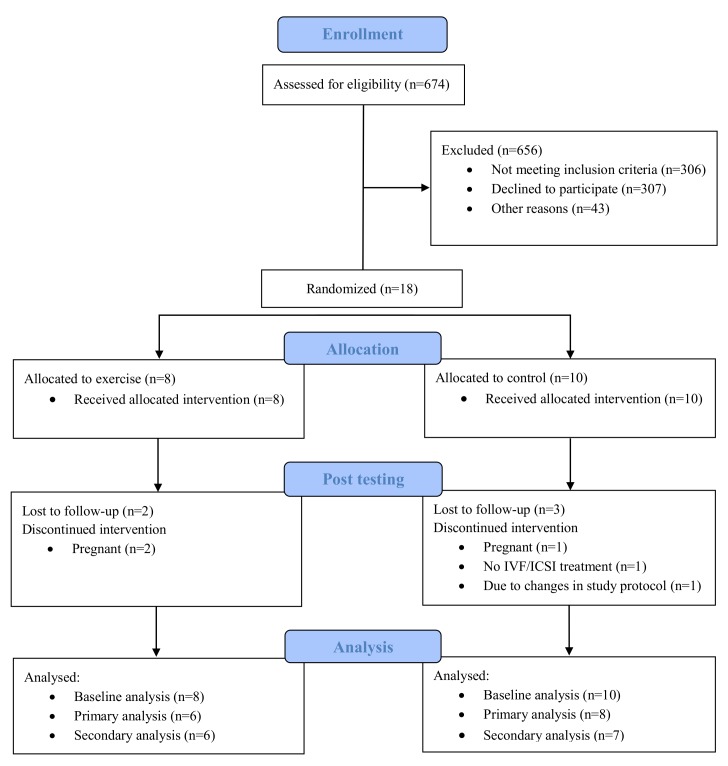
Methods: Eighteen overweight and obese women (body mass index>25.0 kg/m2) were randomised to HIT (n=8) or usual care (control, n=10) before assisted fertilisation. HIT was undertaken three times weekly for 10 weeks; two sessions of 4×4 min HIT and one session of 10×1 min HIT. Primary outcome was ongoing pregnancy. Secondary outcomes included insulin sensitivity, reproductive hormones, oxygen uptake and body composition.
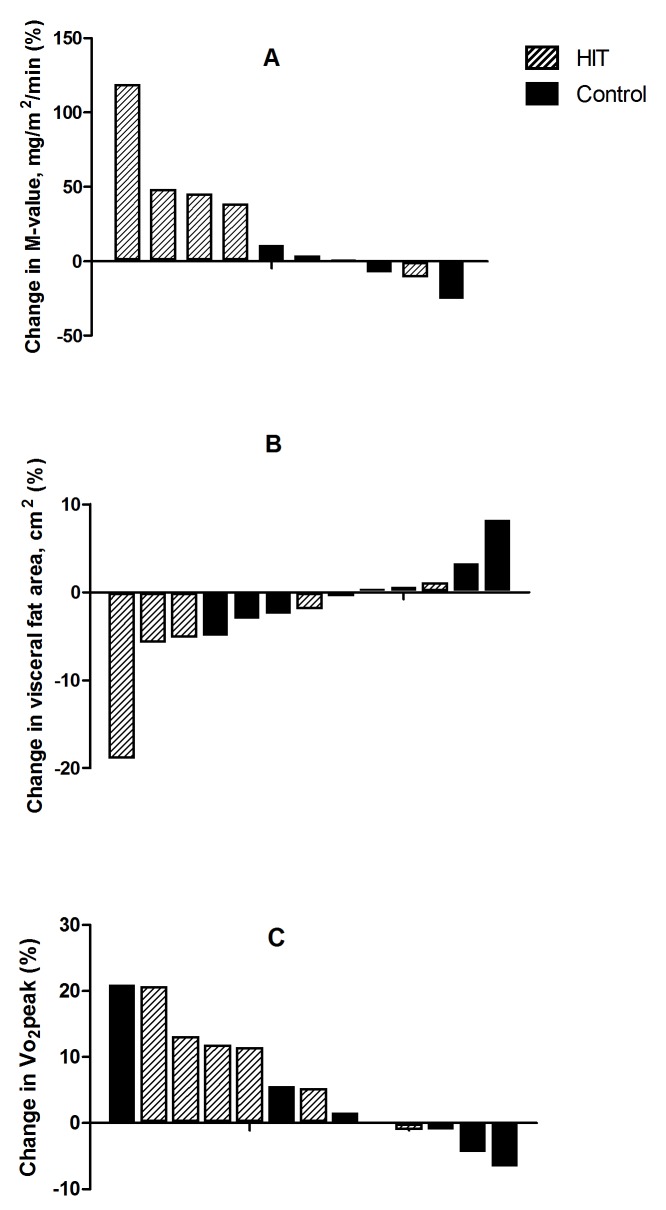
Results: Four women got pregnant in both the HIT group (50%) and in the control group (44%), no between-group difference (p=0.6). Insulin sensitivity (glucose infusion rate) improved significantly after HIT, from 264.1 mg/m2/min (95% CI 193.9 to 334.4) at baseline to 324.7 mg/m2/min (95% CI 247.2 to 402.2) after 10 weeks (between-group difference, p=0.04). Fasting glucose, visceral fat, waist circumference and VO2peak were significantly improved in the group that undertook HIT.
Conclusions: HIT significantly improved insulin sensitivity, VO2peak and abdominal fat. Low statistical power makes it difficult to conclude on whether HIT prior to assisted fertilisation could increase pregnancy rate. Larger trials are needed to determine if improvements in insulin sensitivity are clinically relevant for assisted fertilisation success rates in this population.
Keywords: exercise; female; obesity.
Conflict of interest statement
Competing interests: None declared. Funding: The study was funded by The Liaison Committee for education, research and innovation in Central Norway.
Figures
References
LinkOut - more resources
Full Text Sources
Other Literature Sources
Medical