Influence of Medial Support Screws on the Maintenance of Fracture Reduction after Locked Plating of Proximal Humerus Fractures
- PMID: 30058580
- PMCID: PMC6071468
- DOI: 10.4103/0366-6999.237396
Influence of Medial Support Screws on the Maintenance of Fracture Reduction after Locked Plating of Proximal Humerus Fractures
Abstract
Background: Technical aspects of the correct placement of medial support locking screws in the locking plate for proximal humerus fractures remain incompletely understood. This study was to evaluate the clinical relationship between the number of medial support screws and the maintenance of fracture reduction after locked plating of proximal humerus fractures.
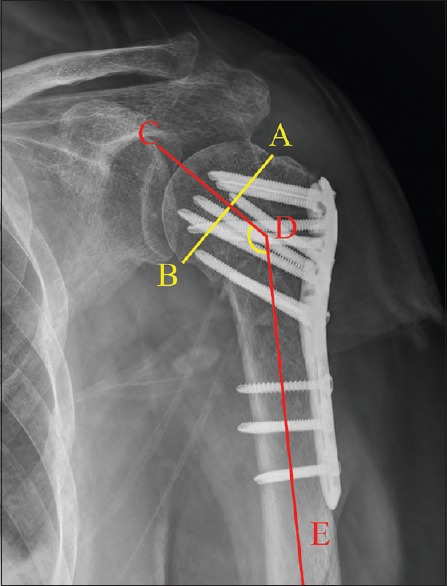
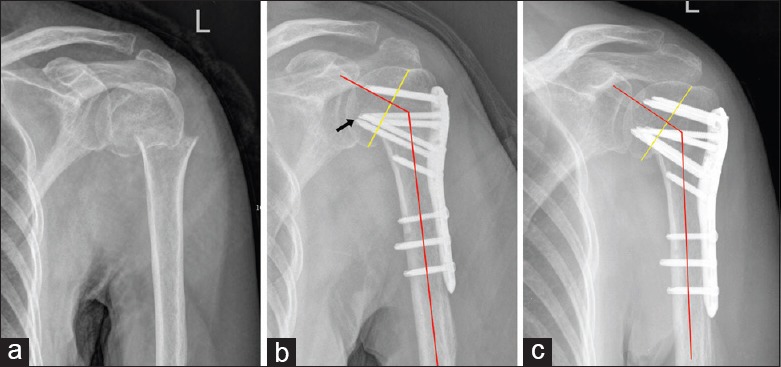
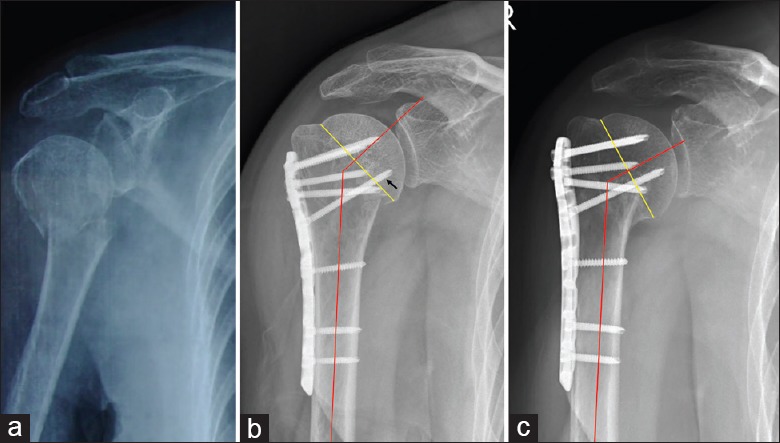
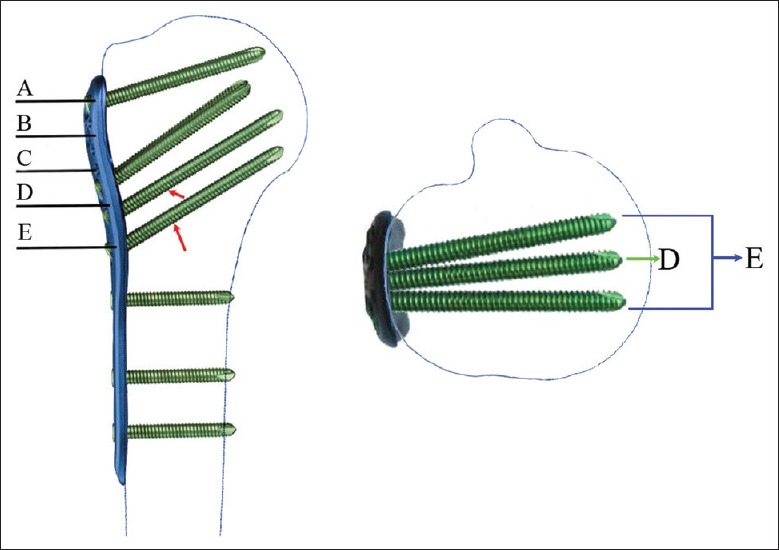
Methods: We retrospectively evaluated 181 patients who had been surgically treated for proximal humeral fractures (PHFs) with a locking plate between September 2007 and June 2013. All cases were then subdivided into one of four groups as follows: 75 patients in the medial cortical support (MCS) group, 26 patients in the medial multiscrew support (MMSS) group, 29 patients in the medial single screw support (MSSS) group, and 51 patients in the no medial support (NMS) group. Clinical and radiographic evaluations included the Constant-Murley score (CM), visual analogue scale (VAS), complications, and revision surgeries. The neck-shaft angle (NSA) was measured in a true anteroposterior radiograph immediately postoperation and at final follow-up. One-way analysis of variance or Kruskal-Wallis test was used for statistical analysis of measurement data, and Chi-square test or Fisher's exact test was used for categorical data.
Results: The mean postoperative NSAs were 133.46° ± 6.01°, 132.39° ± 7.77°, 135.17° ± 10.15°, and 132.41° ± 7.16° in the MCS, MMSS, MSSS, and NMS groups, respectively, and no significant differences were found (F = 1.02, P = 0.387). In the final follow-up, the NSAs were 132.79° ± 6.02°, 130.19° ± 9.25°, 131.28° ± 12.85°, and 127.35° ± 8.50° in the MCS, MMSS, MSSS, and NMS groups, respectively (F = 4.40, P = 0.008). There were marked differences in the NSA at the final follow-up between the MCS and NMS groups (P = 0.004). The median (interquartile range [IQR]) NSA losses were 0.0° (0.0-1.0)°, 1.3° (0.0-3.1)°, 1.5° (1.0-5.2)°, and 4.0° (1.2-7.1)° in the MCS, MMSS, MSSS, and NMS groups, respectively (H = 60.66, P < 0.001). There were marked differences in NSA loss between the MCS and the other three groups (MCS vs. MMSS, Z = 3.16, P = 0.002; MCS vs. MSSS, Z = 4.78, P < 0.001; and MCS vs. NMS, Z = 7.34, P < 0.001). There was also significantly less NSA loss observed in the MMSS group compared to the NMS group (Z = -3.16, P = 0.002). However, there were no significant differences between the MMSS and MSSS groups (Z = -1.65, P = 0.225) or the MSSS and NMS groups (Z = -1.21, P = 0.099). The average CM scores were 81.35 ± 9.79, 78.04 ± 8.97, 72.76 ± 10.98, and 67.33 ± 12.31 points in the MCS, MMSS, MSSS, and NMS groups, respectively (F = 18.68, P < 0.001). The rates of excellent and good CM scores were 86.67%, 80.77%, 65.52%, and 43.14% in the MCS, MMSS, MSSS, and NMS groups, respectively (χ2 = 29.25, P < 0.001). The median (IQR) VAS scores were 1 (0-2), 1 (0-2), 2 (1-3), and 3 (1-5) points in the MCS, MMSS, MSSS, and NMS groups, respectively (H = 27.80, P < 0.001). Functional recovery was markedly better and VAS values were lower in the MCS and MMSS groups (for CM scores: MCS vs. MSSS, P < 0.001; MCS vs. NMS, P < 0.001; MMSS vs. MSSS, P = 0.031; and MMSS vs. NMS, P < 0.001 and for VAS values: MCS vs. MSSS, Z = 3.31, P = 0.001; MCS vs. NMS, Z = 4.64, P < 0.001; MMSS vs. MSSS, Z = -2.09, P = 0.037; and MMSS vs. NMS, Z = -3.16, P = 0.003).
Conclusions: Medial support screws might help enhance mechanical stability and maintain fracture reduction when used to treat PHFs with medial metaphyseal comminution or malreduction.
内侧支撑螺钉在锁定钢板治疗肱骨近端骨折中的研究摘要背景: 内侧支撑螺钉在锁定钢板内固定治疗肱骨近端骨折中的临床意义仍有待进一步研究。探讨锁定钢板治疗肱骨近端骨折,内侧柱支撑螺钉数量与其固定稳定性和临床功能结果的关系。 方法: 2007年9月至2013年6月我们采用肱骨近端锁定钢板系统治疗181例肱骨近端骨折患者。根据术后X线片所示肱骨近端内侧柱支撑重建情况分为4组:内侧骨皮质支撑组(MCS,Medial cortical support ,75例)、多枚内侧支撑螺钉组(MMSS ,Medial multi-screws support,26例)、单枚内侧支撑螺钉组(MSSS ,Medial single screw support, 29例)和无重建内侧柱支撑组(NMS ,No medial support,51例)。随访记录并比较四组患者的肩关节功能Constant-Murley评分、视觉模拟评分(VAS, Visual analogue scale)、术后及末次随访时肱骨颈干角、术后肱骨头内翻角度及并发症发生情况。计量资料比较采用采用因素方差分析或Kruskal-Wallis检验,计数资料比较采用卡方检验或Fisher确切概率法。 结果: 181例患者术后获12-45个月(平均19.5个月)随访。MCS组、MMSS组、MSSS组及NMS组患者术后肱骨颈干角分别为133.46 ± 6.01、132.39 ± 7.77、135.17 ± 10.15和132.41 ± 7.16度,比较差异无统计学意义(F = 1.02 , P= 0.387)。末次随访时,MCS~NMS四组患者肱骨颈干角分别为132.79 ± 6.02、130.19 ± 9.25、131.28 ± 12.85和127.35 ± 8.50度(F = 4.40 , P = 0.008),其中MCS 组与NMS组比较差异有统计学意义(P = 0.004)。四组患者术后肱骨头内翻角度中位数(四分位数间距)分别为0.0°(0.0 -1.0)°、 1.3°(0.0- 3.1)°、1.5°(1.0-5.2)°和4.0°(1.2-7.1)° (H = 60.66 , P < 0.001),其中MCS组与余三组比较差异均有统计学意义(P 值均< 0.05),MMSS组与NMS组比较差异有统计学意义(P = 0.002)。四组患者Constant-Murley 评分分别为81.35 ± 9.79、78.04 ± 8.97、72.76 ± 10.98 和67.33 ± 12.31分(F = 18.68 , P < 0.001),优良率分别为86.67%、 80.77%、 65.52%和 43.14% (χ2 = 29.25 , P < 0.001)。四组患者VAS评分中位数(四分位数间距)分别为1(0-2)、1(0-2)、2(1-3)和3(1-5) 分(H = 27.80 , P < 0.001)。MCS 组和MMSS组患者Constant-Murley评分及VAS评分均优于MSSS组及NMS组患者(P值均 < 0.05)。 结论: 采用肱骨近端锁定钢板系统治疗肱骨近端骨折,当内侧皮质粉碎、骨缺损或骨皮质复位欠佳时,内侧支撑螺钉可能有助于增强其固定的稳定性、维持骨折的复位。.
Keywords: Bone Plates; Bone Screws; Fracture Fixation; Internal; Humeral Fractures; Proximal; Postoperative Complications.
Conflict of interest statement
There are no conflicts of interest
Figures
References
-
- Court-Brown CM, Caesar B. Epidemiology of adult fractures: A review. Injury. 2006;37:691–7. doi: 10.1016/j.injury.2006.04.130. - PubMed
-
- Launonen AP, Lepola V, Saranko A, Flinkkilä T, Laitinen M, Mattila VM, et al. Epidemiology of proximal humerus fractures. Arch Osteoporos. 2015;10:209. doi: 10.1007/s11657-015-0209-4. - PubMed
-
- Friess DM, Attia A. Locking plate fixation for proximal humerus fractures: A comparison with other fixation techniques. Orthopedics. 2008;31 pii:orthosupersite.com/view.asp?rID=34698. doi: 10.3928/01477447-20081201-07. - PubMed
MeSH terms
LinkOut - more resources
Full Text Sources
Other Literature Sources
Medical