


Pregnancy-Related ICU Admissions From 2008 to 2016 in China: A First Multicenter Report
- PMID: 30059363
- PMCID: PMC6147102
- DOI: 10.1097/CCM.0000000000003355
Pregnancy-Related ICU Admissions From 2008 to 2016 in China: A First Multicenter Report
Abstract
Objectives: To identify the key points for improving severe maternal morbidity by analyzing pregnancy-related ICU admissions in Beijing.
Design: This was a retrospective, multicenter cohort study.
Setting: Three ICUs in tertiary hospitals in Beijing.
Patients: A total of 491 severe maternal cases in any trimester of pregnancy or within 42 days of delivery were reviewed between January 1, 2008, and December 31, 2016.
Interventions: None.
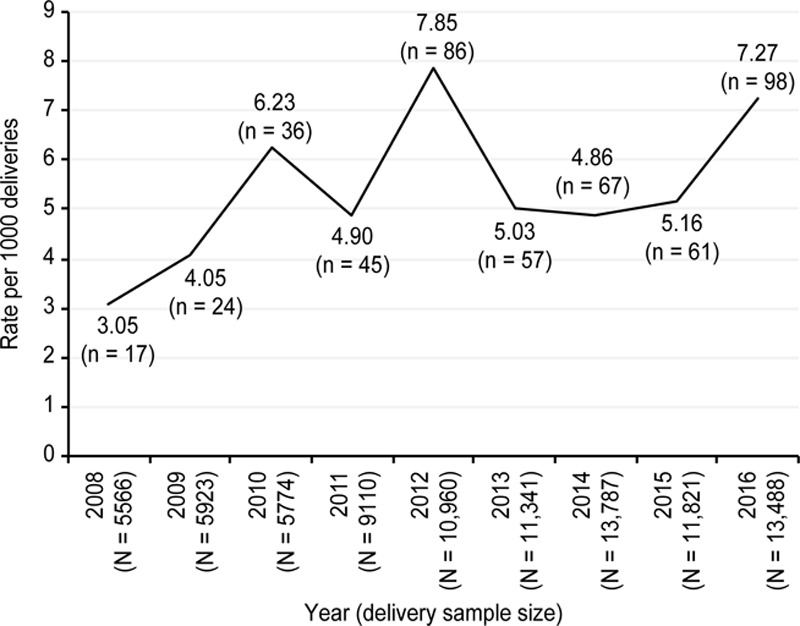
Measurements and main results: Among 491 obstetric ICU admissions (median Sequential Organ Failure Assessment score, 2) out of 87,850 hospital deliveries (a frequency of 5.6 admissions per 1,000 deliveries), the leading diagnoses were postpartum hemorrhage (170; 34.62%), hypertensive disorders of pregnancy (156; 31.77%), and cardio-cerebrovascular diseases (78; 15.9%). Comparing 2008-2011 to 2012-2016, the rates of maternal mortality (2.5% vs 1.9%; p = 0.991) and fetal loss (8.5% vs 8.6%; p = 0.977) did not decrease significantly, whereas the rates of ICU admission (3.05% vs 7.85%; p trends < 0.001) and postpartum hemorrhage (23% vs 38.5%; p = 0.002) increased. Hypertensive disorder (150/156; 96.2% transferred to the ICU postpartum, 24/28 women with fetal loss transferred from lower-level hospitals) was an independent maternal factor associated with fetal loss, and infections were the leading cause of maternal death (6/10) in the ICU.
Conclusions: Our study highlights the increasing rate of intensive care admissions for postpartum hemorrhage. Improving prenatal care quality for pregnancy-induced hypertension and sepsis at lower-level hospitals may improve maternal and fetal outcomes. Specifically, providing more effective regional cooperation before transfer and shifting patients who require continuous surveillance but not necessarily intensive care to a transitional ward in a tertiary hospital would provide more ICU beds for more prenatal intensive care for the most complex medical conditions.
Conflict of interest statement
The authors have disclosed that they do not have any potential conflicts of interest.
Figures
References
-
- Tan J, Chen M, Li Y, et al. Modeling to predict severe maternal morbidity based on 33993 deliveries of registered study in China. Value Health 2014; 17:A750 - PubMed
-
- Leung TY, Leung TN, Sahota DS, et al. Trends in maternal obesity and associated risks of adverse pregnancy outcomes in a population of Chinese women. BJOG 2008; 115:1529–1537. - PubMed
-
- Yang X, Li Y, Li C, et al. Current overview of pregnancy complications and live-birth outcome of assisted reproductive technology in mainland China. Fertil Steril 2014; 101:385–391. - PubMed
Publication types
MeSH terms
LinkOut - more resources
Full Text Sources
Other Literature Sources
Medical
