. 2018 Jul 30;13(7):e0200773.
doi: 10.1371/journal.pone.0200773. eCollection 2018.

Molecular characterization of Treponema pallidum subsp. pallidum in Switzerland and France with a new multilocus sequence typing scheme

Affiliations

Molecular characterization of Treponema pallidum subsp. pallidum in Switzerland and France with a new multilocus sequence typing scheme

Linda Grillová et al. PLoS One. .

Abstract

Syphilis is an important public health problem and an increasing incidence has been noted in recent years. Characterization of strain diversity through molecular data plays a critical role in the epidemiological understanding of this re-emergence. We here propose a new high-resolution multilocus sequence typing (MLST) scheme for Treponema pallidum subsp. pallidum (TPA). We analyzed 30 complete and draft TPA genomes obtained directly from clinical samples or from rabbit propagated strains to identify suitable typing loci and tested the new scheme on 120 clinical samples collected in Switzerland and France. Our analyses yielded three loci with high discriminatory power: TP0136, TP0548, and TP0705. Together with analysis of the 23S rRNA gene mutations for macrolide resistance, we propose these loci as MLST for TPA. Among clinical samples, 23 allelic profiles as well as a high percentage (80% samples) of macrolide resistance were revealed. The new MLST has higher discriminatory power compared to previous typing schemes, enabling distinction of TPA from other treponemal bacteria, distinction between the two main TPA clades (Nichols and SS14), and differentiation of strains within these clades.


Conflict of interest statement

Repsol Technology Center provided support in the form of salaries for an author HB. This does not alter our adherence to PLOS ONE policies on sharing data and materials.

Figures
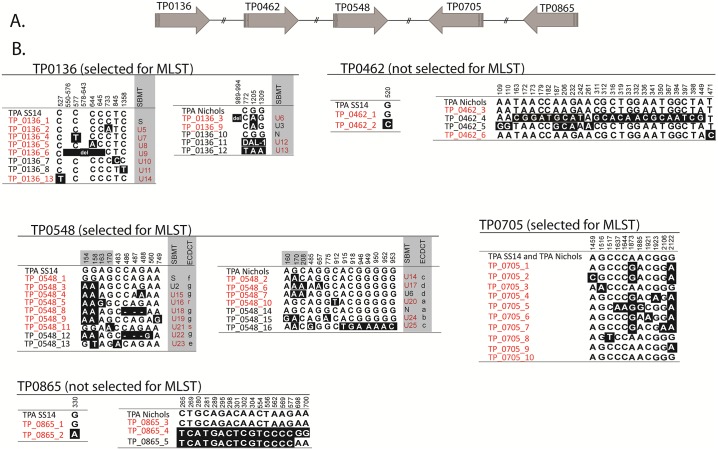
Fig 1
Fig 1. Allelic variants of all available strain sequences for TP0136, TP0462, TP0548, TP0705 and TP0865.
Alleles found in 120 clinical samples examined in this study (samples from France and Switzerland) and in 63 samples published in [24, 25, 36] (total n = 183) are shown. A. Structural arrangement of candidate loci on the genome. The TP0705 and TP0865 genes lie on the complementary DNA chain. B. Allelic variants. Sequence alignments show only positions containing nucleotide variants. Numbers correspond to nucleotide positions in TPASS_0136, TPASS_0462, TPASS_0548, TPASS_0705, TPASS_0865 genes (TPA SS14; CP004011.1) or to TPANIC_0136, TPANIC_0462, TPANIC_0548, TPANIC_0705, TPANIC_0865 genes (TPA Nichols; CP004010.2). Deletions are shown with dashes or “del”. Allele variants that were found among clinical samples in this study (clinical samples from France and Switzerland) are shown in red. For TP0136 and TP0548, the sequence variants were translated to both current molecular typing systems (SBMT and ECDCT) and new sequence variants, which were not identified in previous typing studies, are shown in red. Sequence variant TP0136_11 represent TPA strain Dallas (DAL-1), which contains 30 SNVs and a 58 bp long deletion in TP0136 locus.
Fig 2
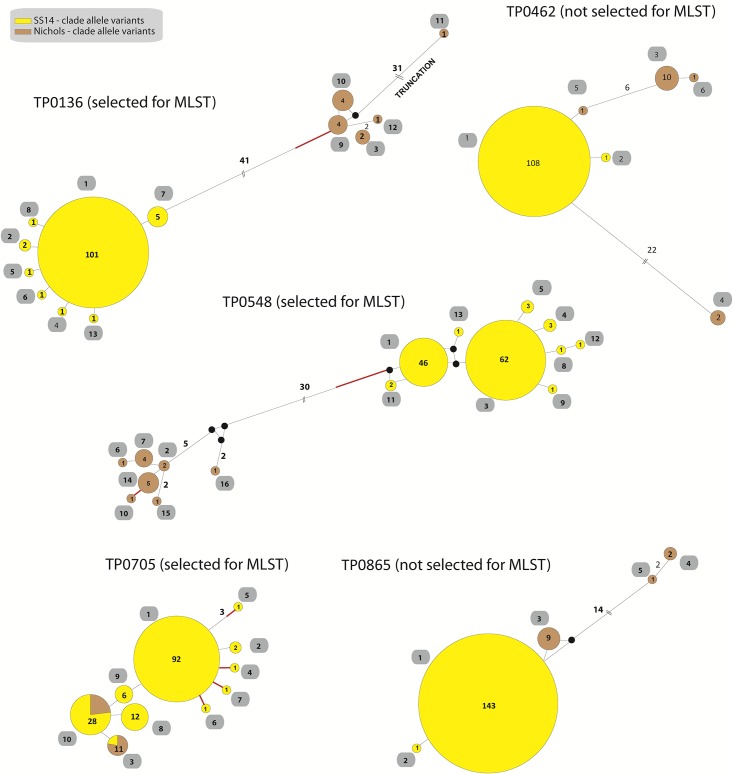
Fig 2. Median joining networks of all available strain sequences for TP0136, TP0462, TP0548, TP0705 and TP0865.
Alleles found in 120 clinical samples examined in this study (samples from France and Switzerland) and in 63 samples published in [24, 25, 36] (total n = 183) are shown. Median joining networks per locus show the different allelic variants and the number of mutational differences among them. Number of mutations, when above one, is given close to branches. Red branch indicates the mutation that did not result in amino acid replacements. Inferred allelic variants (median vectors) are shown as black connecting dots. If contiguous, indels were considered as a single event only. Yellow circles represent the SS14-clade and brown circles represents the Nichols-clade. The number found among the 183 samples is shown inside the circles. Allelic variant numbering as proposed for the MLST scheme are shown in the grey fields.
Fig 3
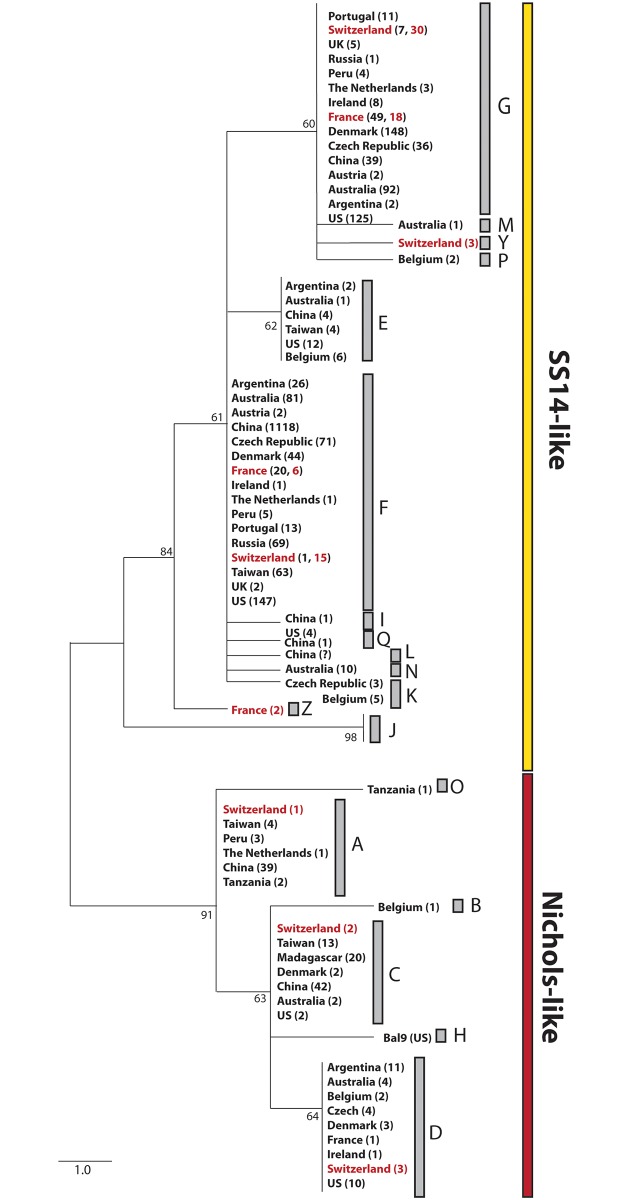
Fig 3. Phylogeny for sequences obtained in typing studies.
Maximum likelihood tree produced in MEGA 6 for the 83 bp overlapping fragment of the TP0548 gene typed with MLST, ECDCT and SBMT. The letters A-S stand for the classification in ECDCT and SBMT typing studies. Rabbit passed strains BAL9 was included as representative for type “H”, which was not found among clinical samples yet. For subtype”L” the number of identified samples is not known [37]. Subtype”J” does not correspond to TPA but was found in T. pallidum subsp. endemicum and T. pallidum subsp. pertenue [35, 38]. As observed, TP0548 does not distinguish TPA from TEN or TPE, reflecting potential recombination events between these three. All samples were obtained directly from patients except the BAL9 (passed through rabbits) and isolates from Tanzania (isolated from flies). The numbers in the brackets represent the number of samples identified in the given country. The numbers in red represent the Swiss and French samples from this study.

References

    1. World Health Organization. WHO guidelines for the treatment of Treponema pallidum (syphilis). 2016; http://www.who.int/reproductivehealth/publications/rtis/syphilis-treatme.... - PubMed
    1. Cameron CE, Lukehart SA. Current status of syphilis vaccine development: need, challenges, prospects. Vaccine. 2014; 32: 1602–1609. 10.1016/j.vaccine.2013.09.053 - DOI - PMC - PubMed
    1. Grange PA, Mikalová L, Gaudin C, Strouhal M, Janier M, Benhaddou N, et al. Treponema pallidum 11qj Subtype May Correspond to a Treponema pallidum Subsp. Endemicum Strain. Sex Transm Dis. 2016; 43: 517–518. 10.1097/OLQ.0000000000000474 - DOI - PubMed
    1. Noda AA, Grillová L, Lienhard R, Blanco O, Rodríguez I, Šmajs D. Bejel in Cuba: molecular identification of Treponema pallidum subsp. endemicum in patients diagnosed with venereal syphilis. Clin Microbiol Infect. Forthcoming 2018. - PubMed
    1. Fraser CM, Norris SJ, Weinstock GM, White O, Sutton GG, Dodson R, et al. Complete genome sequence of Treponema pallidum, the syphilis spirochete. Science. 1998; 281(5375): 375–388. - PubMed

Publication types

LinkOut - more resources